
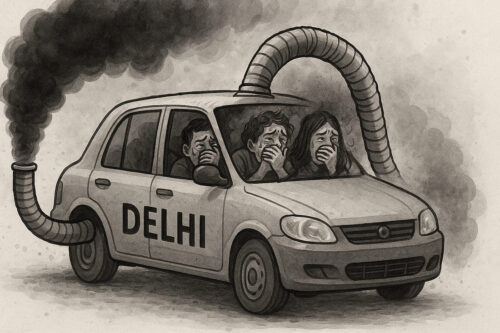
 For over a decade, Punjab has carried the blame of Delhi’s pollution. Every winter, like clockwork, the national narrative descends into a simplistic, almost ritualistic blame-game: “Punjab’s stubble is choking Delhi.” Year after year, farmers of Punjab were painted as villains — irresponsible, ignorant, even criminal — while Delhi’s governments, past and present, hid comfortably behind this convenient scapegoat.
On 22 October, I wrote an op-ed arguing that this narrative was scientifically hollow and politically motivated. I wrote that blaming Punjab for Delhi’s pollution was not just inaccurate — it was intellectually lazy, morally dishonest, and deeply unjust to a state and its farmers already burdened by economic distress. I argued that a city with over one crore vehicles, rampant construction, unregulated industries, and chronic waste burning could not possibly outsource its pollution guilt to a few thousand paddy fields hundreds of kilometres away. Much earlier, I had said bluntly that “Delhi chokes in its own smoke” — not Punjab’s.

Is former Member of Punjab Public Service Commission
A farmer and keen observer of current affairs
You can read that op-ed here: https://substack.com/@gpsmann/p-176802153
Today, the Supreme Court of India has said almost exactly the same.
The Supreme Court’s Bombshell Question: Why Blue Skies During Covid?
While hearing the Delhi pollution matter, the Supreme Court asked the most uncomfortable — and therefore the most important — question:
“Stubble burning was there during Covid. Then why did Delhi have clear blue skies?”
That one line demolishes ten years of propaganda.
If stubble burning was truly the primary cause of Delhi’s toxic air, then Covid lockdowns — when Punjab still harvested and burned stubble — should have caused smog. But Delhi had some of the cleanest skies in its recent history.
Because the real pollutant disappeared:
Delhi itself.
Its cars were off the roads.
Its factories were shut.
Its construction was halted.
Its waste fires were absent.
What vanished was not Punjab’s smoke — what vanished was Delhi’s own emissions.
The Data Now Matches What Punjab Has Been Saying for Years
The government has now placed official data before Parliament that leaves no room for ambiguity:
Punjab and Haryana recorded a 90% reduction in stubble fires in 2025 compared to 2022.
This is not a marginal improvement — it is a collapse of the earlier numbers.
Punjab’s fires fell from 50,738 in 2019 to just 5,114 in 2025.
Punjab’s share of national fires dropped from 82% in 2019 to just 15% in 2025.
This is the most dramatic reduction in India’s history of crop-residue burning.
And yet — Delhi’s AQI still crossed 450 this winter.
How long will we pretend not to see what is obvious?
The New Hotspots Expose the Old Lies
The data shows something else that Delhi’s political class won’t admit:
UP and MP are now the major stubble-burning hotspots, not Punjab.
The worst-hit districts today are:
MP (Sheopur) – 2,643 cases
MP (Jabalpur) – 2,390 cases
UP (Maharajganj) – 1,464 cases
UP (Gorakhpur) – 779 cases
Punjab is not even in the top 10.
When facts change, narratives must change.
Unless, of course, the narrative was never based on facts.
Punjab Did Its Job. Delhi Did Not.
The Centre itself admits:
Over ₹3,120 crore was given to Punjab for stubble solutions.
2.7 lakh machines were distributed.
260,000 farmers adopted alternatives.
33,800 Custom Hiring Centres were created.
Punjab did everything demanded of it — and more.
Yet Delhi’s air stayed toxic. Why?
Because Punjab was never the real problem.
As the Supreme Court said, stubble burning must not become a political or ego issue. But in Delhi, it was exactly that: a diversion strategy to mask the failures of successive city governments — BJP at the Centre and AAP in Delhi.
Delhi’s Failure Is Delhi’s Own
After all this data, after the Supreme Court’s judicial common sense, and after Punjab’s remarkable compliance, the truth stands naked:
Delhi’s pollution crisis is Delhi’s creation.
You cannot allow one crore vehicles, thousands of construction sites, unregulated industries, and uncontrolled waste burning — and then blame a farmer in Sangrur or Ferozepur.
You cannot ignore your own house afire and shout “Punjab!” every winter.
It Is Time for India to Stop Scapegoating Punjab
Punjab has:
✔ Reduced farm fires by 90%
✔ Brought its share of incidents down to 15%
✔ Complied with every central mandate
✔ Invested in machinery, awareness, and alternatives
And yet Punjab is still painted as the villain — because it suits Delhi politically.
But now:
The Supreme Court has questioned the old narrative.
The data has shattered the myth.
The facts are on Punjab’s side.
Delhi’s governments have run out of excuses.
Supreme Court must act and not merely make observations.
A New Narrative Must Replace the Old Lie
India’s air pollution crisis cannot be solved by blaming farmers. It requires:
Honest political leadership
Massive reduction in vehicular emissions
Strict control over construction dust
Enforcement against waste burning
Industrial compliance
Urban planning reforms
For too long, Delhi has escaped responsibility by pointing fingers outward.
This winter, the truth finally caught up.
Punjab was never the problem.
Punjab was the scapegoat.
And now, both the Supreme Court and India’s own environmental data have said so — plainly.