
The Sikh Gurdwara was never intended to be a mere building for ritual worship. From the very beginning of Sikhi under Guru Nanak Dev Ji in the 15th century, the Gurdwara emerged as a revolutionary institution of equality, justice, and service to humanity. Guru Nanak Dev Ji rejected caste, discrimination, religious arrogance, and meaningless practices. Wherever he traveled, he established centers of spiritual learning that later developed into Gurdwaras. These were spaces where humanity stood equal before the One Creator, and where service to others was considered the highest form of devotion. The institution of Langar, later formally structured by Guru Angad Dev Ji and fully institutionalized by Guru Amar Das Ji, destroyed the centuries-old barriers of caste by making every individual—king or beggar—sit together and eat the same food. This was not merely charity; it was a direct social revolution.
The vision of the Gurdwara reached its architectural and spiritual peak under Guru Arjan Dev Ji with the establishment of Sri Harmandir Sahib at Amritsar. Its four open doors symbolized the universal openness of Sikh philosophy to all directions, faiths, and nations. This was not built as an exclusive Sikh temple, but as a global sanctuary of humility and divine wisdom. Later, Guru Hargobind Sahib Ji expanded the role of the Gurdwara through the concept of Miri-Piri, merging spiritual authority with social and political responsibility. Gurdwaras thus became not only places of prayer but also centers for justice, protection of human rights, and resistance against tyranny.
During the Mughal period and successive invasions, Gurdwaras functioned as shelters for the oppressed and centers for Sikh survival and resistance. The martyrdom of Guru Tegh Bahadur Ji for defending religious freedom strengthened the Gurdwara as a symbol of conscience and sacrifice. Under Guru Gobind Singh Ji, with the creation of the Khalsa, the Gurdwara became a place of training not only in devotional discipline but also in moral courage and self-defense. Even during the genocidal campaigns of the 18th century, when Sikhs were hunted like animals, Gurdwaras remained invisible lifelines of resistance, reorganization, and spiritual renewal.
During British rule, however, the corruption of Gurdwaras reached a dangerous level as many historic shrines fell under the control of corrupt mahants who misused offerings and collaborated with colonial authorities. This gave birth to one of the most heroic movements in Sikh history—the Gurdwara Reform Movement of the 1920s. Thousands of unarmed Sikhs courted arrest and martyrdom to free their sacred institutions from corruption. This struggle led to the creation of the Shiromani Gurdwara Parbandhak Committee (SGPC), a democratically elected body meant to ensure transparent and Panth-oriented management. The Sikh world proved that it was ready to die for the purity of its Gurdwaras.
In the modern era, as Sikhs migrated across the globe, Gurdwaras emerged everywhere as spiritual, cultural, and social lifelines. In countries like Canada, the United States, the United Kingdom, Australia, and across Europe, the first structure Sikhs built was always a Gurdwara. These institutions provided more than prayer; they provided food, shelter, immigration guidance, legal help, language education, community safety, and emotional support. Today, Sikh Gurdwaras feed millions of people daily through Langar. During natural disasters, wars, refugee crises, and pandemics, Sikh volunteers connected to Gurdwaras have repeatedly reached where governments and global organizations failed. No religious institution in the world matches the continuous, organized, and unconditional humanitarian service of the Sikh Gurdwara.
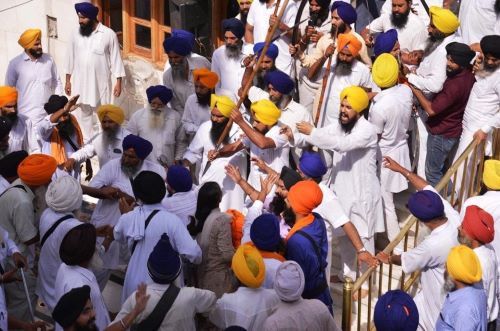
Yet alongside this divine legacy exists a deeply disturbing modern reality. Across the world, many Gurdwaras today are trapped in endless power struggles, factionalism, and ego-driven politics. Instead of being places of unity and humility, they are increasingly becoming battlefields of rivalry and dominance. Committee elections often turn into bitter wars, dividing entire communities. Court cases last for years. Police intervention inside sacred premises is no longer rare. Physical violence in places meant for prayer has become a shameful reality in some regions, shaking the faith of ordinary devotees.
In Punjab itself, the SGPC—created through the blood of Sikh martyrs—has frequently faced public allegations of political interference, favoritism, lack of transparency, and misuse of authority. Many Sikh intellectuals and activists openly criticize its functioning as being driven more by party politics than Panthic responsibility. The very institution created to protect Gurdwaras from corruption now faces accusations of being trapped in the same political machinery it once overthrew. This has created deep disappointment among Sikhs worldwide.
Even at the highest spiritual seats, controversy has not spared Sikh institutions. At Takht Sri Damdama Sahib in Talwandi Sabo, disputes over control, leadership influence, and administrative authority led to public tensions that damaged the sanctity of one of Sikhism’s five Takhts. Instead of standing as an uncontested seat of learning and divine authority, it was dragged into power struggles that wounded the collective Sikh conscience.
In Canada, which hosts one of the largest Sikh diasporas outside India, Gurdwaras in Surrey, Brampton, Abbotsford, and other cities have repeatedly witnessed violent committee elections, prolonged court battles, and bitter public accusations. In several cases, police were called into Gurdwara premises to control physical confrontations. Allegations of donor fund misuse, intimidation of voters, and manipulation of membership lists divided families and fractured communities. Instead of focusing on Sikh unity and national engagement, energy was wasted on courtroom survival and factional warfare.
The United Kingdom has seen similar turmoil. Historic Gurdwaras in Southall, Birmingham, Wolverhampton, and other cities have remained locked in legal disputes over management control for years. Worshippers who visit only for prayer and spiritual peace often find themselves surrounded by tension, propaganda, and voting campaigns. Community projects suffer, youth programs get delayed, and religious education weakens as leadership remains trapped in internal conflict.
In the United States, Gurdwaras in California, New York, and the Midwest have also experienced damaging splits. Disputes over property management, Langar contracts, authority over stages, and financial transparency have repeatedly reached civil courts. In extreme cases, law enforcement had to intervene to prevent violence. These incidents shocked the broader American society, which had largely known Sikhs only through their humanitarian service and dignity.
The pattern of conflict across all these countries is alarmingly similar. The language of seva is used during elections, but once power is attained, factions harden into permanent camps. Control of donations, buildings, prestige, and influence becomes the real objective. Transparency disappears. Dissenting voices are silenced. Instead of humility, dominance prevails. Instead of accountability, secrecy rules. Gurdwaras meant to challenge worldly ego increasingly resemble the very political systems the Gurus rejected.
One of the gravest moral failures is the misuse of donated funds. Money offered by devotees for Langar, education, charity, and religious work is often drained into prolonged legal battles, lawyer fees, and court expenses. This is not just financial loss—it is the betrayal of the sacred trust of the Sangat. Every rupee wasted in factional litigation is a meal stolen from the hungry and an opportunity stolen from the deserving youth.
The greatest damage may be occurring silently among the younger generation. Sikh youth raised amid court cases, violence, propaganda, and scandals inside Gurdwaras become disillusioned. Many begin to separate faith from institutions altogether. Instead of learning sacrifice, humility, and discipline, they witness greed, rivalry, and betrayal. This emotional and spiritual disconnect is a long-term threat to the survival of Sikh values themselves.
The bitter truth is that a century ago Sikhs fought and died to free Gurdwaras from corrupt mahants. Today, the danger no longer comes from colonial rulers or outsiders—it comes from within. The modern battlefield is not physical but moral. The weapons required today are not swords but truth, ethics, transparency, fearless reform, and collective awakening.
Yet despite this decay at the top, the true soul of the Gurdwara still survives in the millions of ordinary Sikhs who serve silently every day. Volunteers continue to wake up before dawn to cook Langar, clean floors, teach children Gurbani, help immigrants, feed the homeless, and rush to disaster zones without cameras or recognition. These nameless sevadars embody the real spirit of Sikhi far more than those fighting for positions and power.
In conclusion, the Sikh Gurdwara stands as one of the greatest humanitarian institutions ever created by humanity. From Guru Nanak Dev Ji to the global diaspora of today, it has symbolized equality, justice, fearlessness, and service to all. But its sacred purpose is under grave threat from corruption, factionalism, politicization, and ego-driven control. This is not merely an administrative crisis—it is a spiritual warning. If the Sikh community fails to reclaim its institutions through reform, unity, and accountability, it risks losing not just control of buildings but the moral authority of its faith itself. The choice before the Sikh Panth is clear: return the Gurdwara to the path of the Gurus—or allow it to drift further into institutional hypocrisy.