
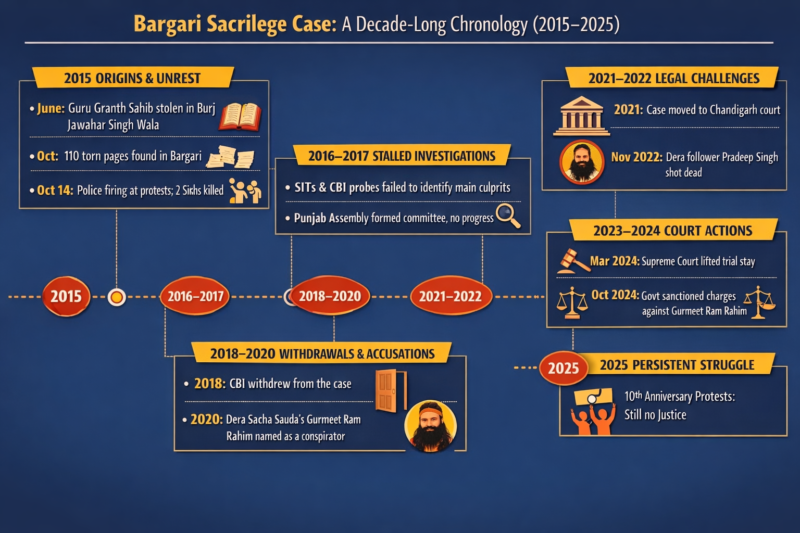
 The Bargari sacrilege case is one of the most sensitive and prolonged controversies in Punjab’s recent history. It began in June 2015, when a copy of the Guru Granth Sahib, the holy scripture of Sikhism, was stolen from a gurdwara in Burj Jawahar Singh Wala, Faridkot district. The initial theft drew attention, but the situation escalated dramatically in October 2015, when over 110 torn pages of the Guru Granth Sahib were found scattered outside a gurdwara in Bargari village. This desecration sparked widespread outrage across Punjab, leading to mass protests and a demand for swift and decisive action against the perpetrators. The incident struck at the heart of Sikh sentiment, as the Guru Granth Sahib is revered as the eternal Guru, and its desecration is considered a profound sacrilege.
The public protests intensified quickly. On October 14, 2015, police opened fire on protestors at Behbal Kalan and Kotkapura, killing two Sikh protestors and injuring several others. These deaths transformed the situation into a broader issue of public accountability and police brutality, drawing criticism from political leaders, religious authorities, and human rights groups. Sikh organizations viewed the killings as emblematic of a larger failure of the state to protect their religious sentiments, and the community’s trust in the authorities was severely shaken.
In response, the Punjab government initially formed a judicial commission to probe the desecration incidents. The case was subsequently handed over to the Central Bureau of Investigation (CBI) in November 2015, aiming to bring impartiality and ensure a thorough investigation. Around the same time, the Punjab Assembly formed a special committee tasked with examining the issue and overseeing accountability measures. However, despite its formation, the committee made no significant progress, failing to provide clarity or actionable recommendations. Meanwhile, the Punjab Assembly passed a law making sacrilege of the Guru Granth Sahib punishable by life imprisonment under Section 295-AA of the IPC, underlining the seriousness of the offence.
From 2016 to 2017, multiple Special Investigation Teams (SITs) were constituted, and the CBI conducted detailed investigations. Despite these efforts, no decisive conclusions could be reached regarding the main perpetrators. Contradictory leads and the involvement of influential individuals, including followers of Dera Sacha Sauda, complicated the investigation. The inability to gather conclusive evidence or secure cooperation from witnesses led to stalled trials, further frustrating the Sikh community and victims’ families.
Between 2018 and 2020, the investigation faced additional hurdles. The CBI eventually withdrew, citing lack of cooperation and incomplete information from state authorities. Meanwhile, the Punjab Police attempted to continue the investigation but faced limitations due to political interference, procedural challenges, and ongoing legal disputes. Allegations of links between the desecration and prominent religious organizations further heightened tensions and made prosecution politically sensitive. In 2020, the Punjab Police SIT identified potential conspirators, including followers of Dera Sacha Sauda, but the path to prosecution remained complex and fraught with delays.
The years 2021–2022 saw additional legal and administrative complications. The Punjab and Haryana High Court imposed a stay on trial proceedings in some of the sacrilege cases, delaying justice even further. In November 2022, one of the accused, Pradeep Singh, a Dera Sacha Sauda follower, was shot dead in Faridkot, highlighting the volatile environment surrounding the case. Such incidents underscored the difficulty in prosecuting individuals involved in sensitive religious and political matters, and public perception of impunity grew stronger.
In 2024, the Supreme Court intervened to lift the stay and order the continuation of trials, emphasizing the need to provide justice to victims and restore public confidence. Following this, the Punjab government granted sanction to prosecute key accused, including prominent figures previously shielded by procedural requirements. Despite these steps, the legal process remained slow, and bureaucratic hurdles, procedural requirements, and ongoing political sensitivities continued to impede rapid resolution.
As of 2025, a full decade after the initial desecration, the Bargari sacrilege case remains unresolved. The case illustrates a combination of challenges: fragmented investigations with contradictory findings, bureaucratic inefficiencies, political interference, procedural delays, and the failure of the Punjab Assembly committee to produce meaningful progress. Sikh organizations continue to commemorate the anniversary of the desecration and police firing deaths, keeping public attention focused on the demand for justice. The case has become emblematic of systemic inertia, highlighting the difficulty of securing accountability in incidents that intersect religion, politics, and law enforcement.
The Bargari sacrilege case thus remains a painful chapter in Punjab’s recent history, reflecting not only the grave violation of religious sentiments but also the long-standing failures of investigative, judicial, and administrative systems. Despite new laws, Supreme Court interventions, and ongoing trials, the wounds of 2015 remain unhealed, leaving a community still waiting for the justice and closure it rightfully deserves