
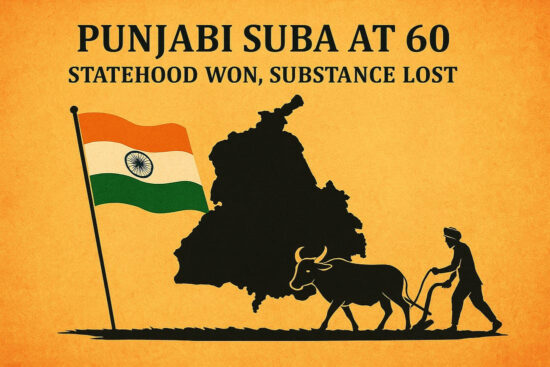
 Punjab has historically been a land of enterprise, courage, and resilience. From leading India’s Green Revolution to producing a globally respected diaspora, the state has shown time and again that it can rise to challenges. However, today Punjab stands at a crossroads. Economic stagnation, rising unemployment, agrarian distress, drug abuse, and fiscal stress have created an urgent need for long-term, well-thought-out planning. Progress for Punjab will not come from short-term populism or headline-driven politics, but from a clear vision supported by strong institutions, transparent governance, and people-centric policies.
The first and most critical area of future planning must be economic revival and diversification. Punjab’s economy remains overly dependent on traditional agriculture, which is no longer sustainable in its present form. The future lies in diversifying towards agro-processing, food technology, dairy innovation, logistics, renewable energy, and small-scale manufacturing. Instead of exporting raw agricultural produce, Punjab must focus on value addition through food parks, cold chains, and export-oriented processing units. Special incentives should be designed to attract private investment, especially from the Punjabi diaspora, while ensuring that local youth benefit through skill-linked employment.
Agricultural reform and rural renewal must remain central to Punjab’s planning. Farmers need support not just in the form of subsidies, but through scientific farming, crop diversification, water management, and assured market access. Excessive dependence on wheat and paddy has damaged soil health and depleted groundwater. Future planning should encourage pulses, oilseeds, fruits, vegetables, and organic farming, backed by minimum support mechanisms and crop insurance. Investment in micro-irrigation, canal rejuvenation, and modern storage infrastructure will help make agriculture profitable and environmentally sustainable.
A progressive Punjab also requires massive investment in education and skill development. The state once had some of the finest educational institutions in North India, but many now struggle with quality and relevance. Future planning must focus on upgrading government schools, strengthening universities, and aligning curricula with modern industry needs such as artificial intelligence, renewable energy, healthcare, agri-tech, and entrepreneurship. Vocational education, apprenticeships, and skill centers at the district level can ensure that youth are employable within Punjab, reducing the distress-driven migration trend.
Employment generation and youth empowerment must be treated as a mission, not a slogan. Start-up incubation centers, low-interest credit for young entrepreneurs, and mentoring programs can help turn job seekers into job creators. Sports, culture, and creative industries should be promoted as viable career paths, given Punjab’s strong tradition in athletics, music, and arts. Simultaneously, strong action is needed against drug abuse through prevention, rehabilitation, and strict action against traffickers, so that the youth’s energy is channelized towards nation-building rather than destruction.
Future progress also depends heavily on good governance and institutional reform. Transparent administration, time-bound delivery of public services, and zero tolerance for corruption are essential. Digitization of government services, independent oversight bodies, and empowerment of local self-governments can rebuild public trust. Instead of excessive spending on advertisements, public funds must be directed towards health, education, infrastructure, and social welfare programs that deliver measurable outcomes.
Healthcare and social security planning must not be ignored. Punjab needs modern district hospitals, strong primary healthcare centers, and affordable access to medicines. Mental health services, especially for youth and farmers, should be integrated into public healthcare. Women’s empowerment through education, safety, employment opportunities, and leadership roles will play a decisive role in shaping Punjab’s future. A society that sidelines half its population cannot truly progress.
Finally, environmental sustainability and infrastructure development must guide all future planning. Punjab’s air, water, and soil are under severe stress. Policies should promote renewable energy, electric mobility, waste management, and strict enforcement against industrial pollution. Planned urbanization, better public transport, and rural infrastructure will improve quality of life and attract investment. Development should be balanced across regions so that progress is not limited to a few cities while villages are left behind.
In conclusion, Punjab’s progress depends on vision, courage, and collective responsibility. The state needs long-term planning that rises above political cycles and focuses on the next 20–30 years. With honest leadership, active citizen participation, and smart policy choices, Punjab can reclaim its position as a leading state—economically strong, socially just, and environmentally sustainable. The future of Punjab is not bleak; it is waiting for the right planning and the will to implement it.