
 Chamath’s critique also lands with an irony that matters politically. He is not merely a commentator; he is a sophisticated, early-stage participant in the very system whose wealth California now seeks to capture. He was an early high-value backer of Groq, and market chatter around the Nvidia–Groq transaction has suggested that early investors in such breakout companies can see extraordinary liquidity outcomes—sometimes on a scale that makes even a 5% one-time levy look, in isolation, “affordable”.
But this is precisely why his argument cannot be dismissed as self-serving. The point is not that venture investors never make money. The point is that timing and liquidity are the difference between wealth on paper and wealth in the bank. If the state taxes you on a valuation before the market has delivered real liquidity, it effectively forces you to manufacture liquidity—often under distress, often at suboptimal prices, and often in ways that damage the company itself. The tax is not simply redistributive; it becomes behaviour-shaping in the most distortive corner of the economy.
The Exodus Thesis: “Voting With Their Feet” in a Federal Union
Chamath argues the measure will trigger a selective exodus: the most mobile, talented founders and operators will relocate to Texas, Florida, and other low-tax jurisdictions, while less established founders—those with illiquid stakes and limited optionality—will face the hardest squeeze. The “vote with your feet” dynamic matters here far more than it does in most countries. In the United States, citizens and permanent residents—and many legal immigrants once settled—can relocate internally with relative ease. Residency is not destiny. It is a choice.
That is what makes California’s bet so risky. Silicon Valley’s ecosystem is a moat, but not an impenetrable one. Austin, Miami and other hubs are competing on cost of living, regulatory friction, and taxation. A wealth tax that is perceived as unpredictable—especially one that crystallises obligations on paper wealth—may accelerate departures. And departures, even a small number at the top, matter disproportionately because high earners and high-net-worth residents account for an outsized share of income tax receipts.
The state’s counter is that truly entrenched billionaires either have already left or possess the sophistication to restructure holdings, establish residency strategically, or litigate. What the tax will catch, critics warn, are emerging founders at the most delicate point in the venture lifecycle: those with one or two large illiquid positions—not liquid enough to be nimble, yet large enough to trip the threshold. These are precisely the people California should want to retain.
The State’s Case: Urgency, Equity—and the Larger Blind Spot
Yet the case for the measure rests on imperatives that cannot be waved away. California faces real pressures in healthcare and education, and supporters argue that billionaire wealth has grown far faster than the tax take from that wealth. They point to an enduring inequity: billionaires can defer taxation for years by not selling, while wage earners are taxed immediately. If a founder’s company appreciates dramatically, she owes no tax on those gains unless she liquidates. Meanwhile, a middle-class professional cannot defer the taxman.
That argument has force. But it also distracts from the larger blind spot: California’s fiscal problem is not only revenue; it is the architecture of expenditure. Subsidies and public spending, even when well-intentioned, can become large, irrational, disproportionate, and poorly guided when shaped by narrow ideological and political incentives rather than hard budget constraints, targeting discipline, and administrative realism. In a rich state, the temptation is to treat ambitious programmes as virtue-signalling rather than as contracts with arithmetic. When spending is allowed to expand without ruthless evaluation, governments do what governments always do: they hunt for new revenue sources that look politically palatable. A billionaire wealth tax, in that light, can be less a principled reform and more a patch applied to a structurally drifting fiscal model.

The Design Question: The Devil Is in the Mechanisms
Here the debate becomes less ideological and more technical. The proposal includes deferral mechanisms meant to reduce forced liquidation. On paper, that sounds like the answer to the liquidity problem. In practice, the adequacy of any deferral regime depends on the conditions, triggers, enforcement posture, valuation disputes, penalties, and the discretion of administrators. A deferral that feels like a long compliance leash—rather than a clean, predictable safeguard—may not reassure the people most likely to leave.
Valuation methodology also matters. Publicly traded assets can be priced. Private businesses cannot. When a presumptive formula is applied to private assets and the burden shifts to the taxpayer to disprove it—often at significant cost—the state creates a new layer of uncertainty. For founders and investors, uncertainty is not a moral concept; it is a cost. And when costs rise, behaviour changes.
The Migration Wild Card: A Selection Problem, Not a Slogan
California’s reliance on wealth-tax revenue is also contingent on migration assumptions. If even a fraction of the state’s most mobile founders and operators relocate, the revenue base erodes and the state is left having damaged its most productive flywheel. Chamath’s critique—that the tax may disproportionately hit the “mid-tier billionaire” with concentrated illiquid startup holdings rather than the already-entrenched or already-departing ultra-billionaire—deserves attention. It is a selection problem: the tax may bite hardest where liquidity is thinnest and exit options are fewest.
The state’s counter is that the measure is temporary and that wealth growth rates will dwarf a one-time levy. That may be true in the abstract. But taxation is not judged in the abstract. It is judged in the lived experience of those who must comply, restructure, defend valuations, and decide where to build.
A Path Forward
What the debate lacks is middle ground. A few practical compromises merit exploration:
Tighter thresholds: Rather than a $1 billion floor, apply the tax only to those above $5 billion, reducing the population of “accidental billionaires” with concentrated illiquid holdings.
Simplified deferral for founders: Expand and clarify deferral with predictable rules. If your wealth is overwhelmingly illiquid, allow full deferral until a genuine liquidity event, with payment from proceeds—while introducing a symmetry mechanism so the liability does not exceed the realised value after a collapse.
Sunset review: Implement with a mandatory review after three years, measuring revenue actually collected, migration trends, and venture formation rates relative to competitor states.
Carve-out for pre-exit founders: Exclude founders whose companies have not yet had a liquidity event (IPO, acquisition, meaningful dividends), so the tax does not force premature liquidation or undermine company stability.
A Short Lesson for Indian States
There is a lesson here for India—and especially for India’s debt-laden states. It is worth noting that New Delhi has recently moved in the opposite direction from California’s current impulse: a controversial provision in the Income-tax Act popularly called the “Angel Tax” (the tax on share premium deemed to exceed “fair value”) was abolished for all classes of investors, a decision widely welcomed by founders and early-stage investors as a long-overdue removal of friction from startup fundraising. The signal was clear: when you tax notional valuations and invite adversarial second-guessing by the revenue authorities, you chill risk capital and punish precisely the sort of innovation the state claims to want.
A further word to India, and especially to India’s debt-laden states. When revenues are already constrained by interest burdens and fiscal ceilings, governments cannot afford a culture of freebies and throwaways. If a rich, developed economy is being pushed into emergency-style taxation debates because expenditure trajectories are politically driven and hard to rein in, Indian states should read the signal clearly: arithmetic is merciless. Welfare must be targeted, guided, and audited—not sprayed as political confetti.
There is a further Indian dimension. A significant number of Indian-origin technocrats and founders sit in America’s highest-paying technology jobs and in startups whose valuations can grow exponentially long before any cash arrives. Policies that treat illiquid equity as immediate spendable wealth do not merely tax “billionaires”; they change the incentive structure for precisely the kind of entrepreneurship modern economies claim to want.
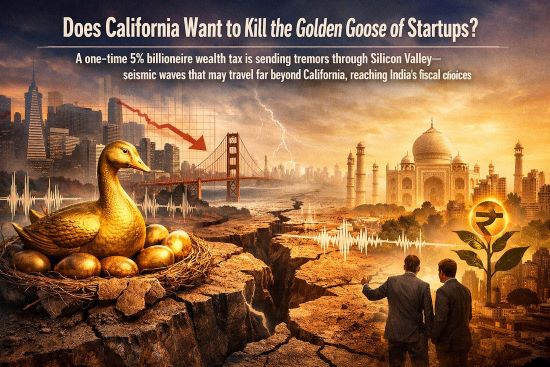
The state’s fiscal pressures are real. But California’s ability to fund those pressures ultimately depends on retaining an ecosystem that generates both wealth and taxable economic activity. That ecosystem is not immobile. In a federal union where residents can vote with their feet—and where zero state income tax alternatives exist—design errors get punished faster.
The question is not whether billionaires should contribute more. It is whether California can design a tax that captures legitimate wealth without turning volatility and illiquidity into personal ruin and driving away the most mobile talent. In a state that is home to Silicon Valley, a policy that feels elegant in theory but punitive in practice risks achieving the worst of both worlds: driving away those with options while ensnaring those with illiquid stakes. California must choose its model carefully—because it cannot assume permanence, not even for a golden goose.