
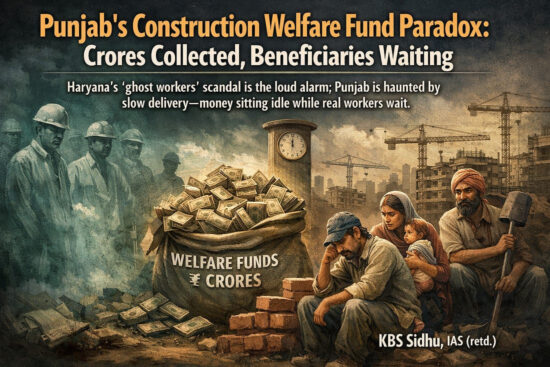
 Haryana’s construction welfare board audit has reportedly exposed a system where verification collapsed and welfare became a conduit for “phantom” beneficiaries. If the figures cited by the Haryana Labour Minister Anil Vij are accurate, fake work slips and registrations were not an aberration but an industry—large enough to drain welfare meant for real workers and to erode faith in the state itself. What makes this especially troubling is that the entire welfare architecture rests on a central enactment—the Building and Other Construction Workers (Regulation of Employment and Conditions of Service) Act, 1996—which was designed to protect one of India’s most vulnerable categories of labour through registration, verification and benefits linked to proven work.
Punjab should not treat Haryana’s episode as a neighbour’s embarrassment. It is a mirror—because it shows what happens when a welfare architecture is built on weak controls, low transparency and high discretion. Fraud is one end of the spectrum; non-delivery is the other. Punjab sits on the non-delivery side—haunted not by “ghost workers” but by slow processing, long pendency, and welfare money that remains parked while genuine workers wait for relief.
Punjab’s paradox: money exists, but help arrives late—or not at all
Punjab’s Building and Other Construction Workers’ Welfare Board does not suffer from scarcity. It suffers from a delivery deficit.
The Comptroller and Auditor General’s compliance audit up to March 2022 recorded what the ordinary worker experiences daily: despite “sufficient funds”, eligible worker members were denied benefits. The Board’s corpus rose from roughly ₹1,017 crore in April 2019 to about ₹1,234 crore by March 2022. In that same period, welfare expenditure remained modest relative to the funds available, and overall utilisation stayed low.
A welfare board is not meant to behave like a cautious investment fund. Its purpose is to convert a statutory cess into timely assistance for workers who build our homes and highways. When balances grow but benefits don’t, the state cannot claim success merely because collections are “healthy”.
Schemes are plentiful; beneficiaries are not
Punjab’s construction welfare list is long—maternity and education assistance, pensions, medical support, marriage grants, and more. The problem is not the lack of scheme headings. It is the absence of scheme outcomes.

The audit noted that the Board failed to identify even a single beneficiary in eight out of 23 welfare schemes. That should provoke immediate questions: are these schemes irrelevant to worker needs, or are they inaccessible in practice? Either way, continuing them unreformed turns welfare into an exercise in paperwork and publicity.
More telling still, several schemes that attracted no applications were not even reviewed for relevance. That reveals a deeper problem: a system that does not learn from its own failure, because failure carries no cost inside the organisation.
Delay is not incidental; it is the policy outcome
The most cruel form of welfare failure is not denial; it is delay.
As of March 2022, the latest data avaiable in the public domain, the audit recorded nearly 62,948 pending applications worth about ₹103.74 crore under 13 schemes, with delays running up to 767 days beyond the stipulated 180 days. The bulk of pendency lay in the Stipend scheme, with over 55,000 cases waiting.
What does a 767-day delay mean on a construction site? It means the worker who needs the stipend for a child’s schooling loses the year. It means an accident compensation claim turns into a debt spiral. It means maternity or medical support arrives after the family has already borrowed at ruinous rates. A delayed welfare benefit is not a smaller benefit; it is often a useless one.
Digitisation does not automatically fix this. It can reduce queues and curb petty discretion, but it can also scale delays if the underlying process is not redesigned—if the file simply moves online and remains stuck.
Who benefits when benefits do not reach workers?
When welfare money remains unspent, someone still gains from the status quo.
Banks benefit from large, stable deposits when welfare funds are parked in fixed deposits. The government benefits from optics: high collections look like performance, even if disbursal is lagging. The administrative system benefits from caution: fewer disbursements mean fewer errors, fewer complaints, and fewer audits triggered by volume.
And in the shadow between worker entitlement and state delay, intermediaries flourish. Where procedures are complex, timelines uncertain and requirements opaque, the “agent” becomes a parallel state—extracting money from those who can least afford it. That is how non-delivery quietly becomes exploitation.
Punjab must ask an uncomfortable question: if the welfare board is not built to prioritise the worker’s urgency, what is it built to protect?
Haryana’s fraud and Punjab’s inertia: two ends, one shared failure
Haryana’s story suggests a gate that was too weak—approvals without adequate verification. Punjab’s story suggests a gate that is too slow and too opaque—verification and processing that fail to translate funds into timely help.
These are opposite failures, but they converge in outcome: the genuine worker loses. In Haryana, welfare may be looted by “phantoms”; in Punjab, welfare may sit unused while genuine applicants wait.
Both erode trust, and once trust collapses, even honest reforms struggle to revive participation.
A Punjab reset: spend faster, verify smarter, publish everything
Punjab does not need more schemes. It needs a new operating discipline.
1) Publish a monthly “delivery dashboard”.
District-wise numbers for: applications received, disposed, rejected (with reasons), pending, and median/90th-percentile disposal time—scheme-wise. If the state can publish revenue collections and procurement figures, it can publish welfare delivery.
2) Turn timelines into enforceable accountability.
If the mandated time limit is crossed, the case must auto-escalate, with the delay reason recorded. “No decision” should be treated as a governance failure, not a worker failure.
3) Adopt risk-based verification.
Low-value, recurring benefits can be fast-tracked with random audits. High-value, one-time benefits can receive deeper checks. The answer to fraud risk is not to punish every genuine worker with universal friction.
4) Register workers where work happens.
Make registration and renewal easier at worksites and through the ecosystem that collects cess—contractors, local bodies and building permissions—so proof is not carried entirely by the worker.
5) Kill dead schemes; redesign what doesn’t work.
If schemes repeatedly produce zero beneficiaries, close them or relaunch them with redesigned eligibility and access. Welfare should follow worker reality: mobility, seasonal migration, safety gear, cashless treatment and timely education support.
6) Create an independent social audit of outcomes.
Not just accounts—outcomes. Who got what benefit, how fast, and with what grievance resolution.
The real picture of Punjab is not the corpus; it is the queue
Punjab’s welfare board should not be judged by how much it holds. It should be judged by how fast it helps.
A construction worker’s life does not run on government financial years. It runs on daily wages, accidents, school fees, pregnancies, and sudden illness. Welfare that arrives after the crisis has passed is not welfare—it is a delayed acknowledgement of a failure.
Haryana’s audit is a warning about what happens when verification collapses. Punjab’s audit is a warning about what happens when delivery collapses. Punjab must not wait for a scandal loud enough to force reform. It already has the data, the corpus, and the mandate.
The only question left is moral clarity: will the system keep protecting balances, or will it start protecting builders?
Share The KBS Chronicle
Citations (for readers who want to dig deeper)
Haryana’s “phantom workers” and the ₹1,500 crore allegation (ThePrint)
Another report on the Haryana audit findings (Indian Express)
Punjab CAG audit: “Welfare of Building and Other Construction Workers” (Chapter II PDF)
Punjab CAG report landing page (Compliance Audit Report-I, tabled Sept 2024)
Punjab govt press release on BOCW disbursals & process reforms (Dec 30, 2024)
Punjab’s record labour cess collection: ₹310 crore in FY2024–25 (UNI)
Punjab BOCW: welfare schemes list (official portal)
The BOCW Act, 1996 (India Code)
The BOCW Welfare Cess Act, 1996 (India Code PDF)
The KBS Chronicle is a reader-supported publication. To receive new posts and support my work, consider becoming a free or paid subscriber.