
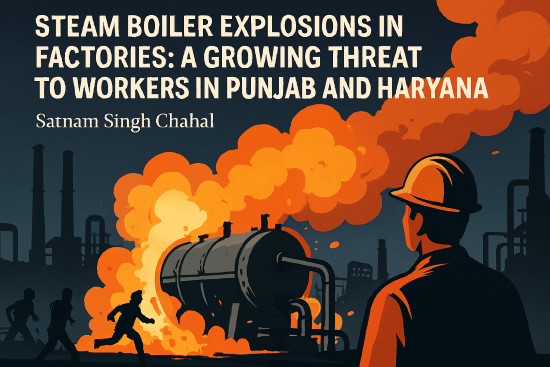
 Steam boiler explosions continue to pose a grave threat to factory workers across Punjab and Haryana, two states that form the industrial backbone of northern India. Boilers are extensively used in textile mills, auto-parts factories, food-processing units, rice mills, sugar factories, and paper industries. While these machines are essential for industrial production, repeated accidents show that negligence, poor maintenance, and lack of safety enforcement have turned them into lethal hazards. The loss of human lives and injuries caused by boiler bursts underline the urgent need for stricter safety compliance.
A major incident highlighting this danger occurred in the Rewari–Dharuhera industrial belt of Haryana on March 16, 2024, when a steam boiler burst inside an auto-parts factory. The explosion injured more than 40 workers, many of whom suffered severe burn injuries and were rushed to nearby trauma centers. Reports indicated that the blast took place during routine operations, raising serious questions about the condition of the boiler and the adequacy of safety mechanisms. This incident once again exposed how factory workers, especially contractual and migrant laborers, are often left vulnerable to unsafe industrial environments.
Similar tragic incidents have been reported in recent years across Punjab and Haryana. In 2025, a boiler explosion in Ludhiana, Punjab, claimed the life of one worker and injured five others. The same year, another boiler blast in Rohtak, Haryana, resulted in one death and left two workers seriously injured. These incidents, when viewed together, reveal a disturbing trend rather than isolated mishaps. Year-wise data shows that in 2025 alone, at least two workers lost their livs in boiler accidents in Punjab and Haryana, while dozens were injured between 2024 and 2025.
The reasons behind these explosions are largely preventable. Poor maintenance, corrosion, metal fatigue, and the use of outdated boilers significantly weaken structural integrity. In many factories, safety valves and pressure-release systems are either faulty or deliberately bypassed to increase production. Low water levels, abnormal pressure buildup, and ignored warning signals often precede explosions, but the absence of trained supervision allows dangerous conditions to persist until disaster strikes.
A critical issue is the lack of proper training and certification among boiler operators. In many small and medium-scale factories, workers are asked to operate boilers without adequate knowledge of pressure limits, temperature controls, or emergency shutdown procedures. Fear of job loss discourages workers from reporting abnormal sounds, hissing steam, fluctuating pressure gauges, or visible leaks, even though these are clear warning signs of an impending accident.
The human cost of boiler explosions is devastating. Workers standing near boilers are exposed to scalding steam, flying metal fragments, and collapsing factory structures. Survivors often suffer permanent disabilities, while families of deceased workers face financial insecurity and prolonged legal struggles for compensation. Migrant workers in industrial belts of Punjab and Haryana are particularly affected, as they lack strong legal and social protection.
Property damage caused by such explosions further amplifies the impact. Entire factory sheds collapse, machinery worth crores is destroyed, and production remains suspended for long periods. In densely populated industrial areas like Ludhiana, Panipat, Faridabad, and Dharuhera, the impact sometimes extends beyond factory premises, damaging nearby homes and vehicles and endangering local communities.
Preventing steam boiler explosions requires urgent action. Regular inspection of boilers by certified authorities must be made mandatory, and safety certificates should be strictly enforced. Boilers should never be operated without a trained supervisor present. Workers must be educated to immediately report warning signs such as hissing sounds, abnormal pressure readings, or steam leaks. Operating a boiler without valid safety certification should be treated as a serious criminal offense, not a minor violation.
In conclusion, steam boiler explosions in Punjab and Haryana are not unavoidable accidents but the result of systemic negligence and weak enforcement. Industrial growth cannot be sustained at the cost of workers’ lives. Ensuring strict safety standards, empowering workers to speak up, and holding factory owners accountable are essential steps to prevent such tragedies from repeating.