
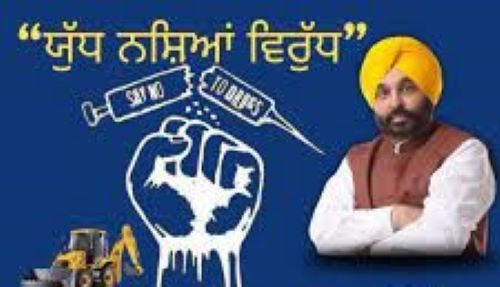
In what officials are calling “the most ambitious anti-narcotics campaign in history,” the Punjab government announced this week that it has invested a staggering thousand rupees into eliminating the state’s illegal drug problem. Sources confirm the cat previously stationed near the Chief Minister’s office has not moved an inch. When asked about the symbolic nature of this investment, a government spokesperson, adjusting his designer tie worth approximately three times the entire anti-drug budget, explained with a straight face: “We are deeply committed to this cause. We’ve purchased two awareness posters and a megaphone. Well, a used megaphone that only works on Tuesdays. What more can the people realistically want?”
The posters, printed in black and white to save costs, feature the inspiring slogan “Just Say No” — a phrase so revolutionary it was first used in the 1980s. One poster is currently hanging in a government office bathroom where it competes for attention with various plumbing-related notices, while the other was last seen being used as a placemat in the state canteen, collecting chai stains and accumulating a thin layer of samosa crumbs. Officials insist this represents “maximum public visibility” and “grassroots engagement with the message.”
Meanwhile, the same cash-strapped administration has reportedly allocated several lakh rupees for its elite “Delhi Operations Team” — a crack squad of 47 advisors, consultants, “strategic relationship managers,” and one person whose business card simply reads “Important.” These individuals operate from plush offices in the capital, making decisions about a state many of them visit only for photo opportunities and festival seasons.
“They’re considered the actual rulers of Punjab,” explained one disillusioned bureaucrat on condition of anonymity, speaking from behind a filing cabinet while nervously checking the door. “We in Chandigarh just provide the funding, sign whatever papers they send us via encrypted email at midnight, and apologize profusely when things inevitably go wrong. It’s a very efficient system — for them.”
The Delhi team’s recent achievements are nothing short of remarkable, if one measures success by expense reports rather than actual outcomes. They have successfully attended 43 high-level meetings that could have been emails, pioneered the revolutionary “work-from-five-star-hotel” model of governance, set new records for per diem expenses, and mastered the ancient art of being “in transit” or “in another crucial meeting” whenever actual decisions need to be made. Their latest innovation involves holding video conferences from hotel suites because “the ambiance inspires better policymaking,” though critics note the policies themselves remain uninspired.
“They’re strategic,” explained another official, his voice heavy with practiced diplomatic vagueness. “Very strategic. We’re not entirely sure what the strategy is, or whom it benefits, or whether it even qualifies as a strategy in the traditional sense, but there’s definitely a lot of it happening in New Delhi’s finest restaurants. Last month’s ‘agricultural policy brainstorming session’ was held at a rooftop lounge. Not a single farmer was present, but the refreshments were apparently excellent.”
In what observers are calling “a rare moment of consensus,” farmers, industrialists, students, shopkeepers, teachers, doctors, rickshaw drivers, and even that one perpetually angry uncle who argues about everything have all miraculously united in their frustration with anti-public policies. Political rallies have been replaced by collective head-shaking. Protests have evolved into weary sighs. The state’s unofficial motto has become “Ki kariye?” — what can we do?
“I’ve never seen such consensus in my entire career,” marveled political analyst Dr. Harmeet Singh, wiping away what might have been a tear or might have been sheer disbelief. “Farmers who violently disagree on crop rotation techniques are now bonding over their shared annoyance at agricultural policies. Business rivals who haven’t spoken in decades are texting each other memes about government initiatives. Families feuding over property are calling truces to collectively complain about new regulations. It’s beautiful, in a completely dystopian sort of way. We’ve achieved unity through mutual exasperation.”
Farmer Kuldeep Singh, 52, who has worked his land for three decades and inherited the wisdom of three generations before him, put it with characteristic Punjabi directness: “They held a crucial meeting about our issues. In Delhi. Without inviting a single farmer. Then they sent us the minutes six months later. In English. As a 15-megabyte PDF that crashes every phone in the village. When we finally got someone’s son to open it on his laptop, it was full of words like ‘stakeholder engagement’ and ‘paradigm shift.’ We just wanted to talk about crop prices and water supply.”
Student Priya Kaur, 21, was equally unimpressed with educational initiatives. “They promised to modernize education and prepare us for the future. So far they’ve modernized the font on official letterhead from Times New Roman to Calibri, added the government logo to the school website, and called it ‘digital transformation.’ Meanwhile, our college computer lab has fifteen computers from 2009, eight of which work, and we’re competing for jobs with students from states that actually invested in education.”
Shopkeeper Rajesh Kumar, whose family has run the same business for forty years, added his perspective while sorting through a stack of government forms: “New policy every single week. Each one requires three new forms in quintuplicate, two witnesses with government IDs, a character certificate from the local police, and apparently my grandfather’s birth certificate. My grandfather was born in 1920. In undivided Punjab. In a village that’s now in Pakistan. I asked the official how I’m supposed to produce a document that predates the existence of the country it’s supposed to be from, and he just said ‘Not my department’ and walked away.”
The government has defended its track record with characteristic confidence, proudly pointing to several recent initiatives that have left citizens scratching their heads and reaching for aspirin. When questioned about public dissatisfaction, officials produced a glossy presentation documenting their achievements, printed on paper so expensive it could have funded a small hospital.
First among their accomplishments was the Publicity Campaign That Cost More Than What It Publicized. This glossy awareness drive about government transparency and accountability consumed more funds than the entire combined healthcare budget of three districts. The campaign’s centerpiece was a series of massive billboards featuring the Chief Minister looking thoughtfully into the distance, presumably contemplating the future of Punjab. The campaign won an award for “creative use of public funds,” though no one is quite sure who gave out the award or why.
Then came the Policy Nobody Asked For, a comprehensive 47-page regulation detailing the proper procedure for filing complaints about regulations. This meta-policy requires citizens to complain about the complaint process before their actual complaint can be processed. Early adopters report that attempting to use the system creates what legal experts call “an infinite loop of bureaucratic poetry” and what regular citizens call “a headache that won’t end.” One man who tried to file a complaint about a pothole in 2022 is still working through the preliminary paperwork and estimates he might reach the actual complaint phase by 2025, by which point the pothole will likely have evolved into a small canyon.
Most recently, the government formed the Committee to Study Committees, a bold initiative launched in response to public criticism that previous committees accomplished nothing except consuming chai and producing reports no one reads. This new body will spend 18 months and several lakh rupees investigating why committees are ineffective, using the exact committee structure that makes committees ineffective. Its first official recommendation, delivered with complete sincerity, was to form a sub-committee. When journalists pointed out the circular logic, the committee chairman replied that understanding the recommendation would require reading the 89-page preliminary report.
“We hear the people’s concerns loud and clear,” the spokesperson insisted, raising his voice slightly. “That’s why we’ve formed a committee to study the formation of another committee to eventually discuss possibly considering potentially scheduling a preliminary meeting to explore the feasibility of reviewing their feedback. This is democracy in action. This is responsive governance.” When pressed about the timeline for actual results, he added with practiced sincerity: “These things take time. Rome wasn’t built in a day. Although, to be fair, Rome also didn’t have our committee system.”
Back in the villages, towns, and cities of Punjab, far from the air-conditioned conference rooms of Delhi and the sanitized press releases of government offices, the drug crisis continues unabated. Families still struggle with addiction tearing apart homes. Treatment centers remain critically underfunded, operating on donations and the goodwill of overworked staff. Rehabilitation programs exist primarily on paper — very expensive paper, printed in full color with impressive charts and graphs, but paper nonetheless.
Social worker Manjit Kaur, who runs a volunteer rehabilitation center in a converted school building, had thoughts when informed about the government’s thousand-rupee anti-drug investment. “They spent a thousand rupees on awareness posters and several lakhs on their Delhi office expenses. I can tell you which investment is more comfortable, but not which one has helped even a single person get clean. We have thirty people here trying to rebuild their lives. We operate on 50,000 rupees a month, mostly from private donations. But sure, two posters will solve everything.”
Health experts and addiction specialists note with increasing concern that Punjab’s drug problem requires sustained, substantial investment in treatment infrastructure, prevention programs, school-based education, community outreach, and coordinated efforts. “Or,” suggested one doctor who has watched too many young lives affected, “you could buy two posters and a used megaphone, declare victory in a press conference, get some nice photos for social media, and move on. Both approaches cost money, but only one requires actual work and political will.”
In an exclusive interview arranged after weeks of negotiations, the cat near the Chief Minister’s office — now an unlikely symbol of governmental inertia and the subject of countless social media memes — offered this profound observation: “Meow.” When pressed for elaboration, the cat stretched, yawned with theatrical indifference, and added: “Meow.”
Political analysts have debated the meaning of these statements, with the prevailing translation roughly conveying: “I’ve been sitting in the same spot for three years, and I’ve accomplished as much as most government initiatives, possibly more because at least I catch mice occasionally.”
The cat, sources confirm with absolute certainty, has still not moved from its position. Unlike the goalposts of government promises, which officials relocate weekly depending on public pressure and media attention. The cat has become something of a folk hero, with a dedicated social media following and a popularity rating that recent polls suggest exceeds that of several officials.
As Punjab approaches another election cycle, political observers wonder if anything will fundamentally change or if the state is trapped in an eternal loop of promises, disappointments, and committee meetings. The Delhi team continues to operate from the capital, the anti-drug budget remains embarrassingly symbolic, and public frustration has evolved beyond mere annoyance into a resigned amusement.
“At least we can laugh about it now,” said college student Arjun Singh, scrolling through memes about the government on his phone while waiting for a bus that’s forty minutes late. “If we didn’t laugh, we’d cry. And actually, crying might require paperwork now — I heard they’re considering Form 27-B for public expressions of dissatisfaction, to be filed in triplicate with a department that doesn’t exist yet but probably will after they form a committee to study its formation.”
His friend Simran added, “My cousin who moved to Bangalore sends me pictures of infrastructure there and asks why we don’t have similar facilities. I sent her a picture of our new government awareness poster about planning. She stopped asking.” The conversation dissolved into tired laughter, the kind that comes from having no other response available.
The government spokesperson concluded the press conference with a rousing message: “We promise to listen to the people, serve their interests, and govern with transparency and accountability. Right after this quick trip to Delhi. There’s a very important five-day seminar on effective governance. These things are essential for policy development. We’ll return with fresh ideas and renewed dedication. Probably. If the flights aren’t delayed. But definitely soon. Sometime. Eventually.”
Outside the press conference venue, the cat yawned with perfect comedic timing, stretched in the afternoon sun, and settled back into its spot. Unchanged. Unmoved. Unbothered. A living monument to the status quo.
The reporters filed out, already writing stories they’d written a dozen times before with only the dates changed. The bureaucrats returned to their offices to process paperwork for committees that would meet to discuss meetings. The Delhi team booked their accommodations. And somewhere in a village, a mother prayed while the government’s posters collected dust in an office nobody visits.
Democracy in action. Punjab style.
EDITOR’S NOTE: This is a work of satire. Any resemblance to actual governmental situations is purely coincidental. No animals were harmed in the writing of this article. The cat declined to comment further and requests privacy during this difficult time of being a metaphor.