
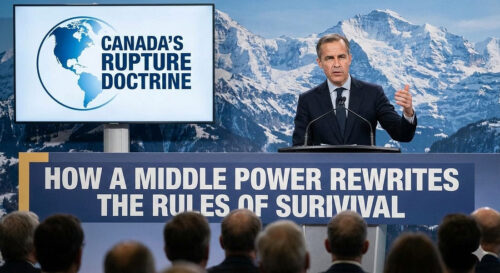
 At the World Economic Forum in Davos on January 20, 2026, Canadian Prime Minister Mark Carney delivered what may become the defining foreign policy statement of the decade—a candid reckoning with the end of the Western-led rules-based international order and a blueprint for how middle powers must navigate the coming era of great power rivalry. Unlike the usual diplomatic hedging that characterises such addresses, Carney’s speech (video clip) represented a philosophical break: an explicit acknowledgment that the rules-based system was always partially illusory, and that Canada’s prosperity can no longer rest on the fiction of universal law or American hegemony.
“Living Within a Lie”
The speech’s core argument is deceptively simple yet radical: the old international order was sustained not by its truth but by collective compliance—what Václav Havel called “living within a lie.” For decades, Canada participated in this ritual, “placing the sign in the window,” accepting asymmetric trade enforcement and selective application of international law in exchange for the stability that American hegemony provided. But that bargain has collapsed. Great powers now weaponise the very tools of integration—tariffs, financial systems, supply chains—that once promised mutual prosperity. The result is not a transition but a rupture: a qualitative break in the international system itself.
From Idealism to “Values-Based Realism”
Carney’s diagnosis represents a maturation in Canadian strategic thinking. Rather than lamenting the loss of multilateralism or calling for reform of the World Trade Organization and United Nations, he accepts these institutions’ diminishment as a fact and proposes to build around them. This shift from idealism to what he terms “values-based realism”—borrowing from Finnish President Alexander Stubb—marks a genuine intellectual repositioning. Canada will remain committed to sovereignty, territorial integrity, and human rights, but will no longer assume that these values automatically translate into geopolitical leverage or that other states share them. Instead, Canada must operate “with open eyes,” pragmatically engaging “as the world is, not as we wish it to be.”
The Domestic Foundation: Strength Before Sermons
The practical implications are sweeping. Domestically, Carney’s government has already begun executing a three-part domestic strengthening strategy: cutting taxes on incomes and capital gains, removing interprovincial trade barriers, and committing a trillion dollars to energy, artificial intelligence, critical minerals, and new infrastructure. This economic agenda reflects a hard-nosed recognition that “a country that cannot feed itself, fuel itself, or defend itself has few options.” The doubling of defence spending by 2030—structured to build domestic industries rather than simply purchase foreign weapons—underscores that strategic autonomy rests on material capacity, not rhetoric.
“Variable Geometry”: Coalitions Without Illusions
Internationally, Carney is executing a deliberate strategy of “variable geometry”: building issue-specific coalitions with partners who share sufficient common ground to act together, rather than relying on either universal institutions or bilateral deals with great powers. This means defence partnerships with NATO allies on Arctic sovereignty, trade blocs linking the Trans-Pacific Partnership with the European Union to create a market of 1.5 billion people, buyer’s clubs within the G7 to diversify critical minerals supply away from concentrated sources, and AI governance frameworks with “like-minded democracies” to avoid technological dependency on either Washington or Beijing. Each coalition is purpose-built; none assumes permanence.
The Rejection of Compliance-as-Safety
What makes this approach distinct is its frankness about the risks of traditional great-power accommodation. Carney explicitly rejects the logic that “compliance will buy safety,” noting that when integration becomes weaponised, appeasing dominant powers only deepens subordination. This directly challenges the Canadian foreign policy tradition of deferential alignment—the assumption that proximity to the United States automatically confers security. Instead, Carney invokes a different logic: “If you are not at the table, you are on the menu.” Middle powers must act collectively, not in bilateral competition with hegemons, or they will be divided and subordinated.
“Living in Truth”: Naming the World as It Is
The philosophical anchor of this doctrine is the return to Havel’s concept of “living in truth.” Carney argues that the first step toward resilience is honesty: naming the system as it is—not a rules-based order but “a period of intensifying great power rivalry, where the most powerful pursue their interests using economic integration as a weapon of coercion.” This clarity of diagnosis creates space for strategic action. Countries must apply consistent standards to allies and rivals, avoid invoking the legitimacy of institutions they know to be weakened, and build institutions and agreements “that function as described”—rather than paying lip service to rhetorical commitments.
The Middle-Power Opening (and the Hegemon’s Bill)
Carney’s framing also contains a subtle but significant rebuttal to both American and Chinese triumphalism. Great powers can afford to “go it alone” because of market size and military capacity, but this freedom comes with a cost: allies will diversify, hedge, and reduce their reliance on a single hegemon. The era of uncontested hegemonic leadership has passed not because of ideological choice but because “hegemons cannot continually monetise their relationships.” This creates an opening for middle powers that act collectively: they can offer legitimacy, predictability, and the stability that comes from shared rule-setting rather than imposed order.
No Nostalgia: A Doctrine of Constructive Realism
The speech concludes with a call to reject nostalgia. The old order will not return, and mourning it is strategically futile. Instead, the task facing middle powers is to “build something better, stronger, and more just” from the fractures of the existing system—to exercise what might be called “constructive realism,” neither hiding from great power rivalry nor surrendering to it. Canada has chosen this path; Carney’s invitation to other middle powers is implicit: solidarity in resilience beats isolation in accommodation.

India’s Moment: Turning “Variable Geometry” Into Statecraft
For India, Carney’s doctrine arrives at a pivotal moment. Just a day before his address, European Commission President Ursula von der Leyen announced at Davos that the EU and India are “on the cusp of a historic trade agreement”—the “mother of all deals”—that would create a combined market of two billion people and nearly a quarter of global GDP. This mega-deal, to be signed in New Delhi on January 27, 2026, exemplifies precisely the kind of “variable geometry” coalition Carney advocates: a middle-power partnership that builds strategic autonomy without great-power patronage.
India should embrace this approach not as a transactional manoeuvre but as structural reorientation. New Delhi should deepen the EU–India pact into a comprehensive framework covering critical minerals, technology standards, and supply chain resilience—moving beyond tariff reduction to forge institutional rules that function as described. Rather than hedging between US and China through bilateral compliance, India should anchor itself in such middle-power coalitions, applying consistent standards to all partners and reducing vulnerability through genuine diversification. The Republic Day summit with von der Leyen and European Council President António Costa offers the perfect stage to demonstrate this: India must show that it, too, is “taking the sign out of the window” and building a new order based on rules that actually work, not rituals that merely pretend to.
The Real Test: Credibility Over Rhetoric
If executed with consistency and matched by concrete investment in domestic strength and international coalition-building, this doctrine could reposition Canada from a comfortable middle power in decline to an architect of post-hegemonic order. Whether other middle powers—from South Korea to Australia to India—heed Carney’s call will determine whether the next decade sees fragmentation into competing fortresses or the emergence of a genuine third path.
Key takeaways for Canadian policy and geopolitics
The doctrine rests on three pillars—honesty about systemic change, domestic material strength, and deliberate coalition-building among peers—each necessary but none sufficient alone. Its success depends on sustained investment and credibility across all three dimensions. The emphasis on “values-based realism” is not a retreat from Canadian values but a recognition that values matter most when backed by capacity and pursued consistently, not selectively.