
 Language is not merely a tool of communication; it is a fundamental democratic right and a reflection of a people’s dignity. Punjabi, one of the most widely spoken languages in the world, continues to face systematic neglect in Pakistan’s Punjab despite being the mother tongue of the majority population. This neglect is not accidental—it is the result of deliberate policy choices that demand urgent correction.
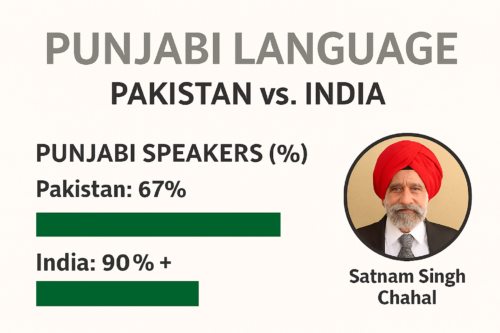
Punjab in Pakistan has a population of approximately 127 million people, and nearly 67 percent of them speak Punjabi as their first language. In absolute terms, this makes Punjabi the most spoken language in the country. Yet paradoxically, Punjabi has no official status in administration, courts, or education. Urdu and English dominate state institutions, creating a governance system linguistically disconnected from the people it serves.
One of the most serious injustices faced by Punjabi speakers in Pakistan is in the education system. Children are forced to begin their learning journey in Urdu or English, languages that are not their mother tongue. Punjabi, written in Shahmukhi script, remains largely absent from school curricula. This results in poor comprehension, early learning difficulties, and the gradual erosion of linguistic confidence among Punjabi-speaking children.
A government that does not operate in the language of its people cannot claim to be fully democratic. In Pakistan Punjab, official documents, court proceedings, police work, and government communication are conducted almost entirely in Urdu or English. Punjabi speakers are expected to navigate state systems in languages imposed from above, effectively marginalizing them in their own homeland.
Across the border, Indian Punjab offers a clear contrast. Punjabi is an official state language, used in schools, government offices, and public administration. Though Indian Punjab has a smaller population, its commitment to linguistic rights has ensured the survival, growth, and modernization of Punjabi. This proves that political will—not population size—determines a language’s status.
A Clear Set of Demands
The continued marginalization of Punjabi in Pakistan Punjab must end. The following steps are urgently required:
Grant official provincial status to Punjabi
Introduce Punjabi as a medium of instruction at primary levels
Use Punjabi in provincial administration and local governance
Promote Punjabi literature, research, and media at the state level
These are not cultural favors; they are constitutional and democratic necessities.
Punjabi does not need sympathy—it needs justice. A language spoken by millions cannot be treated as a second-class tongue in its own land. If Pakistan truly believes in democracy, inclusion, and federal rights, it must recognize Punjabi not just in speeches and songs, but in schools, offices, and laws. The survival of Punjabi depends not on numbers alone, but on the courage of policymakers to respect the people they govern.