
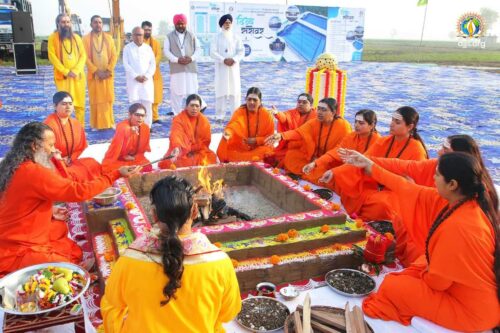
Ashutosh Maharaj, born Mahesh Kumar Jha in 1946 in Darbhanga, Bihar, emerged as a spiritual leader whose legacy now straddles the realms of faith, science, and legal debate. After leaving his family to pursue a monastic path, he spent time with Satpal Maharaj’s sect before founding the Divya Jyoti Jagrati Sansthan (DJJS) in 1983. His teachings emphasized inner transformation through meditation and self-realization, attracting millions of followers across India and abroad. Under his leadership, DJJS expanded into a sprawling spiritual and social organization, with its headquarters in Nurmahal, Punjab, eventually growing to encompass 100 acres and an additional 300 acres of farmland.
On January 28, 2014, Ashutosh Maharaj was declared clinically dead following a suspected cardiac arrest. However, his followers and the DJJS management rejected this conclusion, asserting that he had entered samadhi—a deep meditative state from which he would eventually return. His body was placed in a specially designed freezer maintained at -21°C, and it has remained there for over a decade. The Punjab and Haryana High Court permitted this preservation under the condition of regular medical inspections, which continue to show minimal signs of decomposition. The DJJS leadership insists that the body’s condition supports their belief in his eventual awakening.
Despite the absence of its founder, DJJS has flourished. The organization now claims over 350 centers worldwide, with a strong presence in countries like the United States, United Kingdom, Canada, and Australia. In India alone, it boasts over 2.4 million followers and a digital community of 1.5 million. Remarkably, DJJS has avoided the succession battles that often plague spiritual organizations. There is no appointed successor; instead, a life-size cutout of Ashutosh Maharaj presides over events, symbolizing his continued spiritual leadership. The organization is run by volunteers under a governing body based in New Delhi.
The preservation of Ashutosh Maharaj’s body has not been without controversy. Legal challenges emerged in 2014 when Dalip Kumar Jha, claiming to be his son, and Puran Singh, a former driver, petitioned the courts for cremation and investigation. While an initial court ruling ordered cremation, a subsequent appeal led to a stay, and in 2017, the court formally allowed the body to remain preserved under medical supervision. This legal battle highlighted the tension between religious belief and medical science, raising questions about the boundaries of faith in public life.
Today, the DJJS headquarters remains a high-security zone, guarded by police and paramilitary forces. Access to the enclosure housing Ashutosh Maharaj’s body is restricted to a select few. For his followers, the site is not a memorial but a living symbol of spiritual continuity. As the organization prepares for its next medical inspection, the case of Ashutosh Maharaj continues to challenge conventional understandings of life, death, and devotion—his body frozen in time, while his legacy grows ever more expansive.