
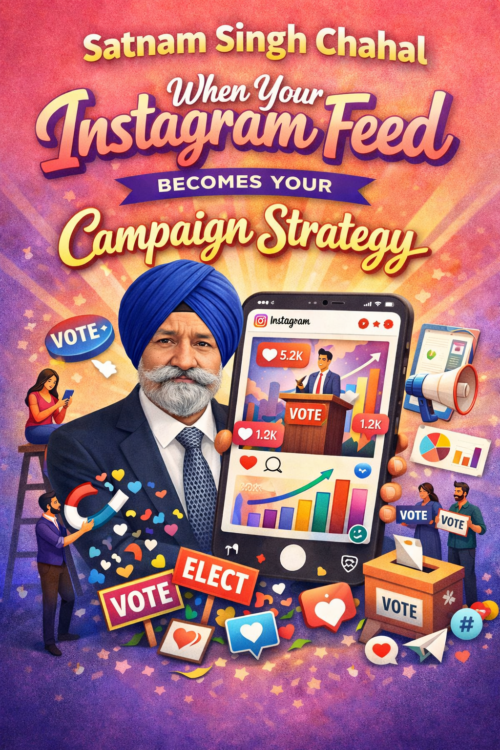
 In what political analysts are calling “the TikTok-ification of democracy,” Punjab’s upcoming 2027 Assembly elections might just be decided by whoever has the best ring light and most engaging reels. Gone are the days when candidates needed pesky things like “manifestos” or “policy positions.” Why bother with economic plans when you can post a perfectly filtered selfie at the Golden Temple with the caption “Vibes only 🙏✨”?
Forget the legislative assembly—the real action is happening in the comment sections. Political parties in Punjab have ditched traditional debate formats in favor of full-blown social media warfare. AAP is sliding into Congress’s DMs with sarcastic memes. Akali Dal is quote-tweeting everyone with savage comebacks. And BJP? They’ve got a 24/7 war room dedicated entirely to crafting the perfect clapback.
The morning doesn’t start with newspaper headlines anymore. It starts with checking which party got ratio’d overnight. “Did you see what SAD posted about AAP’s farm policy?” is the new political discourse. The policy itself? Nobody actually read it. But the meme about it? Viral gold. Party workers are no longer distributing pamphlets door-to-door. They’re creating WhatsApp groups, flooding them with forwards, and blocking anyone who questions the party line. One senior party leader admitted, “We used to have booth-level committees. Now we have hashtag-level committees.”
Every party has now hired an army of “digital warriors”—a fancy term for people who get paid to argue with strangers on the internet. Their job description? Monitor every mention of the party, defend it with aggressive caps lock, and ensure no tweet goes unanswered. Sleep is optional. Victory on social media is mandatory.
Congress accuses AAP of buying followers. AAP accuses Congress of using bots. Meanwhile, regional parties are accusing everyone of running coordinated troll farms. And they’re all probably right. The irony is delicious, served with a side of verified accounts and blue ticks.
Press conferences are now essentially live-streamed roast sessions. Leaders don’t answer questions about unemployment or healthcare. Instead, they pull up their phones mid-conference to respond to a rival party’s Instagram story. “Let me show you what they posted two hours ago,” said one candidate, projecting his phone screen onto a giant display. The actual governance plan could wait.
Political parties aren’t just fighting with words—they’re fighting with photographs. Every party leader’s photo-op is immediately countered by an opposition photo-op. CM inaugurates a bridge? Opposition leader posts 47 photos of potholes. Health Minister visits a hospital? Rival party floods social media with images of neglected government clinics.
The photo editing teams are working around the clock. One party posts an achievement, another party Photoshops in a “2019” date stamp to claim credit. Graphics designers have become more important than speech writers. Why craft a compelling argument when you can create a compelling infographic that nobody will fact-check?
And then there are the “candid” photos. Leaders pretending to drink tea at roadside stalls (with a professional photographer lurking nearby). Politicians “casually” helping farmers (with perfect lighting and three different camera angles). Spontaneous moments that required two hours of planning and seventeen retakes.
But nothing—absolutely nothing—compares to the meme wars. This is where political discourse in Punjab has truly evolved. Or devolved. Depending on your perspective.
Each party has dedicated meme teams. Their weapons? Trending templates, savage captions, and an encyclopedic knowledge of pop culture references. A rival leader makes a gaffe? Within minutes, it’s a meme. A policy fails? Meme. Someone misspeaks? Believe it or not, also a meme.
The AAP IT cell creates a meme mocking Congress’s alliance history. Congress retaliates with a meme about broken promises. Akali Dal jumps in with a meme about both parties. BJP arrives late to the party but compensates with volume, flooding every platform with counter-memes. It’s exhausting, chaotic, and somehow, this is where young voters get their political education.
Party supporters have become meme warriors, sharing, resharing, and defending their party’s memes in comment battles that make medieval warfare look civilized. “Your party’s meme game is weak,” has become a legitimate political criticism.
Traditional manifestos ran into hundreds of pages that nobody read. The 2027 manifestos? Condensed into Instagram carousels and Twitter threads. Ten slides maximum. Bullet points only. Heavy on emojis. Light on actual substance. Our manifesto went viral,” bragged one campaign manager. “It got 50,000 shares!” When asked what specific policies it contained, he looked confused. “Policies? It was mostly about our party president’s inspiring journey. With really good background music.”
Campaign promises are now delivered in 60-second reels with trending audio. “We promise to fix healthcare,” says a candidate, lip-syncing to a Bollywood song. Does he explain how? Of course not. But it’s catchy, and that’s what matters.
Here’s the uncomfortable truth: while parties are busy one-upping each other on social media, actual issues are getting buried under the avalanche of content. Farmers are struggling? Sorry, too busy crafting the perfect comeback tweet. Youth unemployment rising? Can’t address it right now, there’s a viral challenge to participate in.
The quality of political discourse has been replaced by the quantity of posts. Substance has been sacrificed at the altar of virality. And voters? They’re caught in the crossfire, scrolling through endless political content, unable to distinguish between genuine policy discussion and performative posturing.
One frustrated voter summed it up perfectly: “I wanted to know about their education policy. Instead, I got 50 memes about their opponents. I’m still confused about the policy, but at least I’m entertained?”
As Punjab hurtles toward the 2027 elections, one thing is clear: the party with the best Wi-Fi will probably win. Victory won’t be decided in voting booths but in viral moments. The election results won’t just be counted in votes but in likes, shares, retweets, and engagement rates.
Political rallies are being replaced by Instagram Lives. Door-to-door canvassing is now DM-to-DM sliding. And the famous election symbol? Less important than your party’s logo looking good as a profile picture.
The Election Commission might as well hand out certificates for “Most Viral Campaign” and “Best Use of Trending Audio.” Democracy has entered its influencer era, and Punjab is leading the charge.
Is this the future of democracy or just democracy having an existential crisis while scrolling through its feed at 3 AM? Perhaps it’s both. After all, if a political party’s roast tweet gets more engagement than their policy announcement, what does that say about us?
Then again, maybe we should worry when choosing our leaders requires the same decision-making skills as choosing which influencer to follow. But hey, at least the election coverage will have better memes.
Disclaimer: This article is satire. Though given how things are going, it might be satire today and documentary tomorrow. If Punjab’s 2027 elections actually play out this way, we’ll all be governed by whoever has the best content strategy. Which, honestly, might not be the worst qualification we’ve seen in politics.