
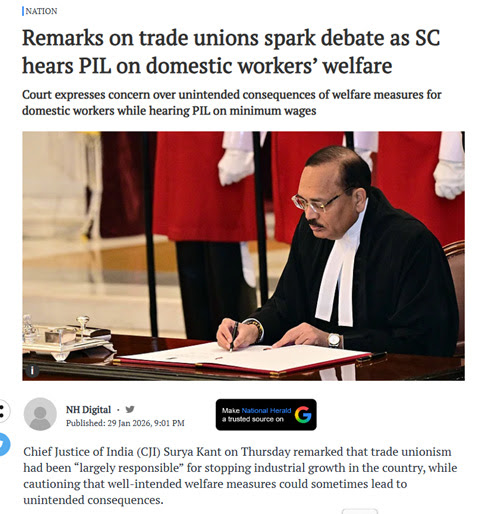
 Chief Justice of India Justice Surya Kant’s recent observation—that aggressive trade unionism has been largely responsible for stalling India’s industrial growth by forcing factory closures—cuts uncomfortably close to the bone. This was not an abstract judicial aside. It was a warning rooted in decades of economic experience, one that resonates sharply with Punjab’s present predicament.
During the 1970s and 1980s, militant trade unionism in states such as West Bengal and Kerala turned factories into permanent conflict zones. Capital fled, investment dried up, and industrial output collapsed. West Bengal’s share in national industrial production fell from over 20 per cent in the 1960s to under 5 per cent by the early 2000s. Punjab, too, felt this early tremor. Union disruptions in industrial centres like Ludhiana discouraged investors and, over time, nudged the state into an unhealthy over-dependence on agriculture.
Today, however, the same veto-driven mindset has migrated from factory gates to farm borders. Farmer unions are increasingly replicating the very trade union excesses that once hollowed out Indian industry—blocking reforms, resisting transition, and freezing the future.
A Pattern of Ideological Recycling
Punjab’s modern history reveals a troubling cycle where grievance repeatedly finds expression through extreme ideologies. In the early 1970s, the state witnessed violent Naxalism—a Maoist insurgency born out of peasant unrest and inspired by the Naxalbari movement. This phase was marked by ambushes, assassinations, and widespread fear, with over 3,650 class-based attacks recorded nationally in 1971 alone.
Although Naxalism eventually declined, violence did not disappear; it merely changed its ideological form. The 1980s and early 1990s saw Punjab consumed by religious extremism during the Khalistan movement. Economic alienation, political grievances, and identity politics fused into a lethal insurgency that claimed thousands of lives before being crushed in the mid-1990s.

These transitions were not accidental. In both cases, economic distress merged with ideological absolutism, often amplified by external influences. The outcome was the same: social trauma and economic stagnation.
From Trade Unions to Kisan Unions
Fast-forward to the present, and the parallels are unsettling. Farmer unions—many with Left ideological roots—are recycling the same confrontational politics, although now on agricultural terrain. Once legitimate champions of farmer welfare, sections of the movement have drifted toward personal glorification, converting collective causes into leadership fiefdoms.
The resemblance to militant trade unionism is stark. Just as industrial unions once vetoed reform and drove away jobs, today’s kisan unions rigidly defend subsidies and MSP demands in ways that entrench inefficiency rather than secure long-term farmer prosperity. Moreover, they obstruct industrialisation, stall infrastructure projects, and choke employment avenues for a state where youth unemployment is nearing 20 per cent.
The Anti-Industry Turn
Another feature shared by militant trade unionism and contemporary farmer mobilisation is the demonisation of corporates and industry itself. This hostility was largely absent in Punjab until the early 2010s. Earlier discourse emphasised industrialisation, agro-processing, and post-harvest value addition as pathways to prosperity.
However, post-2014, anti-corporate rhetoric became central to protest politics. Reforms were portrayed as predatory, private investment as exploitation, and industry as an enemy. Predictably, investors stayed away—reinforcing Justice Surya Kant’s point that excessive union power often stalls growth rather than protecting livelihoods.
A Structural Deadlock
Punjab’s economic numbers reveal the depth of the problem. Agriculture employs roughly 24.6–25 per cent of the workforce—far higher in rural areas—yet contributes about 26.7–27.8 per cent to Gross State Value Added. For a relatively high-income state, this signals inefficiency and over-dependence.
Despite this, farmer unions under platforms such as the Samyukt Kisan Morcha and Bharatiya Kisan Union resist diversification, block reforms, block investments into agriculture and post harvest sector. They rejected even transitional measures like the 2024 five-year MSP-linked contract for alternative crops, insisting instead on legal MSP guarantees without structural reform. Although fears of income loss are understandable—Punjab supplies around 31 per cent of India’s rice and 46 per cent of its wheat—this rigidity ignores institutional gaps such as storage, processing, and market access for new crops. The result is paralysis, not protection.
Human Costs of Stagnation
This resistance perpetuates deeper crises. Farmer suicides remain a grim reality, with academic surveys recording over 16,000 deaths since 2000, largely debt-related, even as official figures understate the scale. Simultaneously, Punjab faces one of India’s worst drug abuse epidemics. Over 15 per cent of the population is affected, opioid dependence is concentrated among youth, and treatment gaps remain massive.
Agrarian stagnation, unemployment, and blocked economic mobility form the common thread.
The Most Dangerous Fusion
Punjab’s Confusion Fusion: When Leftist Unions Meet Religious Mobilisation Most troubling is the convergence of Leftist economics with religious mobilisation. Historically uneasy partners, they found common cause during the 2020–21 farmers’ agitation. Religious symbolism merged with Left organisational discipline; the Nishan Sahib stood alongside anti-corporate rhetoric. The combination proved powerful and emotionally resonant.
Yet it is also deeply risky. Such fusion narrows debate, marginalises dissenting farmers, and edges dangerously close to fundamentalism. Punjab has lived through this before. In the 1980s, a similar mix of grievance and identity plunged the state into prolonged darkness.
A Warning Punjab Cannot Ignore
Justice Surya Kant’s observation is not merely about factories or unions; it is about what happens when protection turns into paralysis. When unions—industrial or agrarian—begin serving ideology and leverage instead of livelihoods, they damage the very people they claim to represent.
Punjab today stands at a decisive moment. Without reforms, diversification, and openness to industry, the state risks replaying its past tragedies—not through closed factories, but through barren fields and lost generations. Ignoring history, once again, would be the costliest mistake of all.