
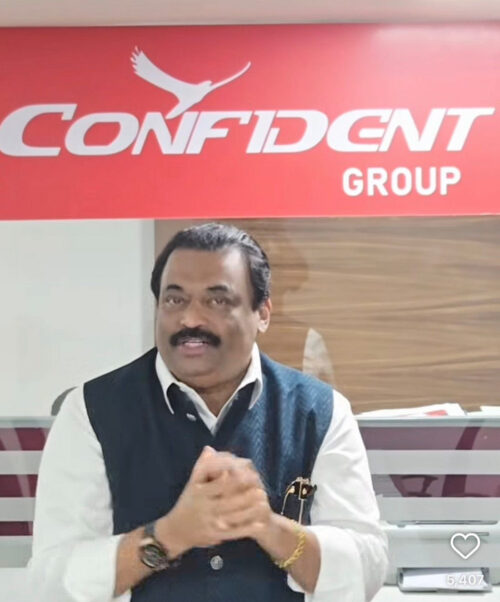
 On the afternoon of 30 January 2026, the Indian real-estate industry was jolted by news that felt unreal in its abruptness. Dr Chiriankandath Joseph Roy (CJ Roy)—57, founder and chairman of Bengaluru-based Confident Group—died by suicide while an Income Tax Department search was underway at his office on Richmond Road. The incident, reported to have occurred around 3.15 pm, was as shocking as it was public: a high-profile entrepreneur, questioned during an active investigation, requesting to step into his private room to fetch documents—then a gunshot, frantic attempts to save him, and confirmation at the hospital that he was dead on arrival.
The tragedy has left behind not only grief, but also a tangle of unresolved questions about enforcement practices, the strain of prolonged scrutiny, the opacity and pressure that can accompany high-value businesses, and the mental-health cost of being under investigation in a sector that has long been treated as a regulatory hotspot.
The man behind the brand
Roy’s personal story had the shape of a post-liberalisation Indian success narrative—corporate stability traded for entrepreneurship, followed by relentless scale. Born in Kochi and raised in Bengaluru, he studied at St Joseph’s Indian High School and began his career in well-known companies: BPL, TVS Electronics, and later Hewlett-Packard, where he worked in planning roles across test equipment, measurement and printer divisions. In 1997, even as promotions came quickly, he resigned—choosing uncertainty over a steady climb.
He completed an MBA, and for years weighed possibilities before committing himself to real estate. By his own telling, his entry into the sector was shaped by personal conviction and family influence, not accident. One early decision became central to the mythos around him: in 2001, amid the dot-com crash and a prevailing mood of caution, he bought land in Sarjapura, then still peripheral to Bengaluru’s urban imagination. The appreciation over time—often described as extraordinary—helped build the platform on which Confident Group would rise.
Roy also cultivated an international profile. He earned a Doctorate in Business Administration from SBS Business School, Zurich, and had studied in France. In 2017, he received an unusual diplomatic recognition: appointment as Honorary Consul of the Slovak Republic with jurisdiction over Karnataka and Kerala, an appointment ratified at the Indian end and marked by the opening of the consulate in Bengaluru. The title bolstered an image he seemed to value: not merely a builder, but an outward-facing businessman with global standing.
Wealth, spectacle—and an unexpected sentiment
Roy’s public persona blended aspiration with flamboyance. Nothing symbolised that more than his well-known automobile collection, frequently described as one of the most valuable private garages in India. Accounts of it listed multiple Rolls-Royce vehicles and a range of supercars and hypercars, maintained across India and Dubai with the involvement of his family, including his son.
And yet the detail that often disarmed even the sceptical was not a hypercar, but a modest memory. Roy is said to have traced and repurchased his first car, a red Maruti 800 bought in 1994. He reportedly paid many times its original price to reclaim it from neglect—suggesting that, for all his display of success, he remained emotionally tethered to the early symbols of a life still being built.
Philanthropy as a parallel identity
Roy’s reputation was not only about wealth. He also became associated with targeted philanthropy—particularly in Kerala and Karnataka—supporting healthcare and education initiatives, underwriting medical procedures for those who could not afford them, running or sponsoring camps, and providing scholarships. His charitable commitments after the 2018 Kerala floods, including a pledge to rebuild homes, were widely cited as evidence of swift and substantial response. He also made gestures that resonated publicly, including a high-profile housing gift to a celebrated Indian athlete.
This mix—spectacular consumption paired with visible giving—shaped Roy’s standing in South India: admired by many, criticised by some, but rarely ignored.
Confident Group: scale, reach, and a distinctive pitch
Confident Group began around 2005–2006 (accounts vary on the precise year). Roy spoke about the company name with characteristic candour: he wanted a word that projected reliability and strength, like the best-known Indian corporate brands. The company, he said, began modestly—at one stage with a single staff member in Kerala—before expanding quickly. A key operational partner was T.A. Joseph, who joined as co-founder and managing director and became closely associated with scaling the business.
Over roughly two decades, Confident Group built a large footprint. It was widely described as having completed well over 150 projects, developed tens of millions of square feet, and served thousands of customers across Bengaluru and Kerala, later extending to Dubai and the United States. In Kerala, the brand became especially visible in residential apartments—typically 2–3 BHK offerings aimed at middle and upper-middle-class buyers—while Bengaluru saw both residential communities and more premium development.
A signature ambition project was Zion Hill Golf County near Kolar, promoted as a luxury lifestyle community with a golf course and high-end villas, positioned for buyers seeking a rarefied, international-style gated experience within reach of Bengaluru’s airport corridor.

The “zero-debt” claim
Confident Group’s most distinctive public positioning was its insistence on a “zero-debt” business model—a striking assertion in a capital-intensive industry where leverage is normal and often heavy. Roy repeatedly framed debt-free growth as resilience: downturns might slow sales, but not threaten survival.
At the same time, Confident Group’s detailed financial disclosures were limited by its status as a private company, making it difficult for outsiders to independently verify claims about debt, profitability, or cash flow. The company’s assets were frequently reported at around Rs 2,039 crore (as of 31 March 2025), but beyond that headline number, public visibility into the full financial picture remained narrow.
RERA compliance as a market differentiator
In Kerala, Confident Group also projected itself as a leader in RERA compliance, emphasising the number of registered projects and highlighting completion of multiple projects in the post-RERA environment. In a market where delays and disputes have eroded buyer confidence over years, this posture—numbers, registrations, milestones—worked as reassurance and marketing strategy.
Diversification: aviation, hospitality, and entertainment
Roy was not content to be seen as only a developer. Confident Group’s diversification was broad: hospitality, with plans for multiple hotels and resorts; aviation, including a chartered services venture; and auxiliary services tied to property ecosystems. Diversification can be a hedge, but it also adds complexity—multiple moving parts, multiple compliance demands, multiple reputational risks.
Most visibly, Roy stepped into entertainment.
He produced and co-produced films, including a high-profile Malayalam production, Casanovva (2012)—expensive for its time, star-led, shot overseas and released on a scale that was itself an event. The outcome was widely regarded as disappointing commercially, despite its production values and ambitions. Yet Roy continued to back films across Malayalam and Kannada cinema.
Where entertainment proved strategically powerful was not cinema, but television. Confident Group became synonymous with large-scale reality programming through title sponsorships, especially long-running music and reality formats in Kerala and beyond, where prizes included apartments and other high-value awards. Roy’s stated logic was straightforward: rather than conventional advertising, attach the brand to mass-viewed entertainment that creates familiarity, aspiration, and emotional recall. In a region where television still commands household attention, the approach made Confident a name people recognised even if they never visited a sales office.
The last hours: what is publicly known
Accounts of 30 January 2026 describe a search operation that began earlier in the day at Confident Group’s premises. Roy arrived around midday and was questioned for a period reported to be roughly an hour. Investigators sought specific documents. Roy requested permission to go to his private chamber to retrieve them, and the request was granted. Shortly after he entered the room alone, those nearby reportedly heard a gunshot. He had used a licensed firearm.
He was rushed first to a nearby facility and then to a larger hospital, where he was declared dead on arrival. Police secured the scene, forensics teams were called, and a case was registered at Ashok Nagar police station, treated initially as suicide pending post-mortem and forensic confirmation.
Family members later alleged that Roy had been under intense and repeated pressure, including multiple days of questioning and searches. The Income Tax inquiry itself was described in reports as focused on assets allegedly disproportionate to known income sources, though detailed allegations were not publicly set out in the immediate aftermath. Police indicated they would examine the circumstances thoroughly, including whether any complaint could support an abetment angle—though such determinations are inherently fact-specific and require evidence beyond grief and suspicion.
A fault-line exposed: enforcement, reputation, and psychological load
Real estate in India carries unique vulnerability to scrutiny: historical patterns of cash transactions, layered corporate structures, large land-bank valuations, project-specific entities, and long timelines between collection and delivery. Even when a company asserts compliance, the sector’s reputation keeps it under a brighter regulatory lamp than many others.
When enforcement action arrives, the consequences are not only legal or financial. They are reputational—unfolding in headlines, in buyer WhatsApp groups, in lenders’ risk reviews, and in staff anxieties. For a founder-centric organisation, the pressure concentrates on the individual who embodies the enterprise. In Roy’s case, that concentration was extreme. He was not merely a chairman; he was the brand—its visibility, its swagger, its philanthropic face, its media footprint.
And that is where a more uncomfortable conversation begins: what safeguards exist when investigative processes intersect with acute stress? India’s system gives tax authorities sweeping powers to search, seize and interrogate under law. But the human being on the other side—facing reputational collapse, potential criminal exposure, and uncertain outcomes—can experience pressure that is invisible until it turns catastrophic.
What happens now: for the company, for the system
For Confident Group, Roy’s death creates an immediate and unavoidable leadership test. The company retains management, including senior leadership that has long worked with Roy, and family members associated with overseas operations. But a founder’s sudden absence can destabilise decision-making, fundraising confidence, buyer sentiment and employee morale—especially in the shadow of an ongoing investigation.
For customers, the urgent questions are practical: project continuity, delivery schedules, and the durability of assurances made over years. For competitors, the disruption may present an opening. For the wider business community, it is a warning that visibility and success can also magnify vulnerability.
For tax administration, the event sharpens questions that are usually asked only after tragedy: how interrogations are conducted, how long they run, how pressure is calibrated, and what accountability and welfare protocols exist when an investigation becomes psychologically destabilising.
A tragedy that should not be wasted
CJ Roy’s rise was not ordinary. He built a large multi-market enterprise, engineered brand recognition through entertainment in a way few developers attempted, and cultivated both glamour and giving as parallel identities. Whatever the final findings on the tax inquiry, the fact remains that a 57-year-old entrepreneur died in the middle of an official process—an outcome that should be unacceptable in any society that values both compliance and human life.
If there is a lesson that deserves to outlast the headlines, it is not the easy moralism of “success has a price”, but the more difficult insistence that systems must be strong without being cruel, and that investigation, however legitimate, must never become indistinguishable from intimidation. India’s growth story needs enforcement that is firm, fair and effective. It also needs a culture—within business and government—that takes psychological stress seriously, especially when the stakes are public, personal, and enormous.
Roy is gone. The inquiry continues. Confident Group’s future will be shaped by what follows—legally, operationally, and reputationally. But the deeper question is for the rest of us: whether this death will simply be filed away as scandal and spectacle, or whether it will force reforms—formal and informal—that prevent another life from ending the same way.