
In the decades before war and extremism reshaped Afghanistan’s identity, the country stood as a beacon of pluralism, modernity, and social progress. The 1970s, in particular, marked a period when Kabul was known not for conflict but for cosmopolitan life, educational advancement, and a society in which women and minorities participated freely in public and professional spheres.
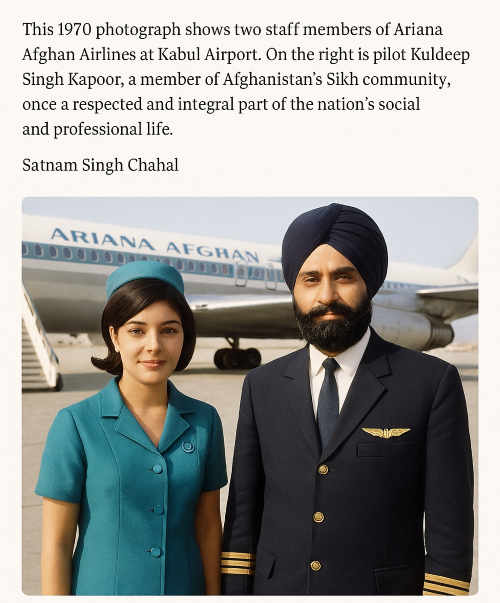
A photograph from 1970, taken at Kabul Airport, offers a poignant glimpse into that era. It shows two staff members of Ariana Afghan Airlines, the national carrier that once connected Afghanistan to cities across Asia and Europe. On the right stands Kuldeep Singh Kapoor, a Sikh pilot whose presence reflects the once-integrated role of Afghanistan’s Sikh community. Wearing a navy blue uniform and turban, Kapoor represents a generation of Afghan Sikhs who served in aviation, business, and civil administration with pride and respect.
Beside him is a young Afghan woman in a turquoise airline uniform, her posture confident and her expression serene. She symbolises the visibility and dignity Afghan women once held in the workforce. During this period, women attended universities, worked as doctors, teachers, and engineers, and were active in government and civil society. Kabul’s streets were filled with women in Western and traditional attire, and girls’ schools flourished across the country.
Ariana Afghan Airlines itself was a symbol of national pride and international connection. Its staff reflected Afghanistan’s ethnic mosaic: Pashtuns, Tajiks, Hazaras, Uzbeks, Sikhs, and Hindus worked side by side. The airline’s routes linked Kabul to Delhi, Tehran, Moscow, Frankfurt, and beyond, projecting an image of a nation on the rise.
This era was not without its challenges, but it was unmistakably moving toward openness, education, and shared citizenship. The social fabric had room for many identities, many languages, and many faiths. The rise of the Mujahideen in the 1980s, followed by the Taliban’s rule in the 1990s, would tragically unravel this pluralism. Minorities fled, women were erased from public life, and institutions collapsed under the weight of ideology and war.
Yet the memory of that earlier Afghanistan, diverse, dignified, and full of promise, remains alive in photographs, in diaspora communities, and in the hearts of those who remember. Kuldeep Singh Kapoor’s image is more than a portrait; it is a reminder that Afghanistan’s true heritage is one of coexistence and possibility.