
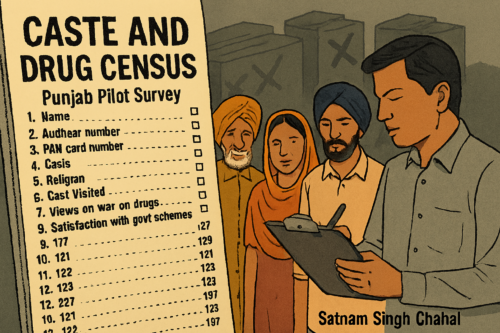
 Chandigarh — A controversial directive from Punjab’s Chief Secretary has ignited alarm across the state. Officials have reportedly been instructed to conduct what is being termed a “Caste and Drug Census,” a sweeping survey that demands citizens answer as many as 127 deeply personal questions.
Among the details sought are Aadhaar and PAN card numbers, caste identity, religious affiliation, attendance at deras, opinions on the government’s war against drugs and gangsters, and satisfaction levels with welfare schemes such as free electricity. Critics argue that the scope of these questions far exceeds any legitimate administrative or welfare purpose, raising concerns of surveillance, discrimination, and political manipulation.
Pilot Villages Raise Red Flags
The exercise is said to have begun in three pilot villages: Lalru in Malwa, Amritpur in Doaba’s Sultanpur Lodhi, and Kotli Shah in Majha’s Ajnala. Civil society groups fear that this pilot could be scaled up into a state-wide survey, potentially creating a vast political database ahead of the 2027 Punjab Assembly elections.
Misuse of Bureaucracy?
Observers warn that such a census could amount to misuse of civil services and public funds for partisan ends. The Chief Secretary, a senior officer of the All India Services, is expected to uphold constitutional norms and service conduct rules. Forcing bureaucrats to collect politically sensitive data risks eroding public trust and undermining the credibility of Punjab’s administrative machinery.
Public Trust at Stake
The move has already sparked debate among academics, activists, and opposition leaders, who see it as an attempt to weaponize governance for electoral advantage. If expanded, the census could reshape the relationship between citizens and the state, turning routine administration into a tool of political surveillance.