
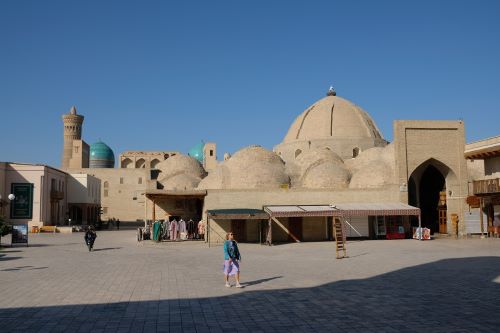
 The ancient trading posts along the fabled Silk Road have captured our imagination for centuries, thanks to not only countless stories about their grand monuments and lively bazaars, but also the cultural and intellectual exchanges between the East and the West that shaped people’s lives. Of all countries crisscrossed by the vast ancient trade routes, Uzbekistan boasts the highest concentration of what are arguably the most beautiful and captivating historical sites in Central Asia, a region at the nexus of the land-based commercial network between Asia and Europe.
We were awed by the magnificence of the centuries-old buildings in Samarkand, a city graced by the likes of the incredibly ornate Registan and the colossal Bibi-Khanym Mosque. But when we came to Bukhara, we were treated to a different ensemble of historical significance. The stately Ark and the photogenic Po-i-Kalyan complex left great first impressions on us. However, we knew there was more to Bukhara than the two places. In fact, both of them beckon visitors to go deeper into the city’s old town district, a relatively compact area that is replete with invaluable heritage buildings constructed during the heyday of the Silk Road.
Unlike Samarkand’s more spread-out historical sites, those in Bukhara are mostly concentrated within approximately 2 square kilometres, the size of the city’s UNESCO-listed historic centre. Walking along the main roads in the largely well-preserved old town, you would immediately notice two types of structures that appear to be a recurring theme in this area: madrasahs (Islamic learning institutions) and toqis (trading domes). This is probably the closest thing one could have when it comes to getting a glimpse of what the ancient Silk Road looked like, where exotic goods were traded, and different faiths were preached.
The madrasahs were in various states of preservation, but the trading domes were never empty. The latter were where I witnessed firsthand the legendary craftsmanship of Bukharan artisans: from miniature illustrations with minute details created by highly-skilled painters, to bird-shaped scissors forged by experienced blacksmiths, there was no shortage of awe-inducing artwork for sale. Obviously, there were more generic items geared toward tourists too, but seeing how the city’s centuries-old traditions were still alive and well was very encouraging.
One of the largest trading domes in the historic centre of Bukhara is the 16th-century Tim Abdullah Khan. Built in the Persian style, the structure was occupied by carpet vendors at the time of our visit. However, despite its location along the main pedestrianised street that connects Po-i-Kalyan with Lab-i Hauz at the very heart of Bukhara’s old town district, only a trickle of visitors checked out this particular trading dome. The prices of the carpets might be high (understandably so since making one requires great skill and a lot of time), but you can just walk in and marvel at the designs of the textile product as well as the structure from the inside. No one pressured us to buy anything, making the little detour a very pleasant experience.
The atmosphere of old Bukhara grew even stronger the deeper we were in the historic center. While each structure was interesting, together they made such a great ensemble of monuments that will likely impress even the most seasoned travellers. During its heyday, Bukhara was a melting pot and a true cultural hub, especially for Persians. It was in this city where Imam Al-Bukhari, one of the most revered and influential figures who collected and interpreted hadiths (actions and sayings of Muhammad), was born. But it was also home to a sizeable Jewish community who developed their own unique traditions. Bukhara was the seat of the Samanid Empire who made it its capital toward the end of the 10th century, and it was here where the court’s poet and musician Rudaki flourished. Even today, more than 1,000 years after his death, he is still celebrated as the most consequential figure in Persian poetry and literature.