
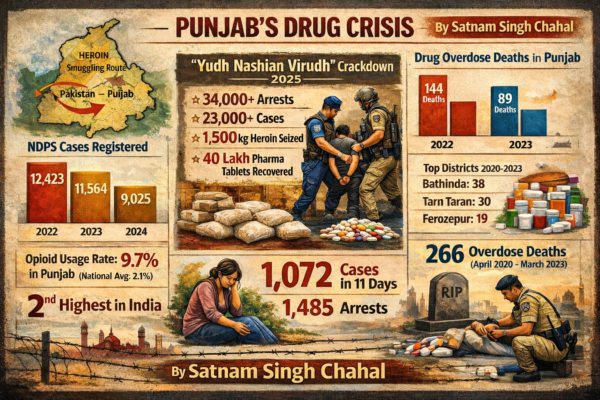
 Punjab has long been grappling with one of the most severe drug crises in India. The illegal consumption of narcotics — particularly heroin, opium, and pharmaceutical drugs — has devastated families, communities, and the social fabric of the state for decades. Despite repeated government crackdowns and awareness campaigns, the problem continues to claim lives and ruin futures at an alarming rate.
When it comes to registered cases under the Narcotic Drugs and Psychotropic Substances (NDPS) Act, Punjab consistently ranks among the top states in India. In 2022, a total of 12,423 NDPS cases were registered, followed by 11,564 in 2023, and 9,025 in 2024 — still the second highest in the entire country despite the declining trend. The year 2025 brought a more aggressive enforcement response. Punjab Police launched a massive crackdown called “Yudh Nashian Virudh” (War Against Drugs) on 1 March 2025, which resulted in more than 34,000 arrests across over 23,000 cases within just a few months. Authorities also recovered over 1,500 kg of heroin and nearly 40 lakh pharmaceutical tablets during this drive. In just the first 11 days of the campaign alone, 1,072 cases were registered and 1,485 persons arrested.
The human cost of this crisis is equally devastating when measured in lives lost. Punjab recorded the highest number of drug overdose deaths in India for two consecutive years. In 2023, the state reported 89 overdose deaths — a decline from 144 deaths the previous year, yet still the highest in the nation. Nationally, the total number of drug overdose deaths in 2023 stood at 654, of which Punjab alone contributed a disproportionately large share. A government report submitted to the Punjab and Haryana High Court further revealed that 266 people died due to narcotic and psychotropic substance overdoses between April 2020 and March 2023. Among districts, Bathinda reported the highest number of such deaths at 38, followed by Tarn Taran at 30 and Ferozepur at 19.
Ground-level data from NGOs adds further depth to this grim picture. One Bathinda-based organisation reported handling at least two to three drug overdose deaths every single month, along with four to five cases of unconscious addicts brought in monthly due to dangerously high doses. The opioid usage rate in Punjab stands at 9.7%, compared to the national average of just 2.1%, underlining how acutely the state is affected relative to the rest of the country.
A significant factor driving the crisis is Punjab’s geography. The state serves as a major transit corridor for heroin smuggled from Afghanistan through Pakistan, before being distributed to other parts of India. Punjab tops the country in drug smuggling cases at 25.3 cases per lakh population, reflecting how deeply entrenched the trafficking networks have become. In response, the state government finalized the Punjab Substance Use Disorder Treatment and Counselling and Rehabilitation Centres Rules, 2025, aimed at streamlining the disbursal of substitute medicines like buprenorphine and preventing their diversion into the black market.While enforcement statistics for the full 2025–2026 fiscal year are still being compiled, it is clear that Punjab’s battle against drugs remains one of the most critical public health and law enforcement challenges facing the state today.
Note on 2025–2026 Data Gap
Specific NDPS case registrations and overdose death figures for the full 2025–2026 fiscal year are not yet available in official reports, as the NCRB annual crime report for 2024 and 2025 had not been fully released at the time of this response. The figures above reflect the most recent verified data. The “Yudh Nashian Virudh” crackdown figures (23,000+ cases) represent the most current enforcement data available for 2025.can you make in paragraphs and also in punjabi12:21 PMHere is the article in both English and Punjabi: