
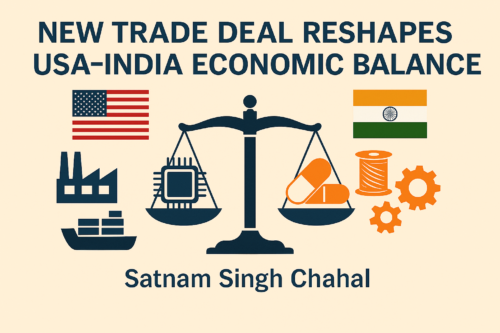
 The current trade relationship between the United States and India has entered a new phase, marked by a significant reduction in tariffs and a renewed commitment to cooperation after years of friction. The latest agreement, finalised in 2026, lowers U.S. tariffs on Indian goods from nearly 50 per cent to around 18 per cent, restoring competitiveness for Indian exporters who had been struggling under the previous tariff regime. In return, India has agreed to ease restrictions on several categories of American industrial, technological, and agricultural products. This shift signals a broader strategic alignment between the two countries, driven not only by economics but also by geopolitical considerations in the Indo‑Pacific region.
Indian exporters stand out as the biggest beneficiaries of this agreement. With lower tariffs in the U.S. market, sectors such as textiles, pharmaceuticals, machinery, and consumer goods regain the price advantage they had lost during the tariff war. Many Indian companies are expected to recover market share and expand their presence in the American market. On the U.S. side, manufacturers of high‑tech equipment, aerospace components, medical devices, and energy technology gain improved access to India’s rapidly growing economy. The agreement also boosts investor confidence, with both countries expecting a rise in joint ventures, infrastructure investment, and technology partnerships.
However, the benefits are not evenly distributed. Indian farmers are widely seen as the most vulnerable group under the new arrangement. Reduced barriers on certain U.S. agricultural products raise fears that cheaper, subsidised American imports could undercut local producers, particularly in dairy, pulses, and grains. This concern has already sparked protests and political resistance within India. Similarly, some U.S. industries—especially those that rely on low‑cost labour, such as textiles, leather goods, and generic pharmaceuticals—may face intensified competition from Indian imports as tariffs fall.
Small manufacturers in India also face challenges. While large export‑oriented companies stand to gain, smaller firms that lack the capacity to compete with American imports may lose domestic market share. Protectionist groups in both countries, who had supported higher tariffs, view the agreement as a compromise that weakens domestic industries. Yet, despite these concerns, both governments see strategic value in strengthening economic ties, especially as global supply chains shift and geopolitical tensions rise.
Overall, the agreement creates clear winners and losers. Indian exporters, U.S. high‑tech manufacturers, and international investors emerge as the primary beneficiaries. Indian farmers, certain U.S. labour-intensive industries, and smaller Indian manufacturers face the greatest risks. In the long term, the success of the agreement will depend on how effectively both countries support vulnerable sectors while leveraging the opportunities created by reduced trade barriers. For now, the deal represents a major step toward deeper economic integration and a more stable partnership between two of the world’s largest democracies