
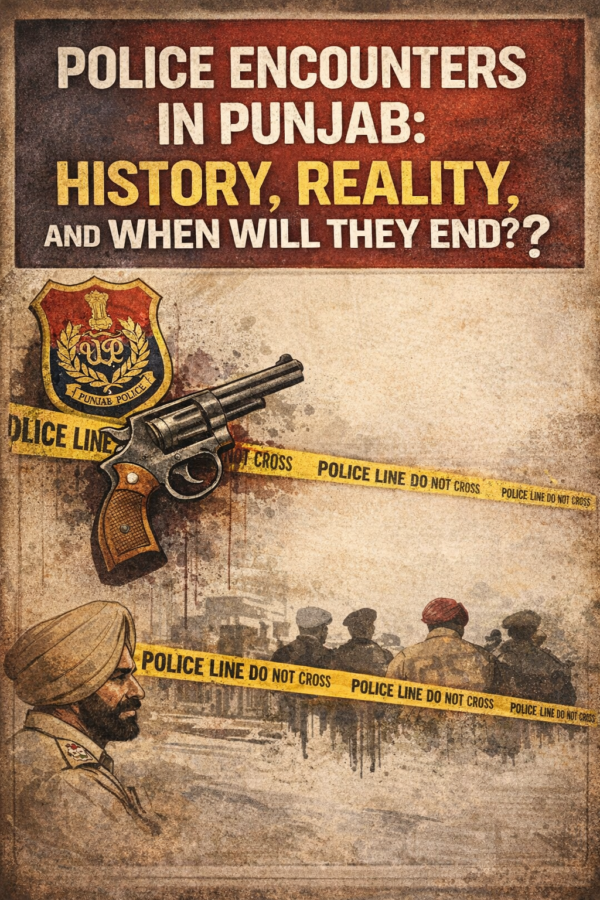
 Police encounters in Punjab have long been a subject of controversy, political debate, human rights scrutiny, and deep public concern. This is not just a law-and-order issue; it is connected to governance, accountability, justice, and the relationship between the state and its citizens. As encounter deaths rise again in recent years, one central question returns: Will there ever be an end to police encounters in Punjab? And if so, when?
The roots of this issue lie in the turbulent 1980s and 1990s, when Punjab was battling a violent insurgency. During those years, the police and security agencies conducted widespread operations. Thousands of people were detained, many disappeared without a record, and numerous deaths occurred in what were officially described as encounters. Families often had no answers about what happened to their loved ones, and even decades later, many continue the search for truth and justice. Human rights activists exposed large-scale secret cremations and identity-less burials, revealing that many killings occurred without trial or due legal process.
One of the most well-known symbols of this era is the 1993 fake encounter case. In that incident, two individuals were deliberately killed and falsely labelled as terrorists to hide the real circumstances of their deaths. A legal struggle of more than thirty years eventually resulted in convictions, but this case highlighted both the weaknesses of the justice system and the unchecked power that sections of the police exercised during those years. The fact that it took decades for victims’ families to receive even partial justice demonstrates how difficult accountability has been in encounter-related cases.
After the insurgency ended, Punjab entered the 2000s with relative peace, but encounters did not disappear completely. Although the number of such cases dropped compared to the earlier era, questions continued to surface about custodial deaths, alleged staged encounters, and the excessive use of force in anti-crime operations. As gang culture, drug trafficking, and organised crime expanded during the 2010s, the police once again adopted aggressive methods, and encounters gradually increased.
Between 2018 and 2026, Punjab witnessed another significant surge in encounter cases. Reports indicate that hundreds of suspects were killed in encounters during these years. In 2025 and 2026, the issue returned to the spotlight when several families alleged that their sons were taken from their homes and later killed in staged encounters. In multiple cases, families claimed that CCTV footage was seized or destroyed, raising further suspicion about the legitimacy of police actions. Such allegations brought renewed calls for independent investigations and strict accountability.
These repeated incidents raise an important question: Is the government enabling a policing system that relies on encounters rather than on due process? Or is the state prepared to uphold democratic values that prioritise justice, transparency, and the rule of law? Courts have, from time to time, expressed serious concern over encounter deaths and ordered independent inquiries. However, despite these judicial interventions, the problem continues to reappear whenever crime rates rise or political pressure increases.
Looking ahead, the end of police encounters in Punjab is possible only if several major reforms take place. First, judicial and legal oversight must be significantly strengthened so that every encounter is automatically subjected to transparent investigation. Second, police training and internal reforms must emphasize human rights, lawful procedures, and non-lethal methods of law enforcement. Third, political interference in policing must be removed so that professional law-and-order decisions are made without pressure to show “quick results” through violent means. Without these structural changes, encounters may reduce temporarily, but are unlikely to end completely.
Ultimately, police encounters in Punjab are not merely episodes of crime-control; they reflect deeper systemic challenges. Ending them will require commitment from political leadership, accountability from police institutions, vigilance from civil society, and sustained action from the judiciary. In a democratic society, the right to life is the most fundamental value, and encounters will truly end only when the state fully commits to protecting that right for every citizen — without exception.