
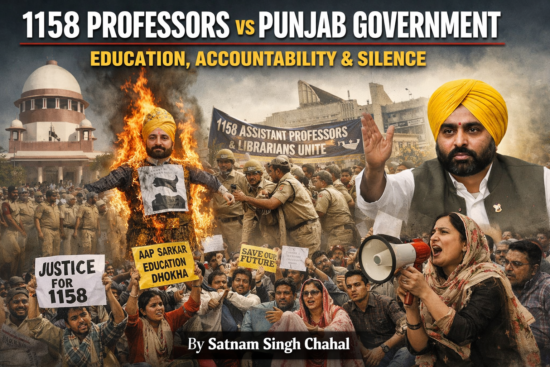
 The ongoing struggle of 1158 Assistant Professors and Librarians in Punjab has evolved into far more than a recruitment dispute; it has become a powerful reflection of governance under strain. What began as a legal and administrative issue has now turned into a political flashpoint, raising serious questions about accountability, priorities, and the state of higher education. At the centre of this storm is Chief Minister Bhagwant Mann, whose government faces growing criticism for its handling of the crisis.
The roots of this issue trace back to 2021, when the Punjab government recruited 1,158 Assistant Professors and Librarians to strengthen higher education. For many, it was the fulfilment of years of struggle and preparation. However, this hope was short-lived. Legal challenges soon emerged, and in 2022, the Punjab and Haryana High Court quashed the recruitment. Though temporary relief came later, the situation took a decisive turn in July 2025, when the Supreme Court struck down the recruitment entirely, citing procedural irregularities. Overnight, hundreds of working educators were pushed into uncertainty, their careers hanging in the balance.
In response, the Punjab government approached the Supreme Court, seeking relief and continuation of services to prevent disruption in colleges. While temporary protection was granted, no permanent solution followed. This prolonged uncertainty became the breeding ground for frustration, eventually spilling onto the streets in the form of protests. Demonstrations intensified throughout 2025, with professors gathering outside official residences, organizing rallies, and publicly expressing their anger over repeated delays and unfulfilled assurances.
The situation has now escalated further in 2026, with reports of protest leaders being detained, especially ahead of political events. These detentions have added a new dimension to the issue—transforming it from a policy failure into a question of democratic rights. The government’s reluctance to engage directly with the protesting professors has only deepened the crisis. Meetings have reportedly been postponed or cancelled, reinforcing the perception that the issue is being avoided rather than addressed.
This brings us to a crucial question: what is the “threat” posed by these 1158 professors? The answer is not rooted in law and order, but in politics and perception. These educators represent a living contradiction to the government’s claims of an “education revolution.” Their protests expose the stark reality of vacant posts, delayed recruitment, and policy paralysis. In doing so, they challenge the narrative that the system is improving. For any government, such a contradiction can become politically uncomfortable.
Another significant factor is the symbolic power of these protests. Punjab is already grappling with unemployment and youth migration. When highly educated individuals professors and librarians take to the streets, it sends a strong message that even the most qualified are not secure within the system. This amplifies public discontent and puts additional pressure on the government.
The question of why Bhagwant Mann has not met the protesting professors remains central to the debate. While legal complexities certainly play a role, they do not fully explain the continued lack of dialogue. Governance, after all, is not just about legal positioning it is about communication and trust. Avoiding direct engagement may help manage immediate political risks, but it also creates a perception of disconnect and indifference.
Critics argue that the government appears more focused on public rallies and messaging than on resolving ground-level issues. This perception, whether entirely accurate or not, is gaining traction. It raises a deeper concern about the nature of governance: is it becoming more about optics than outcomes? If a government cannot sit across the table with its own educators to resolve their concerns, then questions about its priorities are inevitable.
The impact of this crisis on Punjab’s education system is already visible. With a significant number of posts lying vacant, colleges are struggling to maintain academic standards. Students are the silent sufferers in this conflict, facing irregular teaching and reduced academic support. Over time, this could erode the credibility of public higher education institutions, pushing more students towards private options or even out of the state.
At its core, this is not just a dispute over jobs it is a crisis of trust. The 1158 professors are not merely demanding employment; they are asking for stability, dignity, and recognition of their role in shaping the future. Their struggle highlights the gap between promises and delivery, between announcements and action.
If real issues of education and youth cannot be addressed through dialogue with teachers and professors, then the very purpose of governance comes into question. A government is not elected merely to deliver speeches or manage events it is elected to solve problems, especially those that affect the foundation of society.
In the end, the real threat is not from the 1158 professors. The real threat lies in the growing perception that voices are not being heard, that dialogue is being replaced by delay, and that governance is drifting away from accountability. Until these concerns are addressed with sincerity and urgency, the crisis will continue not just on the streets, but in the minds of Punjab’s youth.
#Justice_For_1158 #HigherEducation