
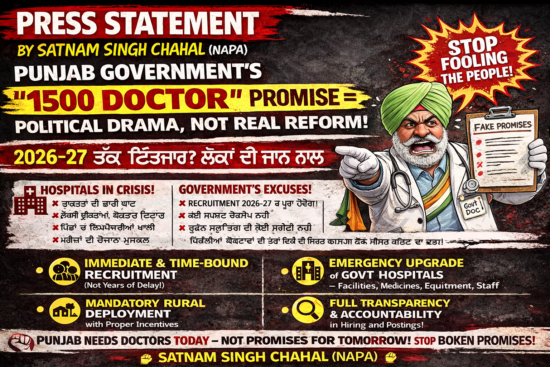
 The Punjab government’s recent announcement to recruit 1,500 doctors has been presented as a major step toward strengthening the state’s healthcare system. On the surface, this initiative appears timely and necessary, especially given the chronic shortage of medical professionals in government hospitals. However, a deeper analysis raises serious concerns about intent, timing, and execution—leading many to question whether this is genuine reform or merely another political promise.
To begin with, the timeline extending to 2026–27 immediately weakens the credibility of the announcement. Punjab’s healthcare system is already under severe strain, with rural dispensaries and primary health centres struggling to function due to a lack of doctors. Patients often travel long distances or depend on private clinics, which are expensive and inaccessible to many. In such a situation, a plan spread over several years appears less like urgent governance and more like delayed action disguised as policy.
Critics argue that if the government truly prioritized healthcare, recruitment should have been fast-tracked, not stretched across years. The delay raises an uncomfortable question: is the government trying to solve a crisis, or simply managing public perception until the next election cycle? Large announcements without immediate implementation often risk becoming headline politics rather than ground-level change.
Another major concern is the lack of clarity on execution. The government has not clearly outlined how these doctors will be distributed, what incentives will be offered for rural postings, or how it plans to ensure retention. Historically, many doctors avoid rural service due to poor infrastructure, lack of security, and limited career growth. Without addressing these core issues, recruitment alone will not fix the system. There is a real danger that newly hired doctors will either seek transfers or leave government service altogether, leaving the rural healthcare crisis unresolved.
Furthermore, the announcement ignores the larger structural problems in Punjab’s healthcare system. Government hospitals continue to suffer from outdated equipment, shortage of medicines, and insufficient support staff. Hiring doctors without upgrading infrastructure is like adding drivers to vehicles that are not roadworthy. Critics rightly point out that healthcare reform requires a comprehensive approach, not isolated decisions.
There is also a growing perception that such announcements are being used as a tool to address unemployment among educated youth, particularly medical graduates. While job creation is important, healthcare policy should not be reduced to an employment scheme. The primary goal must remain patient care, not political optics.
Opposition voices and independent observers have also highlighted the government’s track record of delays and unfulfilled promises in various sectors. In this context, skepticism around the 1,500-doctor recruitment is not unfounded. People are asking: how many similar announcements in the past have actually translated into visible change on the ground?
While the recruitment of 1,500 doctors is undeniably a step in the right direction, the slow timeline, lack of detailed planning, and absence of structural reforms raise serious doubts about its effectiveness. If the Punjab government is truly committed to improving healthcare, it must move beyond announcements and deliver immediate, transparent, and measurable results. Otherwise, this initiative risks being remembered not as a turning point, but as yet another example of promises that sounded good on paper but failed in reality.