
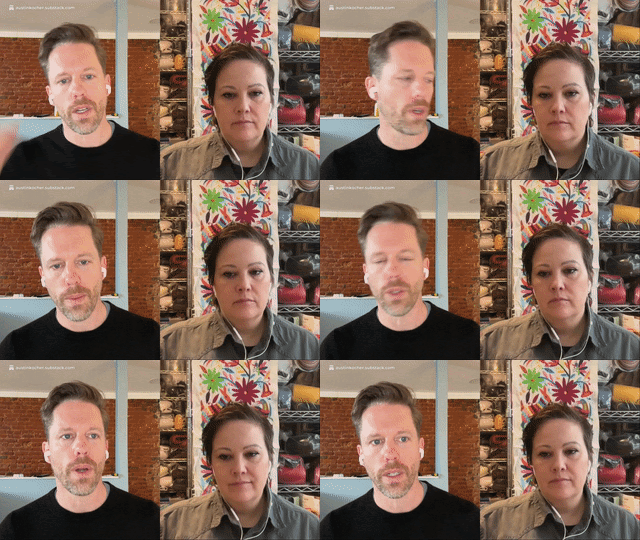
 I first spoke with Julie Moreno back in October, when she and her husband Neff, made the difficult decision for him to self-deport to Mexico after more than twenty years of building a life together in the United States. This week, we reconnected for a live follow-up conversation that focused on what it’s like to sustain a loving marriage across borders and how Julie is using her experience to explain the realities of our harsh immigration system to other Americans.
What struck me most about our conversation is how much ground Julie has covered since October not just personally, but publicly. With Neff no longer in the country, Julie has felt a new kind of freedom to speak out without putting herself and her husband at risk. As she put it, once he left, ICE couldn’t deport him anymore. That shift gave her an ever more powerful voice, and she has been using it to do tremendous good. In the months since we last spoke, she has spoken to a 55-and-over community, a high school, made trips to D.C. to speak to elected officials, and worked with several dioceses to host events at churches throughout the New Jersey area. She’s been out there doing the hard, unglamorous work of explaining to people (neighbors, faith communities, students, reporters) the reality that marrying a U.S. citizen does not automatically protect someone from deportation, and why the law, as written, simply doesn’t function for families like hers.
Our conversation covered a lot of ground: the counterintuitive ways that trying to “do things the right way” (filing paperwork, requesting an ITIN, attempting the I-601A waiver process) can actually expose families to greater legal risk; the emotional reality of separation, which Julie described not as simply being “apart” but as having the life they built together “shattered”; the relief she felt when she visited Neff in Mexico earlier this year and jumped in his car at the airport and it felt like no time had passed at all; and the wider systems of labor exploitation that keep undocumented workers vulnerable and silent. She also talked about the Dignity Act, which AFU supports as the best available legislative vehicle for change—imperfect, as Julie readily acknowledges—but bipartisan, and something real that could give people in her community a protected legal status and the ability to live without constant fear.
About American Families United
American Families United is the leading organization in the country representing U.S. citizens whose spouses face deportation or are barred from obtaining legal status. This affects far more people than most Americans realize, over a million U.S. citizens are estimated to have a spouse who is ineligible for a green card due to outdated and punishing provisions of immigration law, many of them dating back to 1996. AFU is a non-partisan, 501(c)(3) organization that has been fighting for legislative reform since 2006. They don’t just tell stories, they work with AFU Action to show up on Capitol Hill, train members to meet with their representatives, and build the kind of sustained constituent pressure that actually moves legislation.
If you or someone you know is in a mixed-status marriage and trying to understand your options, AFU has put together a comprehensive resources page that is an excellent place to start. It covers everything from legal options and the waiver process to how to connect with local and regional AFU members who have been through this themselves. As Julie mentioned in our conversation, AFU is also actively working to connect families who have recently gone through voluntary departure or self-deportation, so that those who are navigating life across borders don’t have to do it alone.
The legislative centerpiece of AFU’s advocacy is the Dignity Act (H.R. 4393), a bipartisan bill that includes the full text of the American Families United Act. The Dignity Act would, among other things, provide long-term undocumented residents with a legal status and work authorization, not a path to citizenship, but a protected status that would mean spouses of U.S. citizens could finally go to the hospital without fear, report wage theft without threat, and live in the open. It is the most viable piece of legislation currently on the table, and AFU has been instrumental in building the bipartisan coalition behind it.
Connect with Julie and AFU
Julie Moreno is one of the most clear, grounded, and compelling voices I have encountered on this issue. She lives this and she knows how to explain both in a way that meets people where they are whether they’re coming to this for the first time or have been living it for years.
Julie is available for speaking engagements, both in person in the New Jersey region and virtually over Zoom. To invite Julie to speak or to ask questions about her story and AFU’s work, reach out to her directly at [email protected].
You can also follow Julie and AFU’s work on social media:
Julie Moreno on Instagram: @juliemoreno_
Ashley DeAzevedo (Executive Director, AFU Action) on Instagram: @afuashley
American Families United: americanfamiliesunited.org
AFU Resources: americanfamiliesunited.org/resources
AFU Action & the Dignity Act: afuaction.org/american-families-act
If you are a reporter covering immigration and the impact of current policies on U.S. citizens, I want to echo what I said at the close of our conversation: please reach out to American Families United. They are the experts on this, they speak from a nonpartisan and bipartisan position, and they have members whose stories will change how your readers and viewers understand what is happening in this country.
As Julie said near the end of our conversation: “The law is broken. It literally doesn’t function.” The least we can do is make sure people know that and know where to turn.