
 Announcing the repeal of three farm laws passed with a strong parliamentary majority, the Prime Minister acknowledged that his government had failed to convince a section of farmers. The laws designed to open agricultural markets, reduce intermediary control, and enable farmers to sell beyond mandis were withdrawn after a prolonged and intense agitation.
History remembers that episode as a farmers’ movement. That is not incorrect. But it is incomplete.
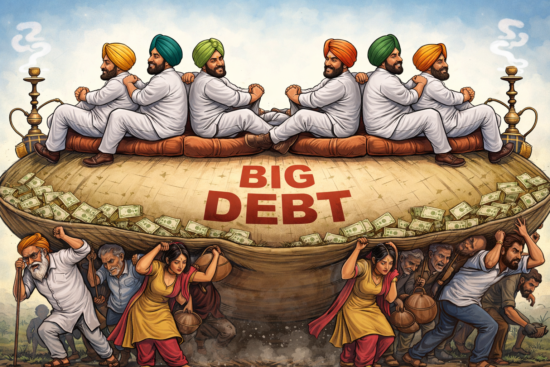
Among the most organised, economically invested, and structurally affected stakeholders in that agitation were Punjab’s arhtiyas the commission agents who sit at the centre of the state’s mandi system. The farm laws, if implemented, would have made them optional. Open trade would weaken the regulated mandi monopoly. The gatekeeper would lose his gate.
The question now is whether Bhagwant Mann is confronting the same structural power and whether he can succeed where long over due reforms once faltered.
From Intermediaries to Power Centres
Arhtiyas were never meant to be power brokers. Their role under the APMC system was to facilitate transactions between farmers and procurement agencies.
Over time, they have evolved into something far more consequential.
Today, they:
Control access to mandis
Manage procurement logistics
Provide informal credit at high rates of interest and inputs at high costs
Influence the flow and timing of transactions
Partner with the other stake holders such as officials, sheller owners
With roughly 45,000 licensed agents handling procurement for lakhs of farmers, this is no longer a support system it is a system within the system controlling the entire procurement system
At its core lies what economists call an interlocked market: the same intermediary provides credit, inputs, and handles the sale of produce. This creates efficiency in the short term but cartel-ed dependency in the long term. Farmers who borrow from an arhtiya typically sell through the same agent, who deducts dues before releasing payment.
This is not a market with middlemen.
This is a market that is the middlemen.
The 2026 Flashpoint
The current confrontation has emerged during the wheat procurement season of April 2026.
As procurement began, arhtiyas launched an indefinite strike with three primary demands:
Restoration of the 2.5% commission (as against the Centre’s ₹50.75 per quintal; at MSP ₹2,585, this equals about ₹64.62)
Reimbursement of EPF-related deductions
Reversal of reduced commissions linked to silo storage
The demands may be negotiable.
The timing is not.
Punjab is expected to procure 122–132 lakh metric tonnes of wheat this season. Early April is peak arrival. Disruptions at this stage send a clear message:
Without arhtiyas, the system slows, if not stalls.
This is not a routine negotiation. It is leverage (arm twisting as Bhagwant Mann says) exercised at maximum pressure.
Mann’s Moment of Decision
The response of Bhagwant Mann marks a departure from past patterns.
He has:
Described the strike as “blackmailing”
Activated cooperative societies as alternative procurement channels
Assured that every grain will be procured
Emphasised that commission structures are largely a Central subject
Most importantly, he has refused to concede under pressure.
This is not without risk. Procurement delays directly affect farmers. Alternative channels are still evolving.
Yet the larger principle is unavoidable:
If the state yields now, it validates their method! Wait for peak dependency, then negotiate through disruption.
Punjab has seen this pattern before. Breaking it requires the state to hold firm, even at short-term cost.
The Real Fault Line: Direct Payments
The deeper roots of this confrontation lie in the shift to Direct Benefit Transfer (DBT) of MSP payments. This was a big reform which happened under the Modi Government.
Earlier:
Payments flowed through arhtiyas
Loans and dues were deducted before farmers were paid
Financial control rested with the intermediary
Now:
Payments go directly into farmers’ bank accounts
Arhtiyas have lost control over cash flows
Their leverage over credit recovery has weakened
This was not a minor administrative change.
It was a transfer of economic power.
The resistance to DBT, including earlier strikes, reflected this shift. The current agitation is part of the same continuum.
The Farm Laws Context
The 2020 farm laws sought to open agricultural trade beyond mandis, weakening the monopoly of regulated markets. The movement that followed drew wide participation and cannot be reduced to a single cause, the primary of which was the fabricated narrative that corporate entry would eventually displace traditional systems a proposition whose long-term validity remains debated. The narrative building was crafted very carefully and the mischief of the corporate taking the lands of farmers, worked very effectively, unfortunately.
However, one aspect is clear:
The mandi system itself was under threat with the monopoly being diluted and bringing competition among buyers
Arhtiyas, as its principal beneficiaries, had the most to lose, financially, monopolistically.
They became influential stakeholders in the agitation
They became the biggest sponsors of the agitation
Recognising this does not diminish the farmers’ concerns. It places the agitation within its full economic context.
Convenience and Control
Arhtiyas continue to provide services that formal institutions struggle to match quick credit, minimal paperwork, and operational ease at interest rates ranging from 1% to 3% per month.
But these advantages come with costs:
Opaque interest structures
Limited competition
Long-term financial dependency
Exorbitant and exploitative rates of interests
Over time, facilitation has become control.
A Fight for the Control
This is not a dispute over commission rates.
It is a contest over control of Punjab’s agrarian economy.
Whether the state retains authority over procurement
Or whether an intermediary network continues to exercise leverage over it
By choosing not to yield, Bhagwant Mann has taken a position that is politically difficult but institutionally necessary.
Conclusion
The wheat is already in the fields, waiting to be procured.
What is at stake now is not just this season, but the state’s ability to govern its own agricultural system.
The real test is whether Punjab can act decisively or continue to operate under pressure.