
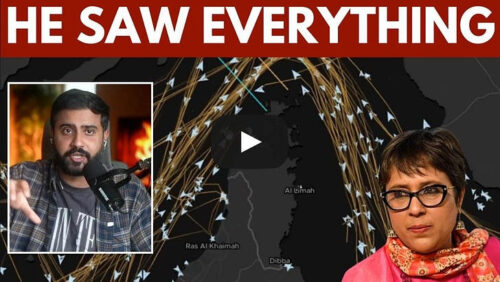
 I watched Barkha Dutt’s live conversation with Bilawal Sidhu with more than ordinary interest. Part of that interest was intellectual; part of it was deeply personal. Bilawal is our elder son, based in Austin, Texas, and he also serves as the Honorary Tech Advisor to The KBS Chronicle. Yet even after making full allowance for a father’s natural pride, I can say without hesitation that this was no routine interview. It was a serious conversation about how war, crisis, and geopolitical disruption are increasingly being seen, understood, and interpreted in entirely new ways.
We are living through a period in which conflict is no longer grasped only through official briefings, delayed reports, newsroom graphics, or stray satellite pictures released after the fact. A new grammar is emerging—one in which war can be tracked live, layered spatially, and reconstructed dynamically as it unfolds.
From reporting events to visualising conflict
What Bilawal has helped build is not just a tool, but a method of observation. Through WorldView, and through the geospatial command environment he described, fast-moving events can be transformed into a live intelligence picture. As the Iran strikes began, his system reportedly tracked satellite passes, GPS jamming, flight diversions, maritime movement through the Strait of Hormuz, and airspace shutdowns across nine countries.
What emerged was something extraordinary: a 4D reconstruction of conflict. Every strike, every rerouted aircraft, every vessel going dark, every shift in the operational landscape could be mapped and replayed minute by minute on a 3D globe.
This marks a profound shift. We are moving from static maps to dynamic spatial awareness; from delayed narration to near real-time synthesis.
Why Bilawal Sidhu stands out
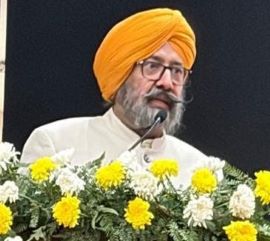
Bilawal Sidhu belongs to a rare category of contemporary technologists—those who can both build and explain. A creator, engineer, and product builder, he has consistently worked at the intersection of imagination and computation, art and science. He is the technology curator for TED Talks and a venture scout for Andreessen Horowitz. He spent six years at Google as a product manager working on spatial computing and 3D maps, and his work has been noticed by major international publications including Bloomberg, Forbes, BBC, CNBC, and Fortune.
What makes him especially interesting, however, is not just his professional pedigree, but his ability to make complex technological systems intelligible to a wider public. In an age where many people speak loosely about AI, Bilawal has shown what happens when AI, geospatial intelligence, visual storytelling, and systems thinking are brought together with clarity and purpose.
Why Barkha Dutt was the right interlocutor
This conversation gained additional depth because it was led by Barkha Dutt. A discussion of this nature needed someone who could go beyond technological fascination and ask what all this means in human, strategic, and geopolitical terms. Barkha’s long experience in conflict reporting made her a natural and effective interlocutor.
She brought the right questions to the exchange: not merely what the technology does, but how it changes perception, how it alters public understanding, and how it may reshape the future of crisis reporting itself.
A father’s pride, but also a larger reflection
As a father, I watched the conversation with pride. But I also watched it as a citizen and a writer, aware that the issues under discussion reach far beyond one individual’s achievements. What is coming into view is a new mode of public intelligence—one in which the physical behaviour of war can be tracked across domains: land, sea, air, signal, and space.
That is why this conversation deserves attention. It was not just a well-conducted interview, nor merely an occasion to appreciate Bilawal’s accomplishments. It was a glimpse into the future of how conflict will be monitored, narrated, and understood.
This was not simply a conversation worth watching.
It was a sign of the times.