
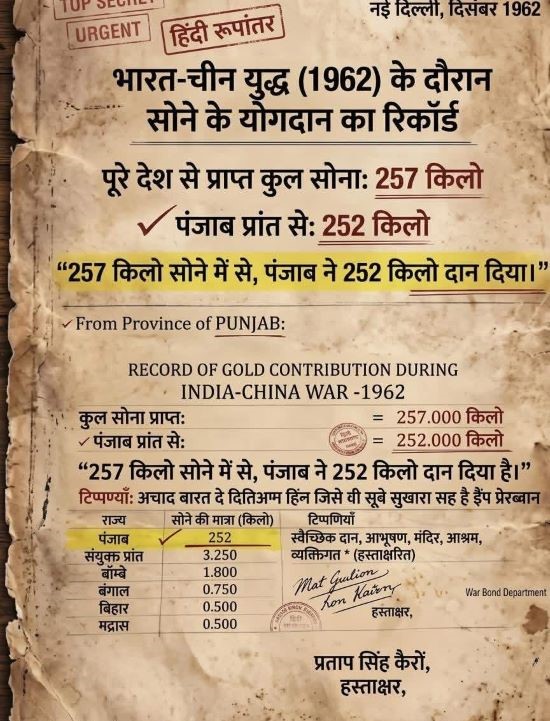
 The story highlighted in the document is not just a statistic it is a powerful reminder of the spirit of sacrifice and patriotism that defined India during one of its most challenging moments. During the 1962 India-China war, when the nation was facing an unprecedented crisis, citizens across the country stepped forward to support the war effort. Among all regions, Punjab emerged as a symbol of unmatched generosity and commitment to the nation.
According to the record, out of a total of 257 kilograms of gold collected from across India, an overwhelming 252 kilograms came from Punjab alone. This staggering figure reflects not only the economic contribution but also the emotional and cultural dedication of the people of Punjab. Families, farmers, traders, and ordinary citizens voluntarily donated their gold often including personal jewellery, heirlooms, and religious offerings without hesitation. This was not an act driven by compulsion, but by a deep sense of duty and national pride.
The contributions were not limited to wealthy individuals. Temples, ashrams, and common households participated equally, demonstrating a collective resolve that transcended class and status. Punjab, known for its rich agricultural base and resilient people, stood firmly with the nation in its hour of need. This act of giving symbolized the true meaning of unity and sacrifice—values that remain deeply embedded in the identity of Punjab.
Beyond the 1962 war, Punjab’s contribution to the nation has been consistent and immense since independence. From ensuring India’s food security during the Green Revolution to providing a large share of soldiers in the armed forces, Punjab has continuously stood at the forefront of national service. The state has played a critical role in feeding the country, defending its borders, and strengthening its economy.
However, this long history of contribution also brings forward a growing sense of imbalance. Many voices in Punjab argue that despite decades of sacrifice and service, the state has not received its fair share in return. Long-standing issues such as the status of Chandigarh, control and management of river waters, and concerns surrounding institutions like the Bhakra Beas Management Board (BBMB) continue to remain unresolved. These matters are often seen not just as administrative disputes, but as symbols of perceived neglect and imbalance in federal decision-making.
The contrast between Punjab’s past contributions and its present challenges is stark. Today, the state faces serious concerns including healthcare gaps, rising debt, unemployment, and agrarian distress. For many, this raises an important question: has a state that contributed so much to the nation’s strength been adequately supported in return?
The legacy of Punjab’s contribution during the 1962 war and since independence should not merely remain a historical footnote. It should serve as a reminder and inspiration for governance rooted in fairness, recognition, and balanced development. A state that has given so much to the country deserves not only acknowledgment but also meaningful policy attention to address its current challenges.