
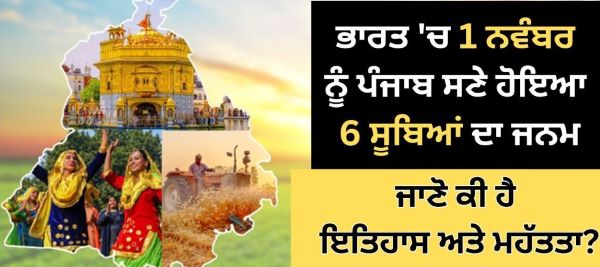
 Punjab Reorganisation Act 1966: A Turning Point that Reshaped the State and Its Political Leadership. The Punjab Reorganisation Act, 1966 (Act No. 31 of 1966), passed on 18 September 1966, marked a historic turning point in the political and administrative landscape of northern India. This legislation led to the creation of the new state of Haryana, the transfer of certain hilly regions to Himachal Pradesh, and the establishment of Chandigarh as a Union Territory to serve as the shared capital of both Punjab and Haryana. These changes officially came into effect on 1 November 1966, a date now recognized as the “Appointed Day” of reorganisation.
Following this reorganisation, Giani Gurmukh Singh Musafir became the first Chief Minister of the newly structured Punjab on 1 November 1966, representing the Indian National Congress. His tenure was relatively short, ending on 8 March 1967, after which Gurnam Singh of the Shiromani Akali Dal assumed office. Political instability marked this early phase, with frequent changes in leadership, including Lachhman Singh Gill and multiple periods of President’s Rule imposed by the central government.
The late 1960s and early 1970s saw continued shifts in governance, with Gurnam Singh returning for a second term, followed by Parkash Singh Badal, who would go on to become one of Punjab’s most influential and long-serving leaders. However, this period was again interrupted by President’s Rule, reflecting ongoing political turbulence in the state.
A relatively stable phase began in 1972 under Zail Singh of the Congress party, whose tenure lasted until 1977. Despite this stability, Punjab again experienced intermittent central rule and leadership changes, including the return of Parkash Singh Badal in 1977. The 1980s, however, were marked by significant unrest and instability, leading to extended periods of President’s Rule, especially between 1983 and 1985, and again from 1987 to 1992.
The mid-1980s briefly saw elected governance under Surjit Singh Barnala, but political instability soon returned. A major shift occurred in 1992 when Beant Singh of the Congress party assumed office, initiating efforts to restore normalcy after years of militancy. His tenure was followed by Congress leaders Harcharan Singh Brar and Rajinder Kaur Bhattal.
From 1997 onwards, Parkash Singh Badal re-emerged as a dominant political figure, serving multiple terms and becoming the longest-serving Chief Minister in Punjab’s history. His leadership spanned from 1997 to 2002, and again from 2007 to 2017, representing the Shiromani Akali Dal. Between these tenures, Amarinder Singh of the Congress party served from 2002 to 2007 and later returned for a second term from 2017 to 2021.
In more recent years, Punjab witnessed rapid political changes. Charanjit Singh Channi became the state’s first Dalit Chief Minister in September 2021, although his tenure lasted only until March 2022. He was succeeded by Bhagwant Mann of the Aam Aadmi Party, who assumed office on 16 March 2022 and continues to serve as the incumbent Chief Minister.
Overall, the post-reorganisation history of Punjab reflects a dynamic and often turbulent political journey, marked by frequent leadership changes, periods of central intervention, and the emergence of key political figures. Among them, Parkash Singh Badal stands out as the longest-serving Chief Minister, while Giani Gurmukh Singh Musafir holds the distinction of being the first leader of Punjab after its reorganisation.