
“ State legislatures are now free to gerrymander legislative districts to systematically dilute and weaken the voting power of racial minorities — so long as they do it under the guise of ‘partisanship’ rather than explicit ‘racial bias.’”— Barack Obama, responding to the United States Supreme Court ruling in Louisiana v. Callais, 29 April 2026
Even as television channels remain immersed in the cacophony of exit poll results from West Bengal, Tamil Nadu, and the other states that have just gone to the polls — assessments propounded with great authority by those who offer no verifiable basis for their projections — I have been pondering something of far greater and more durable consequence. It was triggered on 29 April 2026 by a seminal verdict of the United States Supreme Court: a ruling that has direct relevance to India, not in terms of legal applicability, but in terms of the technicalities, legalities, and politics of the delimitation of seats. While the noise of exit polls fills the airwaves and the morning papers are consumed by what may or may not happen in the next few days, what I am about to describe will determine the shape of Indian democracy for the next three to four decades.
I am writing this as an open letter to every president of every national and regional political party, and to every Chief Minister of every state in India. A decision is expected to prepared — quietly, administratively, without public fanfare — that will govern electoral representation in this country long after the current exit poll controversies are forgotten. The window to shape it is open right now: not after the census is published, not after the Commission is constituted, and certainly not after the awards are gazetted. By the time the ink dries on a Delimitation Commission’s order, the Constitution itself forbids the alteration of a single line of it. Agitation at that stage is not merely futile — it is constitutionally illiterate.
Barack Obama said what he said about America. I am saying something different about India — not a counsel of despair, but a caution delivered while there is still time to act. India’s legal architecture has not been dismantled the way America’s has. But an architecture that is not actively defended becomes, by default, an architecture that is quietly circumvented. That is what I want you to understand. And to act upon.
KBS Sidhu
On 29 April 2026, the Supreme Court of the United States, in a 6-3 ruling divided strictly along ideological lines, effectively gutted Section 2 of the Voting Rights Act of 1965 — the provision that had for six decades protected minority communities from having their electoral strength diluted through manipulated boundary-drawing. Justice Samuel Alito, writing for the Republican-appointed majority in Louisiana v. Callais, held that a state legislature need only assert a partisan or administrative rationale for its constituency map, and the door to legal challenge by minority communities closes permanently. The cover of ‘partisanship’ becomes an impenetrable shield for what is, in substance, the engineering of minority powerlessness.
Obama’s response named the mechanism precisely: the ruling frees state legislatures to ‘systematically dilute and weaken the voting power of racial minorities — so long as they do it under the guise of partisanship rather than explicit racial bias.’ He called it a failure of the Court’s ‘vital role in ensuring equal participation in our democracy and protecting the rights of minority groups against majority overreach.’ His proposed remedy was emphatically political rather than legal — sustained civic mobilisation at every level of electoral participation — because the legal backstop had been judicially demolished.
I cite this not to compare India’s system to America’s — they are structurally different in ways that matter — but because the ruling names, with judicial precision, the mechanism by which democratic boundary-drawing becomes demographic manipulation: administrative rationalisation deployed as cover for political engineering. That mechanism is not an American invention. It travels. And India’s upcoming delimitation exercise, the most consequential since independence, is precisely the terrain on which it could operate if the rules governing the process are allowed to remain imprecise.Before this letter turns to delimitation — the structural, generational question — it must address the immediate one, because it is live and approaching rapidly.
The Special Intensive Revision of electoral rolls — the SIR — conducted ahead of the 2026 assembly elections in Bihar, West Bengal, and other states, demonstrated what happens when a legitimate electoral housekeeping exercise is conducted under a compressed timeline with inadequate adjudicatory safeguards. In West Bengal, over 27 lakh voters were deleted from electoral rolls through a process so compressed that the Supreme Court itself acknowledged adjudicating officers could not be expected to get more than seventy per cent of decisions right. Names were erased. People who had voted in every election since 2002 found themselves disenfranchised weeks before polling day. The concept of ‘logical discrepancy’ — invented specifically for this exercise and never previously applied in Bihar, Gujarat, or Uttar Pradesh — became the administrative alibi for mass exclusion.
With Uttar Pradesh and Punjab both facing assembly elections in early 2027, the SIR is certain to extend to both states. The minority communities in western UP and the border districts of Punjab — already vulnerable to identity document irregularities arising from partition-era migration, post-independence administrative gaps, and the layered complexity of refugee settlement — face particular exposure.I want to be precise about what the SIR does and does not do, because the distinction is critical.The SIR threatens the individual voter.
A citizen who is genuinely eligible and finds a name deleted has recourse: claims, objections, appeals before Electoral Registration Officers, and ultimately the courts. That remedy is imperfect, compressed, and exhausting, but it exists and it must be pursued. Every party organisation, every booth-level worker, every legal cell must be mobilised now in every constituency in UP and Punjab to ensure that not one eligible voter is lost without a fight. This is urgent. This is for 2027.
.
A voter wrongly deleted today can, through the claims process, be restored before the next election. A constituency wrongly drawn — one that fragments a geographically concentrated community across three seats where it once had critical mass in two — cannot be corrected until the next delimitation exercise. Given constitutional freeze provisions and administrative timelines, that is a decade or more away. The SIR operates on the timescale of a single election cycle. A flawed delimitation award operates on the timescale of a generation. Obama told American citizens to mobilise because the courts had failed them. I am telling Indian citizens something more specific and more demanding: the SIR demands mobilisation for 2027; delimitation demands mobilisation now, before the Commission is even constituted, for 2030, 2035, and 2040.
The most consequential and least discussed dimension of the forthcoming delimitation is what the failure of the Constitution (131st Amendment) Bill, 2026 has now made constitutionally inescapable.That Bill — which proposed to expand the Lok Sabha from 543 to 850 seats and conduct delimitation on the basis of the 2011 census — was defeated in the Lok Sabha on 17 April 2026. It received 298 votes, against the 352 required for the two-thirds majority mandated by Article 368. The accompanying Delimitation Bill, 2026 was thereupon withdrawn. It was the first time in twelve years that the government failed to carry a constitutional amendment. The federal anxieties it sought to address — the fear of southern states that population-proportionate reallocation would penalise their demographic discipline — remain entirely unresolved by legislation.
What remains, unmodified and unmediated, is Article 81 of the Constitution. And Article 81, once the post-2026 census figures are published, will come into full operation for the first time since 1973.Article 81(2) is unambiguous in its command. Seats in the Lok Sabha must be allocated to each state in such manner that the ratio between the number of seats and the population of the state is, ‘so far as practicable, the same for all States.’ Within each state, constituencies must be drawn so that each represents, as far as practicable, an equal population. The only exemption is for states whose total population does not exceed six million — a threshold protecting very small states and certain Union Territories, with no application to any major state. For every other state, the principle admits no qualification: one citizen, one vote, one value.
For fifty-two years, this constitutional command was suspended by amendment. The 42nd Amendment of 1976 froze the inter-state seat allocation on 1971 census figures. The 84th Amendment of 2002 extended that freeze until the first census after 2026. The political rationale was defensible: states that had controlled their population growth should not be penalised with reduced parliamentary representation. The freeze was a federal bargain. But it has now expired by its own terms. No fresh constitutional amendment has replaced it. The 131st Amendment that attempted to soften the consequences — so that no state lost seats in absolute terms even as proportional shares shifted — has failed.
The consequence is irreversible short of a fresh constitutional amendment requiring the same two-thirds majority the government has already failed to secure. States whose populations have grown fastest — principally Uttar Pradesh, Bihar, Madhya Pradesh, and Rajasthan — will gain seats. States whose demographic discipline has been greatest — Tamil Nadu, Kerala, Karnataka, Andhra Pradesh, and Telangana — face proportional reduction. No instruction in the Commission’s terms of reference, no act of Parliament short of a fresh constitutional amendment, and no exercise of Commission discretion can alter this.
To the Chief Ministers of the southern states, I say this in particular: the time to negotiate the terms of this exercise — through the content of the Commission’s mandate and the structure of its hearings — is before the Presidential Order constituting the Commission is notified. After that, your options narrow to legal submissions and public objections. Both remain available. Neither can alter the constitutional arithmetic.
And to every party president reading this: the Women’s Reservation Act — the Nari Shakti Vandan Adhiniyam, enacted as the Constitution (106th Amendment) Act, 2023, and notified into force on 16 April 2026 — cannot be operationalised until the delimitation exercise is complete. The one-third reservation for women in the Lok Sabha and state assemblies, which this Parliament passed with unanimous acclaim, is now linked directly to the quality and integrity of the delimitation process. A compromised delimitation produces compromised women’s reservation. You cannot separate the two.
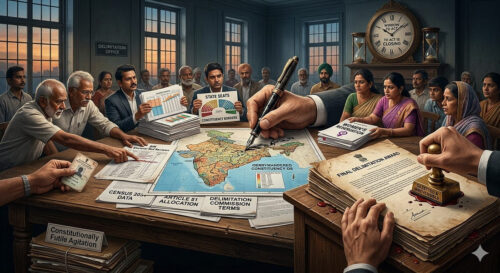
Article 81 governs the inter-state arithmetic. It is a constitutional command and it will do what it does. What is manipulable — and what most politicians and most citizens do not focus on until it is too late — is the intra-state dimension: how constituency boundaries are drawn within each state, which communities are concentrated together and which are dispersed across multiple seats, and whose voting weight is amplified or diluted by where the line falls.
That is determined by the terms of reference that the Central Government sets for the Commission through a Presidential Order, before the Commission is constituted. These terms define what the Commission must consider, how it must balance population equality against geographic compactness, community concentration, and administrative unit boundaries, and whether it is explicitly required to assess and record the impact of its proposed configurations on the voting strength of identifiable geographically concentrated communities. Once that Order is notified, it is not publicly revisable. The Commission works within it. Its awards follow from it.
A Commission given broad discretion and imprecise instructions can take a Muslim-majority concentration in western Uttar Pradesh, a Dalit-dense belt in coastal Andhra, a Sikh-majority cluster in the border districts of Punjab, or a tribal concentration in the Jharkhand-Chhattisgarh corridor — and distribute it across three constituencies, citing contiguity and administrative unit integrity as justification. The result is indistinguishable from deliberate dilution. The award will be formally unimpeachable. Nagaon in Assam is not a theoretical illustration — it is a documented outcome. Post-delimitation fracturing of Muslim voter concentration there measurably altered representation without a single line of the award being constitutionally assailable. The engineering happened in the instructions, not in the award itself.
I am asking every party president and every Chief Minister reading this letter to submit formal written representations to the Central Government now, before the Presidential Order is framed, demanding terms of reference that explicitly require the Commission to assess and record the representational impact of its proposals on geographically concentrated communities, and to provide written reasons — not conclusions — for any configuration that diminishes that impact. This is not a demand for communal reservation in delimitation. It is a demand that a quasi-judicial body behave as quasi-judicial bodies are constitutionally required to behave: with reasoned, documented, publicly accountable transparency.
The Delimitation Commission’s public hearings are mandatory under the Delimitation Act. They are also, historically, the site of the greatest missed opportunity in Indian electoral politics. Community organisations appear and assert. The Commission listens and proceeds. Awards are gazetted. Outrage follows — and accomplishes nothing, because the Act forbids modification and the courts will not substitute their judgment for the Commission’s on questions of discretion.
The West Bengal SIR established, at brutal cost, what happens when an adjudicatory process is allowed to operate without accountability for its reasoning. Adjudicators were not required to examine all documents submitted. Reasons were not recorded. The Supreme Court acknowledged the inadequacy and could do little more than observe it. Delimitation hearings carry the same structural risk at a far larger scale. The Commission must not be permitted to proceed in silence.
Effective engagement at the hearing stage requires three things. First, any organisation representing an affected community must come armed with constituency-wise demographic maps demonstrating population concentrations before and after the proposed delimitation — not assertions, but data. Second, objections must quantify, as far as electoral history permits, the shift in representational probability that proposed boundaries would produce. Third — and this is the one that creates legal traction — the Commission must be formally asked to record written reasons for rejecting any data-supported objection. A reasoned rejection order, even if adverse, constructs the factual architecture for the only judicial intervention that remains available after an award: a challenge on grounds of jurisdictional excess under the basic structure doctrine. A Commission that cannot explain its reasoning has exceeded its mandate. Make it explain.
To the Citizens and the Political Parties: Mobilise Now, Not After the Ink Dries
Barack Obama told American citizens to mobilise because the courts had failed them and the legal architecture had been stripped away. I am telling Indian citizens, and the NGOs that claim to represent them, something more specific and more demanding: mobilise now, at the pre-notification stage — before the Presidential Order is framed — not at the street level, but through organised, documented, legally grounded representations to the Central Government on the content of the Commission’s mandate.
The SIR is coming to your state before your next election. Every eligible voter in Uttar Pradesh and Punjab must know the claims and appeals process and must be helped to use it. Party workers, civil society organisations, legal aid networks, gurudwara committees, mosque committees, community panchayats — all of them must become, immediately, voter registration and voter protection agencies. This is the battle for 2027, and it is fought at the level of the individual name on the roll.
But delimitation is the battle for 2030, 2035, 2040, and beyond. It is fought at the level of the Presidential Order, the Commission’s terms of reference, the quality of the submissions placed before the hearing, and the insistence that every rejection be reasoned. A constituency wrongly drawn will not be redrawn because you held a rally. It will be redrawn only at the next delimitation exercise — a decade away at minimum, and only if the same mistakes are not repeated.
The injury inflicted by a wrongful SIR deletion is individual and recoverable. The injury inflicted by a wrongful delimitation award is collective and generational. The response must be calibrated to that difference.
I have spent four decades inside the administrative machinery of this country, including having served as Election Observer in three Lok Sabha elections — 1999, 2004, and 2014. I have watched Presidential Orders framed, Commissions constituted, and hearing processes managed. I know exactly how much of the outcome is decided before the Commission holds its first public session. The window between today and the notification of the Commission’s mandate is the only window that matters. It is not a large window. It will not stay open.
To the various political parties, especially those in the Opposition, I earnestly say this: do not wake up after the drafts are finalised, the notifications issued, and the statutory framework gazetted, and then run to legal experts who are themselves angling for Rajya Sabha seats, asking what can still be done. The Constitution’s answer at that stage will be brutally simple: nothing — not without a two-thirds majority you do not possess. The time to act is now, before the pen moves, before the mandate is sealed, and before the political ground beneath your feet is permanently redrawn. This is my free and unsolicited advice.