
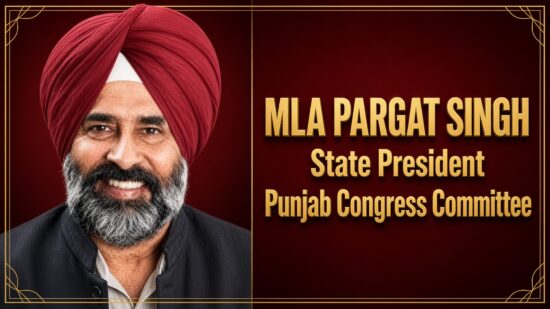
Chandigarh-Punjab Pradesh Congress Committee president Pargat Singh has strongly criticised the Aam Aadmi Party (AAP)-led Punjab government after he and Patiala MP Dr Dharamvira Gandhi were reportedly denied permission to meet Youth Congress leaders lodged in Patiala Central Jail. The Congress leaders had visited the jail on Saturday to meet Punjab Youth Congress president Shubham Sharma, popularly known as Shubhi, and other party workers arrested following a protest outside the Punjab Public Service Commission (PPSC) headquarters in Patiala.
The incident has triggered another political confrontation between the Congress and the ruling AAP government, with the Opposition accusing the state administration of attempting to suppress questions about alleged irregularities in government recruitment processes.The controversy centres on allegations of irregularities in the Punjab Civil Services (PCS) Mains examination recruitment process. Several aspirants have questioned aspects of the examination results, which were declared on November 4, 2026. Candidates have reportedly raised concerns about examination-centre-wise selection patterns, consecutive roll numbers among shortlisted candidates, attendance records and the handling of examination results.
Punjab Youth Congress activists organised a protest outside the PPSC headquarters in Patiala, demanding transparency and an impartial investigation. However, the protest escalated when demonstrators allegedly entered the commission’s premises, locked the main entrance and obstructed government officials from carrying out their duties.Police registered an FIR in connection with the incident, booking protesters on charges that include obstructing public servants, forcibly entering government premises and damaging public property. Punjab Youth Congress president Shubham Sharma and other activists were arrested, with several subsequently sent to judicial custody.
The police action has become a major political issue, with Congress leaders arguing that the government should address the recruitment-related questions instead of taking action against those raising them.After being denied permission to meet the detained workers, Pargat Singh accused the Bhagwant Mann government of adopting what he described as a dictatorial approach towards political opposition.
He questioned why elected representatives were not being permitted to meet their party colleagues and argued that demanding an impartial investigation into alleged irregularities in PCS recruitment should not be treated as a criminal activity.Pargat Singh also accused the government of applying different standards when dealing with political demonstrations and protests. Referring to the alleged vandalism at the Enforcement Directorate office in connection with the GMADA matter, he questioned the government’s response to that incident compared with the police action against Youth Congress activists.
He maintained that intimidation, arrests and legal proceedings would not stop the Congress from raising questions concerning the future of Punjab’s unemployed and educated youth.Expanding his criticism beyond the PCS examination, Pargat Singh referred to allegations concerning the Greater Mohali Area Development Authority (GMADA) and Baba Farid University of Health Sciences.He raised questions about an alleged ₹10,000-crore irregularity involving GMADA and demanded accountability over reported irregularities in recruitment and examination-related matters at Baba Farid University.
These allegations have added another dimension to the political debate in Punjab, with the Congress demanding independent investigations into different government departments and recruitment processes.However, allegations of corruption and irregularities must be established through proper investigations and legal proceedings. No individual or institution should be treated as guilty merely because allegations have been made.
Meanwhile, the denial of permission to meet the detained leaders has also generated questions about prison visitation procedures.According to reports, Patiala Central Jail Superintendent Gurcharan Singh Dhaliwal maintained that meetings with undertrial prisoners are governed by jail regulations. He stated that family members are ordinarily permitted to meet inmates, while other visitors require special grounds and their names must be included in the relevant list provided by the prisoner.
This explanation presents the jail administration’s stated position, while the Congress has questioned the manner in which the rules were applied in this particular cases.
The PCS recruitment controversy has also reached the judicial arena. The Punjab and Haryana High Court reportedly stayed the ongoing PCS and Allied Services selection process on November 19 and sought the complete recruitment record. The matter has been listed for further hearing on December 16.The legal proceedings are significant because the concerns raised by candidates now require examination through the appropriate judicial and administrative processes. The Punjab Public Service Commission and the state government have maintained that the examination process was conducted fairly and transparently, rejecting allegations of irregularities.
The latest confrontation highlights a larger issue facing Punjab: public confidence in government recruitment.
Thousands of young people spend years preparing for competitive examinations, often investing considerable financial resources and personal effort. For them, transparency in examination procedures, evaluation, shortlisting and final selection is essential.Whether the allegations concerning PCS recruitment, GMADA or Baba Farid University are ultimately established or rejected, the government must ensure that credible questions receive clear and evidence-based answers.
At the same time, political protests must remain within the framework of the law, and allegations of unlawful conduct during demonstrations must be examined through due legal process.The AAP government faces an important test in addressing the concerns of young aspirants, while the Opposition must pursue its allegations through documented evidence and democratic institutions.The central issue is not simply whether Congress leaders were allowed to meet their colleagues in jail. It is whether Punjab’s recruitment institutions can maintain public confidence through transparency, accountability and procedures that leave no room for suspicion.
Disclaimer: This article and accompanying images are for informational and illustrative purposes only. Some visuals may be AI-generated or digitally enhanced and may not depict actual events or persons.Views expressed are based on publicly available information and analysis
By Satnam Singh Chahal | Punjab Outlook — Political Analysis