
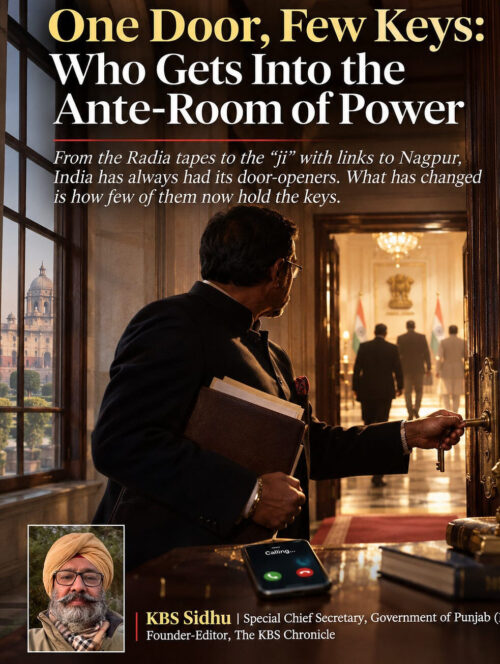
 In every system, under every government since 15 August 1947, there has been a class of people whose real trade is not policy but proximity. Call them middlemen, fixers, facilitators, liaison men, or (in the politer vocabulary of the corporate brochure) “government relations”. Their service is simple to describe and hard to price: they open a door. What happens once you are inside the room is, in the end, your own affair. The case still has to be argued, the file still has to move, the Minister still has to be persuaded. But the door has to be opened first, and in New Delhi doors have never opened by themselves.
I do not write this as an outsider peering in. Over thirty-seven years in the IAS, across districts, the State Secretariat and a spell in the Government of India, I met the whole spectrum, from the humble “liaisoner” who knew which section officer had a file on his table, to the polished consultant who knew which Joint Secretary would be on the Minister’s flight. Most were harmless. A few were useful. Some were dangerous. None was ever absent.
The Radia Recordings: When the Ante-Room Was Overheard
The one time the country heard this trade at work was the Radia episode. Between 2008 and 2009, acting on a complaint made to the Finance Minister, the Income Tax Department put the telephones of corporate lobbyist Niira Radia under surveillance, and some 5,800 calls were recorded. In November 2010, in the thick of the 2G storm, portions leaked. Politicians, industrialists, bureaucrats and journalists were heard talking to one another as if the public were not in the room, discussing alliances, portfolios and how a story ought to be framed.
The late Ratan Tata went to the Supreme Court on 29 November 2010, on the ground of privacy, and later told the Court that the leak was the product of corporate rivalry. In 2013 the Court observed that the conversations revealed deep-rooted malice by private enterprises in connivance with government officials, and asked the CBI to examine fourteen issues. Nine years later, in September 2022, the CBI told the Court it had found no criminality.
So the lesson of Radia was never criminality. The lesson was plurality. There were many lobbyists, many clients, rival business houses, coalition partners with their own demands, and competing editors with their own sources. It was an ugly market. But it was a market, and markets have a way of exposing their own players, which is precisely how those tapes reached the public.
From Lutyens to Khan Market: The Vocabulary Changes, the Trade Does Not
After 2014 came a new vocabulary of exclusion: “Lutyens’ Delhi”, the “Khan Market gang”, “urban Naxals”, “award wapsi”. The old courtiers were told, loudly, that they were no longer welcome. Many genuinely lost access: the cocktail-circuit editors, the club-house consultants, the retired mandarins with a fat telephone diary and nothing else to sell. A good number of citizens saw that as a long-overdue cleansing, and I would not entirely disagree with them.
But nature abhors a vacuum, and so does Delhi. Doors that close for the many do not necessarily close for all.
Not Many Middlemen, but a Chosen Few
What follows is about perception, not an allegation of wrongdoing against anyone. In public life, however, perception is itself a fact that a government must reckon with, because a citizen who believes the game is rigged behaves as though it is.
In the business world, no group is more closely identified in the public mind with the present dispensation than the Adani Group. Ports, airports, power, coal, green energy, cement and, since 2022, a television network: the footprint has grown at a pace that has made “Adani” an Opposition talking point for years. The legal record must be stated fairly. In September 2025, SEBI, in two orders, found no stock manipulation or related-party violations on the Hindenburg allegations; in September 2026, five group companies settled certain disclosure and audit proceedings for about ₹1.5 crore, without admission; in the United States, the November 2024 indictment was dismissed with prejudice in May 2026, and the parallel SEC civil matter was settled without admission or denial. The group has consistently denied any wrongdoing. I do not allege that any policy was tailored for any group.
And yet the perception has scarcely moved. That is the point. The question is not whether rules were broken. It is why so many Indians believe that doors open more readily for one house than for its rivals, and why the system offers no transparent way of showing otherwise.
In the world of news, a parallel perception attaches to ANI. A private agency founded in 1971 by Prem Prakash, it has been close to governments of every hue; in its early TVNF avatar it made films for Doordarshan. Critics, Newslaundry among them, argue that under the present government its access has become unrivalled: the first microphone at the airport, the first footage of the Prime Minister’s events, and, as that portal reported, the only private media house permitted into the sanctum sanctorum during the Ram Mandir consecration in January 2024. ANI’s editor-in-chief rejects the “godi media” label, and her riposte deserves a hearing: that NDTV once enjoyed unprecedented access, not only under the Congress but under the Vajpayee and Narasimha Rao governments as well.
Take her at her word, and the argument proves my thesis rather than refuting it. The favourite changes. The favouritism endures. (There is a further irony, unremarked by either side, that NDTV itself now belongs to the Adani Group.)
There is a third variety of doorkeeper, harder to photograph. In the corridors one keeps hearing of people who are “supposed to have links with Nagpur” (readers will need no help with the postcode). They are seldom on a dais and almost never in a newspaper. They go by a first name and that all-important suffix, “ji”, and hardly ever by a surname. In India a surname reveals a great deal, region, community and, more often than not, caste, and one is tempted to wonder whether its absence is a quiet camouflage, keeping a Brahmin or Baniya lineage out of the conversation. Not that every such “ji” is a Brahmin or a Baniya; the point is that a surname, written openly, would reveal it one way or the other. Whatever the reason, the price of a door opened this way, as the stories go, is seldom paid in cash. It is paid in ideological surrender, or at least barter: a speech re-worded, a column softened, a past politely disowned.
The legal world has its own version. In virtually every bar room across the country, one hears of influential advocates who are rarely seen on their feet before a bench, yet whose names surface behind an unusual number of happy endings, whether by “settling” matters (the pun is intended) or by means no one can quite describe. I cannot prove any of this, and I suggest nothing about any judge. But in those bar rooms it is treated as something of an axiom, and anyone who argues otherwise is gently told he is naive.
One Door, One Key
The Radia era was a crowded ante-room: noisy, unedifying, but with many doors and many keys in many pockets. The present era, as the public perceives it, resembles a palace that has bricked up its side entrances and cut a master key, or two or three at most. A crowded bazaar of influence is corrupting. A monopoly of influence is something worse, because it removes even the competition that once let rivals expose one another. The Radia tapes surfaced because there were rivals. Who leaks when there is only one tenant in the ante-room?
Exclusion is not reform. A single window is a fine thing for an investor; a single key is a dangerous thing for a republic.
What a Sensible Republic Would Do
None of this needs a witch-hunt. It needs rules that would bind any government, of any party, at the Centre or in the States.
First, a lobbying register. India has no law on lobbying at all. The United States has required lobbyists to register and disclose clients and spending since 1995, and Canada and the European Union keep public registers. India could begin modestly: anyone paid to seek meetings with Ministers or Secretaries must register, name the client and state the subject.
Second, publish the diary. Ministers and Secretaries should publish, every quarter, a list of their meetings with outside interests, as British ministers routinely do. Sunlight is cheaper than any vigilance bureau.
Third, equal access for the press. Government events should be covered through a pool feed, through Doordarshan and the PIB, released to every agency, PTI, UNI, ANI and the rest, on equal terms and at the same moment. No single private lens should frame the State for the nation.
Fourth, automatic scrutiny where competition vanishes. Where one bidder keeps emerging in big-ticket allocations, a public review by the CAG or the Competition Commission should follow as a matter of course, not as a favour to the Opposition.
As Punjab heads towards 2027, the same test will apply in Chandigarh as in New Delhi: who gets through the door, and can the rest of us see the guest list?
Middlemen we shall always have. What a republic must never have is a single middleman, or a single microphone.