
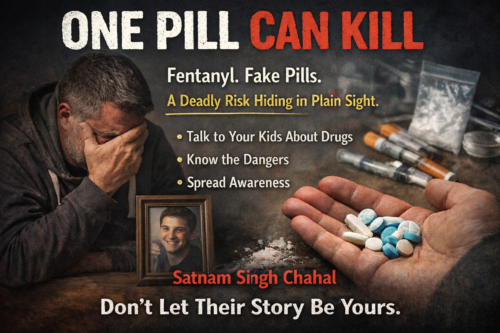
 Punjab bleeds quietly. Not from bullets alone, but from needles, from white powder dissolved in broken dreams, from a generation that was supposed to carry the legacy of the land of five rivers but is instead being carried to cremation grounds before its time. When a head constable of the Punjab Police — a man sworn to protect — loses his own son to a drug overdose and then turns to other parents with advice not of hope but of escape, telling them to leave Punjab if they want to save their children, something has shattered beyond the ordinary. This is not a policy failure. This is a civilizational wound.
How did the land of Bhagat Singh, of Ranjit Singh, of the most resilient farmers on earth, become a narco-state hiding in plain sight? The answers are uncomfortable. Porous borders. Political patronage of drug networks. A police machinery so compromised in parts that the predators and the protectors share the same corridors. Unemployment hollowed out young men who inherited land but inherited no future with it. And a social culture that for too long treated addiction as shame to be hidden rather than a crisis to be confronted. Denial fed the epidemic as much as any smuggling route did.
What is dying is not just individual bodies — though each one is a universe of grief for a family. What is dying is Punjabiat itself. That fierce, generous, rooted identity — the culture of chardi kala, of rising spirit, of langar and seva and the warrior ethos — is being dissolved in synthetic opioids and heroin. The youth who should be its living carriers are instead its casualties. A culture cannot survive the systematic destruction of its young. Civilisations do not collapse only through invasions. Sometimes they collapse through a slow poisoning that nobody stops in time.
The rallies have happened. The speeches have been delivered. The committees have submitted their reports. Politicians of every stripe have stood before microphones and promised wars on drugs while the drugs won every battle quietly, consistently, on the streets of Amritsar, Bathinda, Ludhiana, and a thousand villages nobody televises. What Punjab needs now is not more rhetoric — it is ruthless, transparent accountability. It needs the drug supply chain dismantled, not from the bottom, where addicts shiver in fields, but from the top, where money is laundered and protected. It needs rehabilitation treated as emergency infrastructure, not charity. It needs parents, teachers, gurdwara sangats, and civil society to refuse silence as a coping mechanism.
The head constable’s words were the most honest thing to come out of this crisis in a long time. He was not advising surrender — he was issuing a warning that the institutions meant to stand between Punjab’s children and their destruction have been so weakened, so corrupted, so overwhelmed, that they can no longer guarantee what they exist to guarantee. Honesty like that should not produce resignation. It should produce fury. A righteous, organised, unrelenting fury — directed not at addicts who are victims, but at every network, every official, every political actor who has profited from or protected this plague. Punjab has survived partition, militancy, and drought. It cannot fall to this. It must not.