
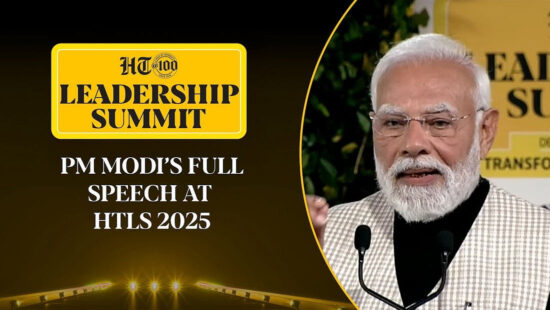
 At the Hindustan Times Leadership Summit 2025 today, Prime Minister Narendra Modi painted a confident picture of India’s place in an anxious world. He began by paying tribute to Dr B.R. Ambedkar on Mahaparinirvan Diwas, linking constitutional ideals with the making of a “new Bharat” that sees itself as a pillar of stability amid global slowdown and geopolitical shocks. India, he argued, is combining high growth with comparatively low inflation at a time when advanced economies are struggling, and is fast becoming a key driver of global expansion.
Equally central was his claim that reforms are no longer crisis-driven but continuous and “Nation First”. He cited tax changes such as zero tax on incomes up to ₹12 lakh and an evolving “next-generation GST” as examples of a more predictable policy regime. The opening-up of the space sector, and the new Skyroot “Infinity Campus” in Hyderabad with its ambition to build one rocket a month, were showcased as proof that government can provide the platform while young entrepreneurs build the future. The speech celebrated nari shakti, digital and physical infrastructure reaching small towns, and an India that no longer apologises for its ambitions. All of this deservedly drew applause. But it also threw into sharp relief the issues that did not find mention.
The issues citizens expected him to address
1. Corruption and shrinking institutional trust.
If India is to be a pillar of trust, the reality of corruption cannot be airbrushed out. The latest Corruption Perceptions Index places India 96th out of 180, with its score slipping over recent years rather than improving. Citizens still see rent-seeking in land records, municipal clearances, police stations and public procurement. These are not merely legacy problems; they shape whether people believe rules apply equally. A candid paragraph on cleaning up contracts, strengthening watchdogs and depoliticising investigative agencies would have signalled that the government recognises this as a live challenge, not a solved problem.
2. Freedom of speech and a nervous media.
India ranks 151st in the World Press Freedom Index 2025, still in the “very serious” band despite a small improvement. The reasons are well known: frequent resort to harsh criminal laws against journalists and activists, opaque online content takedowns, and high concentration of media ownership among a few conglomerates whose fortunes are closely linked to government goodwill. No index is perfect, but a democracy confident enough to call itself a “vishwaguru” can afford to say openly that criticism is not sedition, and that a robust press is a national asset, not an inconvenience. That reassurance did not come.
3. Inequality beneath the growth numbers.
India is rightly proud of being a fast-growing major economy. Yet Oxfam’s “Survival of the Richest” shows the top 1 per cent owning over 40 per cent of wealth, while the bottom 50 per cent hold around 3 per cent. Post-pandemic, billionaire wealth has surged even as food insecurity and informal work have stayed stubborn. Growth has expanded the pie, but the biggest slices keep going to a very small group. A statesmanlike speech might have admitted this skew and opened a conversation on fairer taxation of extreme wealth, stronger public services, and a labour-market strategy aimed at decent work rather than just any work.
4. Jobs and the restless young.
Official surveys show overall unemployment at around 5–6 per cent, which looks manageable on paper. But other data tell us that youth constitute more than four-fifths of India’s unemployed, with urban youth unemployment hovering in the mid-teens or higher. At the same time, female labour force participation, though improving, still lags far behind men and global peers. For a country whose leadership constantly invokes the “demographic dividend,” this is a critical fault-line. HTLS would have been the ideal platform to spell out how the government intends to move from a handful of high-profile schemes to an economy that generates millions of stable, skilled, non-gig jobs every year.
5. Ease of doing business beyond the PowerPoint.
The old World Bank Doing Business rankings, once regularly cited from Indian podiums, have been scrapped after serious questions about their integrity. The new Business Ready index is still being rolled out and does not yet even rate India. On the ground, many businesses acknowledge genuine improvements in e-governance, taxation and logistics, yet complain of regulatory uncertainty, sudden “clarifications” that change the rules mid-stream, and uneven enforcement at state and local levels. Instead of familiar self-congratulation, the Prime Minister could have acknowledged this dual reality and committed to a second-generation reform focused on predictability, contract enforcement and lower compliance friction.
6. Air pollution and the right to breathe.
On the very day of the summit, Delhi woke up to an Air Quality Index in the “very poor” range, with thick smog once again choking the city. Doctors have repeatedly warned that toxic air contributes to around 1.7 million deaths a year in India, and that for children this is nothing less than a silent public-health emergency. Yet pollution still tends to be treated as a temporary inconvenience handled by odd–even days and ad hoc restrictions. Imagine if the Prime Minister had used this high-visibility platform to lay out a concrete, time-bound Indo-Gangetic clean-air plan: phased but decisive movement to clean transport and fuels, strict enforcement of construction and dust norms, generous support for farmers to avoid crop burning, and a single empowered airshed authority. That would have matched the ambition he expresses in other sectors.
7. Smart cities, chaotic lives.
Government figures proudly list more than 7,000 “smart city” projects completed and tens of thousands of crores spent. But independent assessments show that, a decade on, only about 18 of the 100 designated smart cities have actually finished their full project list. For most urban residents, the big problems remain stubbornly familiar: monsoon flooding, unplanned sprawl, dangerous footpaths, unwalkable streets, strained sewage systems and endless traffic. Urban housing schemes have created pockets of new construction without resolving rental laws, speculative land hoarding or weak municipal finances. A frank accounting of why our cities still feel so chaotic – and how metropolitan governance and finance will be overhauled – would have connected directly with the lived experience of millions watching from Mumbai, Bengaluru, Lucknow or Guwahati.
8. Agriculture, farmers and rural distress.
India’s food security rests on farmers who often live in deep insecurity themselves. Farm incomes remain volatile and, in many regions, stagnant when adjusted for inflation. Successive seasons of erratic rainfall, combined with rising input costs and indebtedness, have left many cultivators and labourers anxious about their future. The long-running protests over agricultural laws and MSP were a symptom of this deeper unease. A holistic vision for crop diversification, rural non-farm jobs, better risk cover and more predictable prices was missing from the HTLS narrative of transformation, even though it will determine whether villages share in the promise of “Viksit Bharat”.
9. Data, institutions and the culture of debate.
Over the past few years, some major data series – from consumption to health – have been delayed, revised or released with less granularity. Key institutions, from Parliament to regulatory bodies, are perceived by many to be less willing to challenge the executive. Even if one rejects the harsher versions of this critique, it is difficult to deny that Parliament’s functioning, the frequency of robust debate, and the space for inconvenient questions have all narrowed. A brief acknowledgement that strong institutions sometimes saying “no” are essential to long-run national strength would have reassured those who worry about creeping centralisation of power.
A respectful word to our Prime Minister
None of this diminishes the achievements the Prime Minister listed at the summit. India’s economic resilience, digital infrastructure, space ecosystem and the rising visibility of women are real and deserve recognition. The country is, in many respects, more confident and capable than it was a decade ago.
But precisely because India is stronger, it now deserves a more candid conversation from its leaders. True leadership is not only about reminding citizens how far we have come; it is also about levelling with them on how far we still have to go. Corruption that corrodes trust, constrained freedoms, unequal gains from growth, poisoned air, chaotic cities, anxious farmers, restless youth and strained institutions are not anti-national topics. They are the unfinished agenda of the Indian Republic.
A Prime Minister who often speaks of a “Viksit Bharat” by 2047 could have used the Hindustan Times Leadership Summit to sketch, even briefly, how his government intends to confront these harder questions. That would not have dimmed the celebration of India’s rise; it would have deepened it. The journey ahead will demand not just confidence in what we have achieved, but clarity – and courage – about what we have yet to repair.