
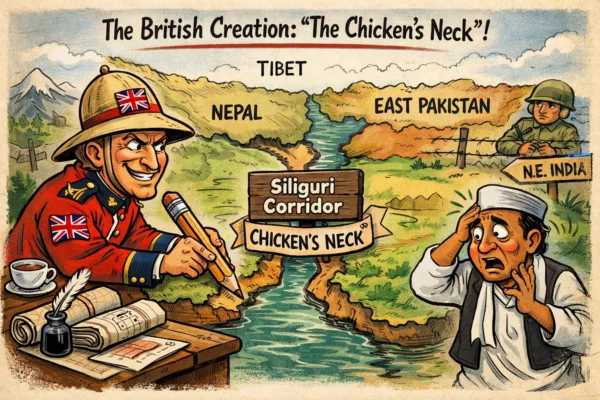
 The Siliguri Corridor — India’s so-called “Chicken’s Neck” — is not merely a narrow strip of land in North Bengal. At just 20–22 kilometres wide at its narrowest point, it is the single terrestrial artery linking over 52 million citizens and roughly 262,000 square kilometres of the Northeast to the rest of India.
Except for this fragile land bridge, the entire Northeast is effectively landlocked — trade-locked, transit-dependent, and strategically exposed.
This vulnerability was not inevitable. It was created and later left uncorrected.
1947: A Foundational Strategic Failure
The first mistake was embedded in the border design of Partition.
When the Radcliffe Line divided India and Pakistan, the Northeast was left connected to the mainland by a precarious sliver of territory. There is little evidence that the long-term strategic viability of this corridor was treated as a core national security concern during negotiations. The result was a structural weakness built into India’s very map.
Partition was chaotic, but chaos is precisely when strategic foresight matters most. Instead, India inherited a geographic gamble: an entire frontier dependent on a 22-kilometre passage bordered by Nepal, Bhutan, what was then East Pakistan, and Tibet.
No sea access was secured for the Northeast. No broader land access was negotiated. A vast region was left isolated by design.
1971: The Leverage That Was Squandered
If 1947 created the structural flaw, 1971 offered the historic opportunity to correct it.
India’s decisive victory in the Bangladesh Liberation War reshaped South Asia. Bangladesh emerged politically, economically, and militarily dependent on New Delhi. It was India’s moment of maximum leverage.
Yet the 1972 Indo-Bangladesh Treaty of Friendship and Cooperation focused on goodwill and diplomatic normalisation. It did not institutionalise permanent transit guarantees, sovereign corridor arrangements, or assured maritime access for the Northeast through ports such as Chittagong.

Military victory was consolidated. Geographic vulnerability remained untouched.
Two defining moments — 1947 and 1971. One embedded the weakness. The other failed to remove it.
The Strategic Weight of the Corridor
Today, thousands of trucks, fuel tankers, defence convoys, and essential goods vehicles move through this corridor daily. Nearly all petroleum pipelines, power transmission lines, optical fibre networks, and bulk freight to the Northeast pass through it.
Despite multiple highways and broad-gauge rail connectivity under the Northeast Frontier Railway, the system remains heavily concentrated and terrain-challenged. Floodplains, congestion within Siliguri, landslide-prone hill stretches toward Sikkim, and seasonal disruptions routinely expose the fragility of the route.
Strategically, the corridor lies close to China’s Chumbi Valley — a wedge-shaped projection toward this narrow passage, a reality underscored during the Doklam standoff in 2017. In any coordinated contingency — precision targeting, signalling disruption, hybrid pressure — overdependence on a single land artery becomes a national vulnerability. Airlift cannot sustain prolonged logistics at scale.
The Corrective Moment: Engineering Strategic Depth and Political Vision
For the first time since Independence, India appears to be addressing the corridor as a structural imbalance rather than a geographic inconvenience.
The proposed underground rail alignment between Tinmile Hat and Rangapani, extending toward Bagdogra, represents a fundamental shift. Roughly 35–40 kilometres in length, the project envisions two deep underground lines operating alongside four upgraded surface tracks — creating a six-line network designed to ensure uninterrupted connectivity even under stress.
This is strategic engineering derived from strong political vision, not routine expansion.
Underground lines reduce exposure to aerial disruption and sabotage. Parallel tracks reduce single-point failure risk. Electrification upgrades and modern signalling systems enhance resilience.
Simultaneously, road redundancy is expanding under Bharatmala and the Gorakhpur–Siliguri greenfield expressway. Alternative access routes are being strengthened through the Kaladan Multimodal Transit Project via Myanmar, offering partial bypass capability. Emergency Landing Facilities and upgraded air bases in the Northeast add further layers of redundancy.
This is no longer about convenience. It is about ensuring that the Northeast can never be strategically isolated.
Regaining Strategic Balance
1947 embedded the structural weakness. 1971 squandered the leverage to correct it. The present moment offers a chance to regain strategic balance — not by reopening history, but by correcting its consequences through infrastructure, redundancy, and foresight.
Military victories fade. Geography endures.
Nations that ignore geographic vulnerabilities inherit crises.
Nations that engineer resilience reclaim control through nationalistic vision.