
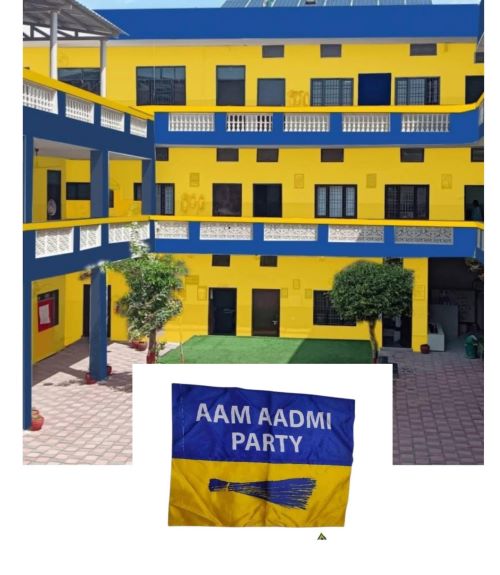
 The Punjab government has faced criticism after many government schools were painted in bright yellow and dark blue, colours that closely resemble the official scheme of the Aam Aadmi Party (AAP). These visuals have raised serious questions about whether public institutions are being used for indirect political promotion.
Schools are meant to be neutral spaces where politics should not enter. Critics argue that using colours linked with a political party symbolically associates children’s institutions with that party, intentionally or unintentionally. They believe the government is attempting to create long-term visual branding in the minds of students and parents.
Punjab’s education system is already struggling with issues such as shortage of teachers, broken infrastructure, outdated laboratories, and lack of basic facilities like clean toilets and drinking water. In such a situation, painting buildings in party-like colours appears to be a misplaced priority, especially when many schools lack essential resources.
Across India, several states renovate schools under different schemes, but they usually use neutral and professional colours. Punjab’s choice of bright yellow and blue stands out because it mirrors AAP’s flag and party identity. This similarity has intensified the controversy.
Opposition parties—including Congress, SAD, and BJP—have accused the government of misusing taxpayer money for political branding. They claim this is an attempt to influence public perception ahead of the 2027 Assembly elections. Some leaders say they will approach the Election Commission and demand a detailed investigation.
The AAP government, however, defends the decision, claiming the colours are part of a beautification project and intended to make schools more attractive. They argue that brighter campuses improve student enrollment and create a more positive learning environment.
Experts warn that allowing political-style colours in government schools sets a dangerous precedent. It opens the door for every future government to repaint schools with its own party colours, turning educational institutions into political battlegrounds instead of places of learning.
Parents’ groups and civil society activists are demanding transparency. They want a complete audit of the funds used for painting, details of the tendering process, and a policy ensuring that public buildings remain free from party-imposed colour schemes.
The controversy raises a fundamental question: Are public funds being used for public welfare, or for party promotion? In a state already burdened with debt and an education system seeking essential improvements, using money for political-style repainting remains a serious concern.