
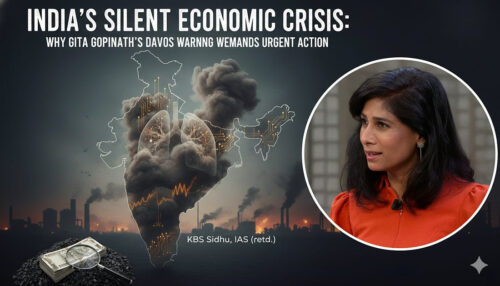
 When Gita Gopinath, former First Deputy Managing Director of the International Monetary Fund and current Harvard Economics Professor, declared at Davos a couple of days ago that pollution poses a greater economic threat to India than global tariffs, the statement reverberated through India’s policy discourse with the force of uncomfortable truth. Her assessment—grounded in the stark reality that approximately 1.7 million Indians die annually from air pollution, costing the economy nearly 10 percent of GDP—was not merely an academic observation. It was an indictment of governance priorities that treat a catastrophic public health and economic crisis as peripheral to the nation’s development agenda (video clip).
Members of the Distinguished Panel
The Davos intervention was not made in isolation. Gopinath’s remarks came during a World Economic Forum 2026 session titled “Can India Become the Third Largest Economy in the World?”, held on January 20–21, 2026, and developed in partnership with the India Today Group—hence the panel being moderated by Kalli Purie of the group. The discussion, running for roughly 45–49 minutes, brought together a deliberately mixed set of voices: Ashwini Vaishnaw representing the Government of India, Gita Gopinath from the standpoint of academic macroeconomics and global institutions, Sunil Bharti Mittal as a leading figure of Indian private capital, and Juvencio Maeztu Herrera as the head of a major international investor and operator (Ingka Group/IKEA). The format mattered: it created a single table where policy intent, economic diagnosis, domestic business realities, and foreign investor expectations could intersect—making Gopinath’s warning about pollution not merely a health lament, but a pointed statement about the investment climate, commercial confidence, and India’s broader growth proposition.

The Numbers: Mortality and GDP Losses
The numbers Gopinath cited deserve sustained attention. According to the 2022 World Bank study and the Lancet Countdown on Health and Climate Change 2024, air pollution claims 1.7 million Indian lives annually—accounting for 18 percent of all deaths in the country. The economic cost is staggering: USD 339.4 billion, or approximately 9.5 percent of GDP, lost to premature mortality, healthcare expenses, and productivity losses. To place this in perspective, the much-debated tariff impacts on Indian exports pale in comparison. Even aggressive trade restrictions would struggle to match the sustained economic hemorrhage caused by the air we breathe.
Three Channels of Economic Damage: Investors, Productivity, Governance
Yet Gopinath’s intervention transcended mere quantification of harm. She articulated three interconnected dimensions through which pollution undermines India’s economic aspirations. First, from the perspective of foreign investors contemplating establishing operations in India, environmental quality is no longer a secondary consideration. As she pointedly observed: “From any international investor’s perspective who is thinking of coming in and putting up a shop in India, and they have to live there and the environment is of a kind that is going to be consequential for health, it is going to hold them back.” This is not hypothetical concern—senior executives are increasingly reluctant to relocate to cities where breathing the air carries measurable health risks, and embassies treat severe pollution postings as high-risk assignments.
Second, pollution’s impact on workforce productivity represents a structural constraint on economic growth. India loses approximately 1.3 billion working days annually to pollution-related illness. Business losses exceed USD 95 billion each year through increased worker absenteeism, declining efficiency, and higher healthcare costs. Retail establishments in North India report five percent declines in footfall during heavily polluted months. Rooftop solar installations experience 13 percent productivity drops on high-pollution days. These are not marginal effects—they are systematic drags on the very sectors driving India’s growth narrative.
Third, and perhaps most consequentially, Gopinath identified pollution as a governance failure at the highest level. Her call for addressing the crisis “on a war footing” as a “top mission for India” implicitly critiqued the institutional architecture that has allowed environmental degradation to persist despite policy pronouncements. This dimension matters most because it exposes the gap between declaratory commitments and implementation capacity.
NCAP: Underperformance, Under-spending, Misplaced Priorities
Consider the National Clean Air Programme (NCAP), launched in 2019 with ambitious targets to reduce pollution concentrations by 20-30 percent across 131 cities. Five years later, most cities have failed to meet these targets. More damningly, approximately 40 percent of the Rs 10,566 crore allocated under NCAP remains unspent. In Delhi, the Municipal Corporation sat on nearly Rs 30 crore of pollution control funds over two financial years, spending barely five percent in 2024-25 even as the city suffocated under hazardous air quality. RTI data reveals that Delhi’s utilization certificates show zero expenditure in 2021-22, 22 percent utilization in 2022-23, and progressively declining deployment thereafter.
Where funds have been spent, priorities reveal a fundamental misunderstanding of the problem. A Centre for Science and Environment assessment shows that NCAP expenditure has been “overwhelmingly” directed toward dust management—paving roads, covering potholes, deploying mechanical sweepers—while less than one percent addresses toxic emissions from industry. Yet PM2.5 pollution, the most harmful fraction emitted primarily from combustion sources like vehicles, industry, and power plants, requires fundamentally different interventions than dust control. The program’s design incentivizes reduction of coarser particulate matter rather than the fine particles that penetrate deep into the respiratory system and bloodstream.
Why the System Fails: Capacity, Compliance, Coordination
This implementation failure is not accidental—it reflects deeper structural problems. Pollution control boards suffer from inadequate staffing, insufficient technical capacity, and bureaucratic fragmentation. Industrial polluters routinely receive deadline extensions for compliance, effectively rewarding non-compliance. Source apportionment studies that would identify major pollution contributors remain incomplete in many cities. Real-time monitoring infrastructure has expanded to over 900 stations nationwide, but enforcement capacity has not grown proportionately. Detected violations rarely trigger timely action due to coordination failures between municipal authorities, transport departments, and pollution control agencies.
The institutional architecture compounds these problems. Air pollution transcends administrative boundaries—Delhi’s winter smog originates substantially from neighboring states—yet regulation remains jurisdictionally fragmented. The Commission for Air Quality Management in the National Capital Region represents one of the few attempts at regional coordination, but elsewhere, pollution control remains trapped within municipal boundaries even as industrial sources sit at city peripheries outside the scope of urban action plans.
The Politics of Deflection and Silence
Political responses to Gopinath’s remarks revealed predictable fault lines. Opposition parties amplified her assessment to challenge government priorities. Congress MP Manickam Tagore observed that “pollution is choking lives, productivity and growth” and that “reality hurts more than criticism,” while Shiv Sena (UBT) leader Aditya Thackeray thanked Gopinath for providing “constructive advice that is real.” Conversely, ruling coalition member Milind Deora of Shiv Sena attempted to deflect by categorizing pollution as an “internal issue we must fix ourselves” distinct from “external” tariff barriers—a distinction that obscures rather than illuminates the comparative economic impact.
The BJP’s silence on the matter is telling. Neither denial of pollution’s severity nor rebuttal of Gopinath’s economic quantification emerged, suggesting recognition that disputing empirically verifiable data would be politically untenable. This creates an opening: if the problem’s magnitude is no longer contested, the debate can shift to implementation mechanisms, accountability structures, and resource prioritization.
The Political Economy of Inaction
Yet sustained policy change faces a fundamental challenge: pollution costs are diffuse and delayed. Unlike factory closures that generate immediate unemployment and political backlash, chronic disease and reduced lifespan unfold gradually, making political mobilization difficult. Electoral competition rewards visible interventions—infrastructure projects, welfare transfers—over invisible public goods like clean air. Even official death certificates do not list air pollution as a cause, rendering the crisis statistically invisible in government mortality data and thereby insulating policymakers from accountability.
From Environment to Growth Strategy: What Must Change
Breaking this pattern requires reframing pollution as Gopinath has done—not as an environmental issue but as a core economic constraint equivalent to regulatory inefficiency, infrastructure deficits, or skill shortages. When pollution control sits within environment ministries alone, it remains peripheral to growth strategy. When it becomes central to investment climate assessments, manufacturing competitiveness evaluations, and productivity analyses conducted by finance and commerce ministries, institutional incentives shift.
Practically, this demands several transformations. First, pollution budgets must be tied to outcome metrics rather than activity tallies, with fund disbursement contingent on demonstrated reductions in PM2.5 concentrations rather than kilometers of road paved. Second, enforcement capacity must expand proportionate to monitoring infrastructure, with automated detection-to-action systems that trigger inspections within defined timeframes. Third, industrial emission controls must become non-negotiable conditions for operating licenses rather than aspirational targets subject to serial extensions. Fourth, regional airshed approaches must replace municipal boundaries as the unit of intervention, recognizing pollution’s transboundary nature.
Most critically, political leadership must internalize what Gopinath’s Davos remarks made explicit: India’s aspiration to become the world’s third-largest economy means little if rising GDP coexists with falling life expectancy, declining workforce health, and deteriorating quality of life. Per capita income—not absolute GDP ranking—determines living standards, and pollution directly undermines that metric through healthcare costs, lost earnings, and premature mortality.
Clean Air as a Competitive Economic Variable
Gopinath’s credentials lend particular weight to this intervention. An Indian-born economist who completed her post-graduation in Economics at the Delhi School of Economics before earning her PhD at Princeton, she brings both institutional authority from her IMF tenure and personal familiarity with India’s policy landscape. Now a naturalized US citizen holding Overseas Citizen of India status and serving as Harvard’s Gregory and Ania Coffey Professor of Economics, she occupies a unique position—sufficiently distant from domestic political contestation to speak candidly, yet sufficiently invested in India’s trajectory to engage constructively.
Her warning should not be dismissed as external criticism divorced from ground realities. Rather, it reflects what global investors, international institutions, and potential collaborators increasingly recognize: that environmental quality has become a competitive economic variable. Countries offering cleaner air attract talent more easily, sustain higher productivity, and impose lower health burdens on enterprises. As India seeks to position itself as a manufacturing alternative to China and a destination for high-value services, the breathability of its cities becomes inseparable from its economic proposition.
The tragedy is that solutions exist. Transition to cleaner fuels, stricter emission standards for vehicles and industry, expansion of public transport, phase-out of coal-fired power plants, and penalties for crop residue burning—these are well-documented interventions with proven efficacy. What remains absent is the political will to prioritize implementation over announcement, enforcement over exemption, and sustained commitment over episodic emergency measures triggered by winter smog crises.
Gopinath’s call for treating pollution control as a “top mission for India” on a “war footing” invokes the urgency typically reserved for national security threats. This is apt—chronic public health crises that claim 1.7 million lives annually and shave 10 percent off GDP constitute security threats of the highest order. They undermine human capital, constrain economic potential, and diminish international competitiveness. If India’s leadership genuinely aspires to developed-nation status by 2047, as articulated in the government’s vision, then air quality cannot remain an afterthought to industrialization. It must become a precondition.
Conclusion: The Invisible Tax
The coming months will reveal whether Gopinath’s intervention catalyses genuine policy reform or fades into the long archive of warnings acknowledged but unheeded. The Union Budget presents an immediate opportunity to demonstrate seriousness through enhanced funding tied to accountability mechanisms. State governments preparing city action plans can shift decisively from dust control to emissions reduction. Pollution control boards can accelerate enforcement against persistent violators. And political leadership must also move beyond the convenience of single-villain narratives: paddy stubble burning in Punjab and Haryana—easy to blame in the politics of Delhi’s winter smog—can no longer be held responsible for the entirety of the capital’s egregious pollution levels, let alone for deteriorating air quality across other urban centres. A credible strategy has to confront the full emissions profile—transport, industry, power generation, construction, and household fuels—rather than outsourcing accountability to the farm fires of one season and two states.
Until that transformation occurs, Gita Gopinath’s Davos warning—delivered in the presence of a highly educated, articulate, and distinguished Union Minister, Ashwini Vaishnaw—will remain less a talking point than a diagnosis, and India will continue to undercut its own growth story through avoidable illness, lost productivity, and premature death. Clean air must be treated as an economic precondition, not an environmental afterthought. Until then, India will continue paying an invisible tax larger than any tariff: the cost of breathing.