
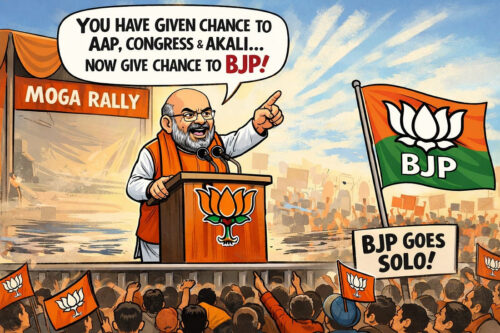
 When Union Home Minister Amit Shah addressed the BJP’s “Badlaav Rally” in Moga, the speech carried a political message far more significant than routine campaign rhetoric.Beyond the attacks on the Aam Aadmi Party government and criticism of Congress and Akali Dal, the speech signalled something fundamental: the BJP is preparing to contest Punjab politics on its own strength and replace the traditional players rather than depend on them.
For decades, the BJP functioned largely as a junior partner in Punjab, aligned with the Shiromani Akali Dal. That political arrangement collapsed after the farmers’ agitation and the repeal of the farm laws. Since then, the party has been searching for a new strategy in the state.The Moga rally suggests that strategy has now taken shape.
“You Have Tried Everyone — Now Try BJP”
At the centre of Shah’s speech was a direct political appeal to voters.He told the gathering that Punjab has already given opportunities to every major political party the Akali Dal, the Congress and the Aam Aadmi Party. Each of them has ruled the state at different times.Yet, he argued, the state continues to struggle with serious problems particularly the drug menace and law-and-order challenges.
Therefore, Shah urged the people of Punjab to give the BJP a chance in the 2027 Assembly elections.
This formulation was politically telling. By placing Akali Dal, Congress and AAP together in the same bracket of failed governments, Shah implicitly indicated that the BJP does not see itself as returning to the old alliance structure.
Instead, the party is attempting to present itself as an alternative to the entire existing political establishment in Punjab.
You can watch his full speech here:
Drugs as the Central Political Charge
The most prominent theme of Shah’s speech was the drug crisis, an issue that has long haunted Punjab’s politics.
He alleged that around 45 per cent of India’s drug trade is linked to Punjab, and blamed successive governments for allowing the problem to grow.
According to Shah, the Akali Dal, the Congress and the AAP government all share responsibility for the crisis because each ruled the state but failed to eliminate drug networks.
The political logic of the argument was clear:
If three different governments have ruled Punjab and the problem still persists, then voters should now consider a completely different political option.
That option, Shah suggested, is the BJP.
The party is thus attempting to frame the drug crisis not merely as a governance failure but as an indictment of the entire political class that has governed Punjab over the past two decades.
Attacking the AAP Government
Shah also launched a sharp attack on the government led by Bhagwant Mann.
He described the state government as remote-controlled from Delhi, arguing that Mann was merely implementing the directions of Arvind Kejriwal.
In one of his sharpest lines, Shah suggested that Punjab had become an “ATM for Kejriwal.”
He cited incidents such as the murder of sarpanches, attacks on police stations, and the activities of gangster networks to argue that law and order had deteriorated under the current government.
The rhetorical flourish that Punjab needs “an administrator, not a comedian” was another pointed attack on the Chief Minister.
The 19% Formula
Perhaps the most revealing part of Shah’s speech was his explanation of the BJP’s electoral strategy.
He argued that in many states the party initially began with modest vote shares but eventually replaced established political forces.
According to Shah, wherever the BJP’s vote share crosses around 19 per cent, the party eventually forms the government.
To support this claim, he cited examples of states such as:
Assam
Odisha
Uttarakhand
Manipur
The underlying message to party workers and voters alike was clear: Punjab may appear difficult terrain today, but political expansion often begins with small footholds.
If the BJP can expand its vote share even modestly, the political balance in the state could change rapidly.
A Broader National Narrative
Shah’s speech also linked Punjab’s politics to the broader national narrative promoted by the BJP.
He highlighted the Modi government’s decision to abrogate Article 370, claiming it strengthened national security.
He said Naxalism in India is now nearly eliminated, projecting the BJP as a government capable of tackling major security challenges.
At the same time, he promised that if the BJP forms the government in Punjab it will introduce legislation to stop religious conversions.
This combination of governance issues, national security themes and cultural politics reflects the party’s familiar political template across the country.
Outreach to the Sikh Community
Alongside political attacks, Shah devoted considerable attention to Sikh heritage and religious history.
He paid rich tributes to Guru Tegh Bahadur and highlighted national commemorations of the 350th anniversary of his martyrdom.
He also referred to:
The 550th birth anniversary of Guru Nanak
The 350th birth anniversary of Guru Gobind Singh
The institution of Veer Bal Diwas
He urged people to spread the message of the Sikh Gurus across the nation.