
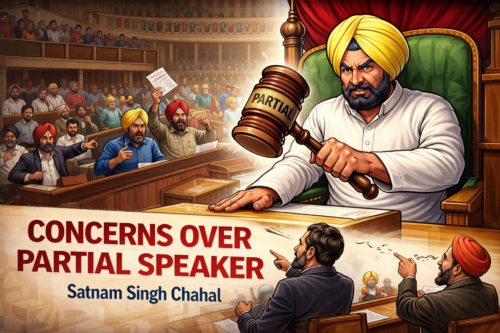
 The recent developments in the Punjab Legislative Assembly during the ongoing Budget session have once again raised serious concerns about the role and neutrality of the Speaker. The decision to pass a resolution referring the conduct of Congress MLA Sukhpal Singh Khaira to the Special Privileges Committee has sparked a sharp political debate, with opposition members accusing the Speaker, Kultar Singh Sandhwan, of acting in a partisan manner rather than maintaining the impartiality expected from the chair.
During the session, the treasury benches led by Finance Minister Harpal Singh Cheema moved a resolution seeking an inquiry into Khaira’s conduct. MLA Sukhwinder Singh Sukhi supported the motion and was quickly taken up for discussion. However, the opposition strongly objected to the move, alleging that the Speaker allowed the treasury benches to aggressively pursue the matter while ignoring equally important issues raised by the opposition.
Opposition members, including Leader of Opposition Partap Singh Bajwa, argued that the Speaker failed to provide an opportunity to discuss their condemnation notice against Chief Minister Bhagwant Mann. The notice reportedly concerned remarks by the Chief Minister about women at a public event in Sangrur. According to opposition leaders, their request for the Speaker’s response was repeatedly ignored while the House proceeded with the motion targeting Khaira.
Such incidents raise broader questions about the functioning of democratic institutions. In a parliamentary democracy, the Speaker occupies one of the most respected and sensitive constitutional positions. The chair is expected to rise above party politics and ensure that both the government and the opposition are given equal opportunity to express their views. When the Speaker appears to favour one side, it weakens public trust in the legislative process.
Critics argue that the situation in the Punjab Assembly is increasingly resembling a political battleground rather than a forum for democratic debate. Instead of encouraging meaningful discussion on issues affecting the people of Punjab, such as economic challenges, farmers’ concerns, unemployment, and law and order the Assembly often witnesses disruptions, confrontations, and selective targeting of opposition members.
The controversy surrounding the referral of Khaira’s conduct to the privileges committee is therefore not just about one individual or one incident. It reflects a deeper institutional concern about whether the Assembly is functioning in a balanced and democratic manner. If the Speaker is perceived as partial, it risks undermining the credibility of the House and weakening the role of the opposition, which is a vital pillar of democracy.
For a healthy democratic system, the Speaker must act as a neutral guardian of parliamentary procedures. Equal treatment of all members, respect for dissenting voices, and adherence to established rules are essential for maintaining the dignity of the Assembly. Any perception of bias—whether real or perceived—must be addressed promptly to restore confidence in the institution.
Ultimately, the people of Punjab expect their elected representatives to debate policies and address public issues in a responsible and transparent manner. The Speaker’s chair carries the responsibility of ensuring that this democratic spirit is preserved. Without neutrality and fairness at the helm, the functioning of the Assembly risks drifting away from its true purpose—serving the interests of the people of Punjab.