
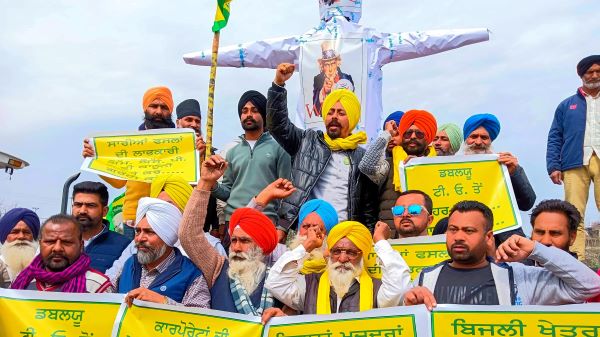
 Punjab, often called the ‘Granary of India,’ has long been the backbone of the country’s agricultural economy. The fertile land of Punjab has fed millions across the nation, and its farmers have historically been regarded as the pillars of Indian society. However, beneath this image of agricultural prosperity lies a deeply troubling reality one of systemic neglect, economic exploitation, political betrayal, and outright state-sponsored violence against the very people who feed the nation. Over successive decades and under multiple governments, Punjab’s farmers have faced mounting crises, but the situation has perhaps never been more acute than in recent years, when the state government has allegedly taken actions that many describe as nothing short of atrocities against the farming community.
The farmers of Punjab are caught in a vicious cycle of debt, deprivation, and despair. While government after government has promised reform, the ground reality has consistently fallen short of these promises. Loan waivers have been partial, compensation for crop damage inadequate, minimum support prices contested, and state machinery often used to suppress legitimate protest rather than address genuine grievances. This report attempts to document the historical timeline of these injustices and present a comprehensive picture of how the Punjab government has, over the years, failed and mistreated the farming community.
Historical Background: Seeds of Discontent
The agrarian crisis in Punjab did not emerge overnight. Its roots can be traced back to the aftermath of the Green Revolution in the 1960s and 1970s. While the Green Revolution did succeed in transforming Punjab into a food surplus state, it also introduced a dependency on high-yielding variety seeds, chemical fertilisers, pesticides, and groundwater irrigation. This dependency increased the cost of cultivation manifold while simultaneously creating long-term ecological damage, including soil degradation, falling water tables, and increasing incidences of cancer and other diseases in rural Punjab a belt stretching from Bathinda to Ferozpur that has grimly come to be known as the ‘Cancer Train’ corridor.
Broken Promises, Batons & Betrayal: How Punjab’s Governments Have Failed Their Farmers for Decades”
As input costs rose and market prices remained volatile or stagnant, farmers began borrowing heavily from institutional and non-institutional sources. The growing debt burden became a social crisis that manifested in thousands of farmer suicides. Despite these warning signs visible for decades, successive Punjab governments took little meaningful action to restructure the agriculture sector, diversify crops, or provide comprehensive debt relief. Instead, political promises were made around election cycles and then quietly abandoned once votes were secured.
Farmer Suicides: A Silent Epidemic
One of the most heartbreaking dimensions of the Punjab agrarian crisis is the staggering number of farmer suicides. Studies by credible institutions, including a landmark study by Punjab Agricultural University (PAU) in Ludhiana, have documented tens of thousands of farmer and farm-labourer suicides in Punjab over recent decades. The majority of these suicides have been directly linked to insurmountable debt, failure of crops, and lack of government support. Between 1988 and 2013 alone, over 16,000 farmers and farm labourers were estimated to have died by suicide in Punjab, according to academic research.
Despite these alarming numbers, the government’s response has been woefully inadequate. Compensation to families of deceased farmers has been delayed, denied on technical grounds, or paid in amounts too small to provide genuine relief. The social security net for farm widows and their children has been essentially non-existent. Political leaders have attended funeral ceremonies for optics while doing little to address structural causes. This callous response to a genuine humanitarian crisis can itself be characterized as an act of institutional violence against the farming community.
The Farm Laws Crisis (2020–2021) and State Government’s Contradictory Role
The most dramatic recent episode in the saga of Punjab’s farmers came with the enactment of three central farm laws by the Government of India in September 2020 the Farmers’ Produce Trade and Commerce (Promotion and Facilitation) Act, the Farmers (Empowerment and Protection) Agreement on Price Assurance and Farm Services Act, and the Essential Commodities (Amendment) Act. These laws were widely condemned by Punjab’s farmers and farm unions as an existential threat to the Minimum Support Price (MSP) system and the mandi (grain market) network that sustains their livelihoods.
In a striking show of political opportunism, the then-ruling Congress government in Punjab under Chief Minister Captain Amarinder Singh initially voiced support for the farmers’ cause. However, critics and farmer leaders pointed out that the state government simultaneously allowed and facilitated the use of police force against early protesters, filed cases against farmer union leaders, and failed to provide basic amenities to protesting farmers at the borders of Delhi. The government’s support for farmers appeared performative rather than substantive, designed more to embarrass the central government than to genuinely protect the interests of Punjab’s agricultural community.
When the Aam Aadmi Party (AAP) came to power in Punjab in March 2022 on an enormous wave of farmer support, expectations were sky-high. Chief Minister Bhagwant Mann and the AAP government had made sweeping promises during the election campaign complete debt waiver for farmers, guaranteed MSP for all crops, pension for farmers, and zero-tolerance for police brutality against agitating farmers. What followed has bitterly disappointed a large section of Punjab’s farming community.
AAP Government’s Broken Promises and Alleged Atrocities (2022–2024)
Despite its farmer-friendly electoral rhetoric, the AAP government in Punjab has been accused of multiple acts of negligence, betrayal, and active repression against farmers. In 2023, when farmer organizations again began mobilizing demanding loan waivers, MSP legislation, justice for Lakhimpur Kheri victims, and compensation for victims of the 2021 state repression the Punjab government under Bhagwant Mann deployed heavy police contingents and used force to prevent farmers from marching towards Chandigarh, the state capital.
Water cannons, tear gas, and lathi charges were reportedly used against peaceful protesting farmers. Roads were dug up to prevent tractor marches from reaching the city. Internet services were suspended in affected districts. Senior farmer leaders were detained without formal charges under preventive detention laws. The very farmers whose votes had brought the AAP to power found themselves on the receiving end of the same state machinery that they had hoped the new government would reform.
The promised complete farm loan waiver never materialized in its entirety. The government claimed fiscal constraints while simultaneously announcing other populist schemes. Farmers who had been waiting for years for debt relief found that the waiver scheme was limited in scope, plagued by bureaucratic hurdles, and simply did not reach many of the most indebted farming families. Stories emerged of farmers submitting paperwork multiple times, only to be told their applications were missing or incomplete. Widows of farmers who died by suicide were reportedly denied compensation on technical grounds that their husbands had outstanding loans above certain thresholds, or that land records were disputed.
The February 2024 Farmer March and State Repression
The crisis came to a dramatic head in February 2024, when farmer unions including SKM (Non-Political) and KMM (Kisan Mazdoor Morcha) launched a major ‘Delhi Chalo’ march demanding legally guaranteed MSP for all crops, debt waiver for farmers and farm labourers, justice for the Lakhimpur Kheri victims, withdrawal of cases against farmers registered during the 2020–21 agitation, and a pension for farmers and farm labourers. While the central government-controlled Haryana state used multilayered barricades, concrete walls, and iron nails on the roads to stop the march, the Punjab government’s role was also deeply problematic.
The Punjab government found itself in a hypocritical position rhetorically supporting the farmers’ demands while physically preventing them from crossing into Haryana and reaching Delhi. Farmer leader Shubhkaran Singh, a young man from Bathinda, died at the Khanauri border point during confrontations with security forces. His death sparked enormous outrage across Punjab. Farmer leaders accused the police of directly contributing to his death, and demanded accountability. The Punjab government’s response was slow, politically calculated, and failed to provide the transparency that grieving farmers and the public demanded.
Farmer leader Jagjit Singh Dallewal began an extended hunger strike to press their demands, his health deteriorating alarmingly while the government engaged in negotiations that produced no concrete results for months. The Supreme Court of India had to intervene, expressing concern over Mr. Dallewal’s health and asking the government to ensure his medical care, highlighting the failure of the state to meaningfully address the farmers’ legitimate grievances through political dialogue.
Water and Environmental Injustice Against Farmers
A dimension of government atrocity against Punjab farmers that receives less media attention is the environmental injustice they have been subjected to. Decades of promoting the rice-wheat cropping pattern a system encouraged and institutionalized by government policy and procurement has led to catastrophic depletion of groundwater. Punjab’s water table is falling at an alarming rate, and millions of farmers who depend on tubewells for irrigation are facing increasing costs and uncertainty. The government, rather than supporting farmers to transition to less water-intensive crops by guaranteeing MSP for alternatives, has continued to rely on rice-wheat procurement while subsidizing electricity for tubewells a band-aid solution that delays but does not address the underlying crisis.
The government’s Pani Bachao Paisa Kamao (Save Water, Earn Money) scheme, which incentivized farmers to reduce paddy cultivation, was launched with great fanfare but proved largely ineffective in achieving its stated goals because the fundamental issue assured alternative procurement was never addressed. Farmers who attempted crop diversification found that the market infrastructure for selling alternative crops was absent, and they were left worse off financially. This constitutes a form of policy-induced economic harm that falls disproportionately on small and marginal farmers.
Paddy Stubble Burning: Criminalizing Farmers for Government’s Policy Failures
Every post-harvest season, the issue of stubble burning erupts into a controversy that encapsulates the Punjab government’s failure to treat farmers fairly. Unable to afford in-situ stubble management machinery, and facing a narrow window between paddy harvest and wheat sowing, thousands of farmers resort to burning stubble. The government responds by registering criminal cases against farmers, imposing fines, and withholding various benefits essentially punishing farmers for a problem that government policy itself created.
Farmer organizations have repeatedly demanded that the government provide free or heavily subsidized happy seeder machines and compensate farmers for the additional labor involved in non-burning stubble management. While the government has announced various subsidy schemes, their implementation has been inadequate and riddled with corruption, with machines often going to politically connected beneficiaries rather than the small farmers who most need them. In the meantime, thousands of first information reports (FIRs) have been filed against farmers for stubble burning, adding to their already crushing legal and financial burdens.
Police Brutality and Suppression of Farmer Movements
One of the most direct forms of government atrocity against Punjab’s farmers has been the repeated use of police force to suppress legitimate and democratic protest movements. This pattern has been observed across multiple governments. When farmers protest their conditions — whether demanding better prices, loan waivers, or compensation for crop damage — the government’s instinctive response has often been coercive rather than conciliatory.
Tear gas shells have caused severe injuries to farmers. Water cannons have been deployed in freezing winter conditions. Lathi charges have injured elderly farmers and women. Section 144 orders restricting assembly have been imposed in vast swathes of rural Punjab to prevent farmers from gathering. Leaders of farmer unions have been arrested under the National Security Act (NSA) and other preventive detention laws without trial. These actions constitute a systematic pattern of state violence against democratic protest that cannot be dismissed as isolated incidents.
TIMELINE OF ATROCITIES ON PUNJAB FARMERS
1980s–1990s: Foundation of the Crisis
1985–1995: The aftermath of Green Revolution-era policies begins to show its dark side. Input costs skyrocket while prices paid to farmers remain low. Institutional credit becomes scarce, driving farmers to private moneylenders at usurious interest rates. The first significant wave of farmer distress and suicides begins in Malwa region. State government data on farmer suicides is either not collected or systematically underreported, and no meaningful policy intervention is undertaken.
2000–2007: Congress Rule and Mounting Distress
2002: A comprehensive study by Punjab Agricultural University reveals alarming levels of farmer indebtedness across the state. Average debt per farming household has risen dramatically. The Congress government under Chief Minister Amarinder Singh acknowledges the problem but takes limited remedial action. A farmer debt relief commission is announced but its recommendations are not implemented in full.
2004–2006: Crop failures due to unseasonal rain and pest attacks devastate farmers in several districts. Compensation under the National Disaster Relief Fund is delayed by months. Many farmers receive little or no compensation due to faulty girdawari (crop inspection) records. Protests are met with police cases. Farmer suicides accelerate, with Sangrur, Bathinda, and Mansa districts becoming epicenters of the crisis.
2007–2017: Akali-BJP Rule Promises and Repression
2007: The Shiromani Akali Dal-BJP government under Chief Minister Parkash Singh Badal comes to power promising agricultural reform. A debt restructuring scheme is announced, but farmer organizations allege it benefits larger landowners disproportionately while small and marginal farmers are left out.
2009–2011: Cotton crop failures in the Malwa belt devastate thousands of farmers. Many who had taken crop loans find themselves unable to repay. Banks begin recovery proceedings, and cases of farmers’ assets being seized are reported. Suicide rates rise sharply. Farmer protests are organized across the state, and police use force to disperse gatherings on multiple occasions, including baton charges in Bathinda and Faridkot districts.
2012: Government data presented in the Punjab Assembly reveals that over 6,900 farmer and farm-labourer suicides had been recorded in the state over the preceding decade, though independent studies put the actual number much higher. Opposition parties criticize the government for data manipulation and insufficient compensation to bereaved families.
2015: A major farmer protest rally in Bathinda demanding debt relief is disrupted by police. Water cannons are used against protesters despite peaceful conditions. Several senior farmer leaders are detained under Section 107/151 of the Criminal Procedure Code. The government justifies the action on grounds of maintaining law and order, drawing sharp criticism from civil society and opposition parties.
2016–2017: As state elections approach, farmer suicide figures become a major political issue. Multiple opposition parties promise full loan waivers if elected. Independent researchers document over 900 farmer and farm-labourer suicides in 2016 alone in Punjab. The government disputes these figures. A family seeking ex-gratia payment for a farmer who died by suicide reports being denied compensation because the deceased had a loan from a cooperative society rather than a nationalized bank a technicality that exemplifies the callousness of the state’s approach.
2017–2022: Congress Rule The Broken Waiver Promise
February 2017: Congress wins the Punjab state election decisively, with a central promise of waiving all farm loans up to Rs. 2 lakh within 10 days of coming to power. Captain Amarinder Singh is sworn in as Chief Minister. This promise galvanizes farmer support for Congress and is widely credited as a key factor in the election result.
June 2017: Ten days pass, then weeks, then months with no loan waiver. Farmer organizations begin protesting. The government announces a partial scheme the Kisan Karza Mukti Scheme that covers a far smaller scope than promised. Many farmers discover that their loans from cooperative societies, arhtias (commission agents), and private lenders are not covered at all. The government’s argument that fiscal constraints necessitate a phased approach is viewed as an excuse.
2018–2019: Farmer protests intensify across Punjab as the waiver scheme’s limitations become evident. The government invokes police powers to prevent large gatherings in Chandigarh and other cities. Multiple FIRs are registered against farmer leaders. A farmer rally attempting to reach the Chief Minister’s official residence in Chandigarh is stopped by police using barricades and force. Leading farmer organizations including BKU Ugrahan hold month-long dharnas (sit-in protests) outside the Deputy Commissioner offices in multiple districts.
October 2019: A massive farmer rally of over one lakh farmers from BKU Ugrahan and allied organizations is held in Patiala. Despite being peaceful, police are deployed in overwhelming numbers. Intelligence agencies reportedly monitor farmer leaders’ communications. The government’s response to farmer protests is widely seen as treating legitimate democratic dissent as a law and order problem.
September 2020: Three controversial central farm laws are enacted. The Punjab government passes counter-legislation in the state assembly, but farmer organizations note that several aspects of the legislation are performative and do not address the core issue of legally guaranteed MSP for all crops.
November 2020 – November 2021: The historic farmer agitation begins, with farmers from Punjab leading a massive protest at Delhi’s borders at Singhu, Tikri, and Ghazipur. During the initial departure from Punjab, there are reports of police using force to prevent convoys from leaving. The state government’s support for the agitation remains ambiguous throughout. When farmers return after the repeal of the farm laws in November 2021, the Punjab government fails to immediately withdraw the cases registered against farmers during the agitation — a promise it had made.
October 2021 – Lakhimpur Kheri: Though this incident occurred in Uttar Pradesh, it deeply affected Punjab’s farmers. The death of four farmers when a vehicle in a convoy allegedly connected to Union Minister Ajay Mishra Teni ran over protesters caused enormous outrage in Punjab. The Punjab government’s calls for justice remained largely verbal with limited political follow-through.
2022–2024: AAP Government — New Name, Old Pattern
March 2022: AAP wins Punjab elections with a historic majority. Its manifesto includes promises of a complete farm loan waiver, Rs. 1,000 monthly honorarium for farmers, legally backed MSP, and free power for farming up to a generous limit. Farmers across Punjab celebrate what they hope is a new dawn.
June–December 2022: The loan waiver scheme that is unveiled is significantly smaller in scope than what was promised. Various categories of farmers — those with loans from cooperative banks, those whose names don’t match land records due to inheritance disputes, and others find themselves excluded. Farmer organizations begin expressing disappointment. The government’s defense is that the state’s financial condition requires a phased approach.
August–September 2022: The paddy stubble burning season arrives, and the government initiates action against farmers, including registering FIRs. Farmers argue that the government has failed to provide ade
quate free machinery for stubble management and that they have been criminalized for a problem caused by government policy. Senior farmer leaders are summoned by police for questioning.
2023: Multiple farmer organizations launch protest marches towards Chandigarh demanding the unfulfilled AAP election promises. Police deploy in large numbers to prevent the marches from reaching the state capital. Roads leading to Chandigarh are barricaded. There are documented instances of police using water cannons and physical force against protesting farmers. Several farmer leaders are briefly detained. The government holds negotiations that yield limited concrete results.
February 2024: SKM (Non-Political) and KMM launch the ‘Delhi Chalo’ march from Punjab. The march is blocked at the Punjab-Haryana border. Farmer leader Shubhkaran Singh, a 22-year-old from Bathinda, dies at the Khanauri border point. His death triggers widespread protests across Punjab. Farmer leader Jagjit Singh Dallewal begins an indefinite fast-unto-death at Khanauri. The government engages in talks but no substantive resolution is reached for months.
March–June 2024: Mr. Dallewal’s fast continues, with his health deteriorating seriously. The Supreme Court intervenes and asks the Punjab government to ensure he receives medical care. The government is seen to be using the negotiations process to stall rather than resolve, while managing optics ahead of the Lok Sabha elections in May 2024. Promises made to farmers during election campaign by AAP candidates remain unfulfilled.