
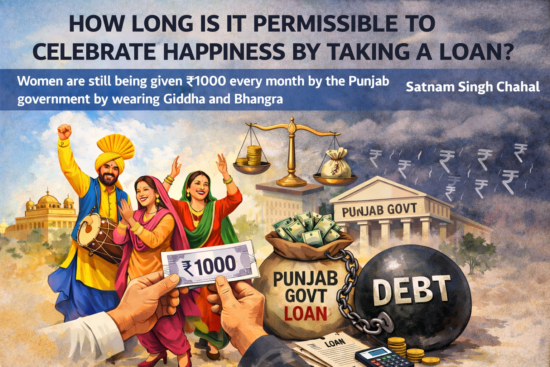
 Punjab has always been known for its vibrant culture, lively traditions, and the spirit of celebration. It is the nature of Punjabis that whenever there is a happy occasion, people express their joy through traditional dances like Bhangra and Giddha. These cultural expressions symbolise happiness, unity, and the energetic lifestyle of the people of Punjab. From weddings to festivals and from harvest seasons to community gatherings, Punjabis celebrate life with enthusiasm and pride. Happiness in Punjab is not hidden; it is danced, sung, and shared openly.
In recent times, however, a new dimension has been added to these celebrations. The Punjab government has started giving financial assistance of ₹1000 per month to women under its welfare initiatives. Many women have welcomed this step, and in several places, celebrations with Bhangra and Giddha have been seen when the payments are announced or distributed. For many families struggling with rising inflation and economic challenges, even a small financial assistance can bring relief and happiness. No one can deny that empowering women and supporting households is an important responsibility of any government.
Yet, alongside this happiness, an important question arises: to what extent is it justified to celebrate such happiness when the state itself is heavily dependent on loans?
Punjab today is facing a serious financial situation. The state government has been continuously borrowing money to meet its expenditures and fulfil various promises. Loans have become a major source of funding for government schemes. While welfare policies are essential in a democracy, their sustainability becomes questionable when they are financed largely through borrowed funds rather than through the state’s own revenue.
The fundamental principle of responsible governance is that welfare should ideally come from strong economic growth, efficient tax collection, and proper financial management. When governments distribute financial benefits while the state treasury is under heavy debt, the burden ultimately shifts to the future. Loans taken today must be repaid tomorrow, often with interest, and the responsibility for repayment falls on taxpayers and the next generation.
In this context, the celebration of happiness funded by borrowed money becomes a complex issue. On the surface, it appears to be a moment of joy and relief for the beneficiaries. But beneath that celebration lies the larger economic question of sustainability. If the government continues to increase borrowing in order to distribute financial benefits, it could lead to deeper financial stress for the state in the long term.
Punjab’s economy already faces several challenges. Agriculture, which has been the backbone of the state, is under pressure due to rising costs and declining profitability. Industrial growth has not been as strong as expected, and many young people are migrating abroad in search of better opportunities. At the same time, the state’s debt has been increasing year after year. In such a scenario, policymakers must carefully evaluate how resources are being utilized.
This does not mean that welfare schemes should be stopped. Social support programs are an important part of governance, especially for marginalized sections of society. Women’s empowerment, financial inclusion, and social security are essential goals. However, these programs must be designed in a way that they are financially sustainable and do not push the state further into debt.
Instead of relying primarily on loans, the government should focus on strengthening Punjab’s economy. Encouraging industrial investment, supporting small businesses, improving infrastructure, and creating employment opportunities can generate long-term revenue for the state. When the economy grows, the government naturally earns more through taxes and economic activity, which can then be used to fund welfare programs without excessive borrowing.
Another important aspect is transparency and public awareness. Citizens have the right to know how government schemes are being financed and what their long-term implications are. A well-informed society can engage in constructive debate and help shape better policies.
Punjab has always been a land of courage, resilience, and pride. The people of this state have overcome numerous challenges in the past and have always moved forward with determination. Celebrations like Bhangra and Giddha reflect the vibrant spirit of Punjab, and they should always remain symbols of genuine happiness and prosperity.
But true and lasting happiness comes not from temporary relief funded by loans, but from economic strength, sustainable development, and responsible governance. The question before Punjab today is not whether people deserve happiness—they certainly do. The real question is whether that happiness is being built on a strong and stable foundation.
As Punjab moves forward, it is important for both the government and society to reflect on this issue. Celebrating joy is part of Punjabi culture, but ensuring a secure and prosperous future for the coming generations must remain the ultimate goal.