
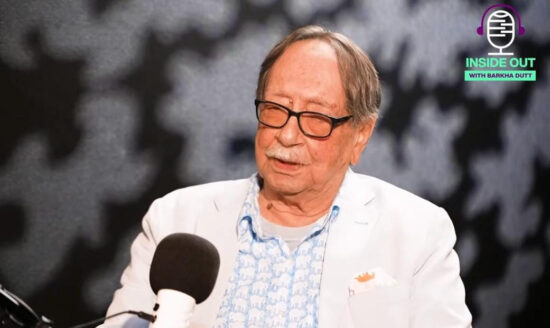
 When A.S. Dulat, a former chief of India’s external intelligence service, says Ajit Doval is “a much better spook” — even calling him a “perfect spook” — the line is crafted to travel. What is easy to miss, however, is that this was not said yesterday. The interview with Barkha Dutt premiered more than two years ago, but it has recently been surfaced again — whether through active promotion or the platform’s recommendation logic — and is now being consumed in a fresh context by audiences who may not even realise they are watching an older conversation. The soundbite, therefore, lands today with a force and meaning it did not necessarily carry at the time: as if it were a current, contemporaneous endorsement rather than a recirculated clip.
The Book Tour Incentive
The context is not incidental. Dulat made these remarks in conversation with journalist Barkha Dutt at a time when he has been prominently visible discussing his latest book, The Chief Minister and the Spy: An Unlikely Friendship. The book has been positioned as an insider’s narrative on Kashmir politics and relationships, and it has generated predictable turbulence — a controversy that has amplified both the author’s presence and the demand for his “inside” interpretations.
There is nothing inherently wrong in promoting a book. But readers should recognise the incentive structure. A retired intelligence chief’s main public-market commodity is not data — it is aura: the suggestion of proximity to hidden decision-making. A flattering comparison with a serving NSA therefore does double duty. It praises Doval, but it also keeps Dulat central to the story by making him the narrator who confers the crown.
A Quarter Century Later: New Rules, New Pieces
A quarter of a century has passed since Dulat headed RAW. In intelligence and internal security, that is not merely a change of faces; it is a change of era. The rules of the game have shifted — technology, surveillance, cyber operations, open-source intelligence, financial tracking, and information warfare have transformed both state capability and the speed at which narratives spread. And the chess pieces have changed too: institutional arrangements, political incentives, public expectations, and the international environment around Pakistan and Kashmir are fundamentally different from what they were at the turn of the millennium.
That simple fact should temper the authority with which any retired official speaks about today’s operational logic or strategic posture. Experience matters — but it is not a passport to timeless certainty.
Why “Doval Doctrine” Is a Mislabel
This brings us to the label itself. The problem is not that Ajit Doval is influential; he plainly is. The problem is that calling today’s posture a “Doval Doctrine” is a mislabel because it relocates doctrine from where it constitutionally belongs.
In a parliamentary democracy, doctrine is ultimately political. It may be publicly articulated, partially signalled, or deliberately left undeclared. But it originates in the elected executive’s mandate, priorities, and appetite for risk. The NSA can shape options, coordinate agencies, drive execution, and influence outcomes at the margin. Yet he cannot possess an autonomous doctrine independent of the Prime Minister’s constitutional authority and the government’s political direction.
Which is why the more accurate question is the one that should be asked openly: is what people call the “Doval Doctrine” actually an unambiguous but undeclared Modi Doctrine? The answer appears self-evident. The broad direction of travel — whatever one thinks of it — sits within a political architecture defined by Prime Minister Narendra Modi and his government. Ajit Doval is a pivotal executor within that architecture, not its sovereign author.
What Retired Spymasters Can — and Cannot — Know
A further caveat is necessary whenever retired intelligence chiefs speak with sweeping confidence about current operations. Yes, a former chief may continue to receive a trickle of information from professional relationships — former colleagues and subordinates who remain in service. That is natural in any close-knit field.
But it cannot be presumed that a retiree enjoys unrestricted access to classified information, or that he sees the full picture behind present-day decisions. Compartmentalisation is real. Leadership changes priorities. Current hierarchies control current flows. A trickle is not a pipeline, and familiarity is not authority.
The Democratic Bottom Line
Read Dulat’s praise of Doval, then, with clear eyes. It may reflect genuine admiration for a capable operator. It also sustains Dulat’s own relevance by placing him at the centre of the comparison he appears to concede. And it arrives at a moment when the author’s public stature is intertwined with a book whose commercial and political life depends on the value of the “insider” voice.
If India wants a healthier national security debate, it must outgrow the impulse to personalise policy. Respect competence, certainly. Debate policy choices robustly. But do not mislabel an unmistakably political line as one man’s private doctrine. If India is operating under a doctrine today, it is far closer to an undeclared Modi Doctrine — implemented with discipline by those the Prime Minister trusts — than to a freestanding doctrine of any individual official.
Share The KBS Chronicle
Share
Citations (clickable)
Barkha Dutt interview clip (with premiere date shown on YouTube): YouTube
Dulat’s tenure heading RAW (1999–2000): IPCS+1