
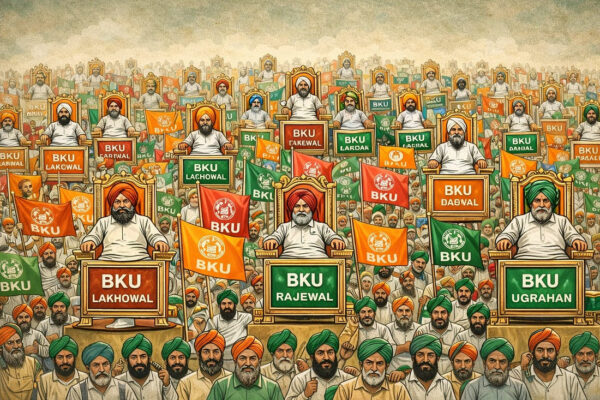
 As winter fog descends over Punjab’s fields, an old drama is staged once again. Meetings are announced, slogans resurrected, and calls for “farmer unity” amplified. Reports speak of gatherings by BKU Ekta Sidhupur and the Sanyukt Kisan Morcha (non-political), with familiar invocations of the 2020–21 agitation and its supposed lessons. Legal MSP, the Swaminathan Commission, debt waivers—every demand is dusted off and paraded again.
But this is not unity. It is choreography—once again.
With the 2027 Punjab Assembly elections drawing closer, farmer platforms are being mobilised not to resolve agrarian distress, but to blur political fault lines through dharnas, blockades and manufactured outrage—this time centred on the Electricity (Amendment) Bill and the Seeds Bill. Punjab has seen this script before. Farmers have always paid the price of such false narratives.
I have watched this degeneration from the beginning—having grown up as the son of an activist, with police knocking at our door in the early hours whenever a protest was announced.
In 1965, as a young activist confronting corruption within the Food Corporation of India, my father, S. Bhupinder Singh Mann, witnessed Punjab’s farmers being crushed between urban-biased policies and political indifference. In 1971, with colleagues such as Balbir Singh Rajewal and Ajmer Singh Lakhowal as general secretaries, he founded the Bharatiya Kisan Union (BKU) as a strictly non-partisan farmers’ organisation—one platform, one voice, for all cultivators. The BKU drew strength from earlier efforts like the Punjab Khetibari Zamindari Union and rose rapidly through the 1980s, confronting governments directly over pricing, subsidies and procurement.
The movement was national in spirit. In the late 1970s, when Tamil Nadu farmer leader Narayanaswamy Naidu lost seven workers during an agitation, BKU mobilised in large numbers to express solidarity. Naidu later addressed a massive rally in Hoshiarpur to acknowledge that support. The Batala Sugar Mill agitation of 1981 became another landmark, leading to the introduction of the calendar system and a revision in sugarcane prices.
The seven-day gherao of Punjab Raj Bhawan in 1984—under the presidentship of Bhupinder Singh Mann, with Lakhowal and Rajewal as general secretaries—remains one of the most consequential farmer agitations in Punjab’s history. The BKU announced a stoppage of wheat sales; until May 1984, not a single grain arrived in mandis. Panic followed in Delhi. Pamphlets were reportedly dropped from helicopters warning that the wheat blockade would not be allowed. Political parties too sensed the movement’s power and attempted to appropriate it, adding to confusion and escalation. Akali Dal announced that it will block the FCI godowns. Generel KS Brar, in his book “Operation Blue Star A true story” makes a reference that wheat blockage announced by BKU was one of reason for operation blue star.

A unified farmers’ force had emerged—and it had become a threat to entrenched political interests.
The BKU filled the vacuum left by a weakening Shiromani Akali Dal and marginalised the rigid ideological posturing of left-wing Kisan Sabhas. The focus remained practical: cheaper inputs, assured markets, access to technology, freedom from exploitative middlemen. Alongside Sharad Joshi, the All India Kisan Coordination Committee was formed to take these demands nationwide and Bhupinder Singh Mann was chosen as the first Chairman in 1982. During his tenure in the Rajya Sabha (1990–96), nominated by President of India for his contribution to farmers movement, these reforms, agro-industrialisation, market freedom and farmer choice were consistently pressed.
The first crack in the BKU did not emerge from ideology. It emerged from ambition.
In 1987, at the peak of BKU’s influence, Ajmer Singh Lakhowal broke away with open backing from the Akali Dal, forming BKU (Lakhowal). The shift was unmistakable—from farmer-centric mobilisation to political alignment. His nearly decade-long tenure as Chairman of the Punjab Mandi Board under an Akali-BJP government only confirmed what many already understood: the split was transactional. The Mann-Rajewal faction stayed the reformist course, but the damage was irreversible.
From there, fragmentation became a habit.
Lakhowal’s camp splintered repeatedly like an amoeba; first into BKU Ekta, then into further offshoots driven by ideological capture and political allegiances. By the early 1990s, left-wing cadres had begun embedding themselves within farmer unions, repackaging agrarian distress as class warfare. CPI(M) affiliates and its radical groups quietly entered rural Punjab through these platforms, exploiting the vacuum created after militancy. Simultaneously, Akali factions courted farmer leaders as vote banks, mirroring their own long history of splits and regroupings. Rajewal himself split from the parent organisation on 3rd November 2006 and parted ways with Bhupinder Singh Mann to chase his political ambitions which were later unravelled in 2022 polls.
Major National level split occurred on 2nd October 1989 at Boat club Delhi when Mahendra Singh Tikait’s goons threw Sharad Joshi from almost a twenty feet high stage in a gathering of lakhs. He had his own violent means which were never quite healthy for a peaceful movement. Mahendra Singh Tikait was a rustic, while Sharad Joshi was a trained economist who had worked with the United Nations and advocated for market liberalization and free trade in farm produce.
But politics and ideology alone do not explain the endless fragmentation. There is a more uncomfortable truth—ego.
A powerful driver of these splits has been the unchecked ego and ambitions of union leaders: the obsession to be president, convener or supremo, even if the organisation exists only on a letterhead. One-upmanship has replaced collective purpose. Leaders compete not to strengthen farmer bargaining power, but to pull each other down. Any dissenting voice, any call for realism or reform, is swiftly branded a “gadaar”. Sanity itself is declared betrayal. Dialogue is treated as treason.
This culture, where disagreement or an alternative view equals disloyalty—has hollowed out farmer movements from within. Once, the farmer’s cause was supreme. Today, it is often the last item on the agenda. What dominates instead is self-preservation, personal relevance and headline-hunting. Many so-called leaders are no longer fighting for kisans; they are fighting proxy battles—for political parties, for select business interests, or simply for their own pockets.
By the 2000s, Punjab’s farmer landscape resembled a political bazaar. One union waved saffron for Panthic patronage, another red flags for ideological relevance, a third leaned towards Congress convenience. By 2019, more than 35 BKU factions existed. Today, the number is far higher. Nearly every fifth village boasts its own “union”, complete with letterhead, loudspeaker and grievance.
This is no longer mobilisation. It is monetisation.
Road blockades are staged for “donations”. Development projects are stalled for leverage. Industries, highways, industrial belts and public projects are held hostage to protest theatrics, often at the command of invisible yet well-known forces. The agrarian face is used to legitimise coercion.
The 2020–21 Delhi border agitation was the exception, not the rule. For a brief moment, disparate unions appeared united. But even that agitation and unity was politically directed. Farm law reforms long advocated by Sharad Joshi and my father were misrepresented as corporate land grabs. Political opposition and left networks supplied narrative, logistics and amplification. Misinformation drowned nuance. The laws were repealed—but the aftermath exposed the truth. Unity collapsed instantly, spawning fresh factions, rival morchas and competing platforms allegations flew like anything. Mann was appointed by Supreme Court as a Member of a Committee to speak to the agitating farmers. But the “dialogue, talks, discussion” were elusive in their agitational agenda, hence he recused himself from the Committee.
Now the cycle repeats.
The Electricity (Amendment) Bill and the Seeds Bill have become fresh rallying points—fresh narratives, fresh misinformation. Concerns may exist, but the synchronised protests, district-level theatrics and recycled slogans reveal orchestration rather than organic farmer anxiety. The same left-aligned unions are again at the forefront, often sharing platforms with Congress-linked “people’s fronts”. One must ask plainly: is this about farmers—or about 2027?
Punjab today desperately needs investment, diversification and agro-industrial revival. Youth needs jobs, not dharnas, youth need vision, not to be pushed into chaos and anarchy. Haryana has attracted nearly ₹1 lakh crore in investments. Punjab repels them through permanent agitation and fear-mongering. The farmer pays the price—not the union leader, who enjoys administrative recognition, access to power corridors and courtesy meetings with the SSP and DC.
A Hard Truth for Punjab
True unity cannot be built on ego, patronage or ideological rigidity. It cannot emerge from leaders who thrive on chaos, survive on confrontation, and grow powerful by keeping farmers permanently agitated and permanently insecure. They survive on chaos. Punjab does not need more unions; it needs fewer egos. It does not need louder slogans; it needs honest reform.
Unless the farmer movement is reclaimed from self-styled messiahs, political middlemen and professional agitators, Punjab’s agriculture will not merely stagnate, it will collapse under the weight of personal ambition masquerading as public cause. The greatest threat to Punjab’s farmer today is not Delhi, not markets, not reform but the hijacking of his voice by those who claim to speak for him.