
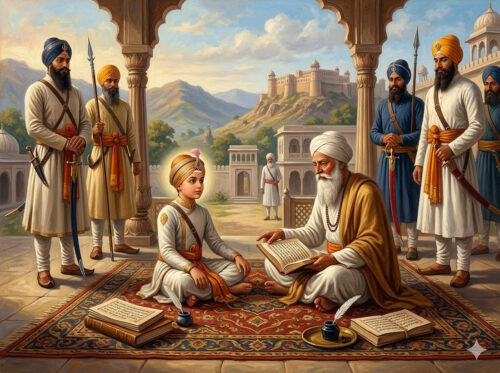
 From the very beginning of his life, Guru Gobind Singh appears in Sikh history not just as a gifted child, but as a divinely‑ordained personality around whom destinies were quietly being arranged. In this sacred choreography, two figures stand out: Mata Gujri Ji, who mothered, steadied and sanctified his life from birth to the last separation; and the relatively lesser known Pandit Kirpa Ram Dutt, the Kashmiri scholar whom the Guru honoured with the rare privilege of shaping his early education and then drew into the revolutionary fraternity of the Khalsa.
The divine child and his first sanctuary
Gobind Rai was born in Patna Sahib in 1666, the only son of Guru Tegh Bahadur and Mata Gujri. From the start, his childhood was framed not by worldly indulgence but by devotion and discipline. Shabads were his lullabies, the stories around him were of Guru Nanak’s compassion, Guru Hargobind’s saint‑soldier ideal, and the growing tension between imperial power and spiritual freedom.
Mata Gujri Ji’s role was not merely domestic. She knew that this child was the carrier of the Guru‑ship and the future of the Panth. As Guru Tegh Bahadur undertook long journeys, she became both mother and daily guardian of the young Guru’s body, mind and spirit. Under her watch, play was infused with remembrance of Waheguru, and affection was never separated from moral clarity. It was in this atmosphere that fearlessness and tenderness fused in the young Gobind Rai.
Kashmiri Pandits, a child Guru, and a turning point
By 1675, the Mughal policy in Kashmir had turned brutal, with forced conversions, humiliation of scholars, and the desecration of temples. A large delegation of Kashmiri Pandits, led by Pandit Kirpa Ram Dutt of Mattan, arrived at Anandpur Sahib, seeking not just political help, but a spiritual verdict: who would stand between them and the empire’s coercion?
They poured out their grief before Guru Tegh Bahadur. The young Gobind Rai witnessed their plight firsthand. When his father reflected aloud that only a supreme sacrifice by a great soul could halt this tide, the child answered with luminous simplicity that no one was greater than his own father. That utterance—springing from intuitive recognition of divine greatness in his father—crystallised the Guru’s resolve. Kirpa Ram thus became witness to the moment when the pain of Kashmir, the innocence of a child, and the courage of the Ninth Guru converged into the decision that would lead to the martyrdom of Guru Tegh Bahadur.
Pandit Kirpa Ram: from supplicant to honoured tutor
The martyrdom in Delhi, carried along the chain of events that began with that delegation, changed Kirpa Ram forever. Returning to Anandpur Sahib, he did not recede back into anonymity. Instead, he placed himself in the service of the very household that had paid the ultimate price for his people’s freedom of conscience.
It was now that Guru Gobind Rai, still in his youth but already bearing the mantle of Guru‑ship, extended a unique honour: he accepted Pandit Kirpa Ram Dutt as one of his teachers in Sanskrit and classical Indian learning. The Guru gathered around himself a constellation of scholars in multiple languages—Sanskrit, Persian, Arabic, Braj, Punjabi—and Kirpa Ram was among those who introduced him to the rich forest of shastra, kavya and puranic narrative.
In the worldly sense, the roles were clear: an elder Pandit, a young royal disciple. But spiritually the movement was in the other direction. The Guru allowed his mind to be trained, his intellect to be sharpened, his literary horizon widened; yet the very contact with the Guru’s vision and character gradually transformed the Pandit’s own understanding of Dharma. Ancient texts were read now against the living example of Guru Tegh Bahadur’s martyrdom and the emerging need for a community that would defend the weak with both compassion and the sword.
Mata Gujri: mother of a Guru, grandmother of martyrs
Throughout these years at Anandpur, while learned men like Kirpa Ram shaped the Guru’s study, Mata Gujri continued to shape his inner world. Widowhood did not reduce her to lament; it elevated her to a new kind of guardianship. She carried within her the memory of Guru Arjan’s martyrdom and now that of her own husband, and she helped her son interpret these not as tragedies, but as the highest affirmations of Sikh commitment to justice and religious freedom.
Later, when the Guru’s sons—the Sahibzade—were born, she became the spiritual matriarch of a second generation. She nurtured in them the same clarity she had instilled in their father: that there can be no compromise with oppression, even under threat of death. Her final journey to Sirhind, separated from Guru Gobind Singh and the elder Sahibzade, with the two younger grandsons in her care, is the ultimate testimony to this. In the cold tower of Sirhind she encouraged the boys to stand firm, and when they were bricked alive, her own life ebbed away in that same fort. In Sikh memory, she is wife, mother and grandmother of martyrs—and a martyr herself.
The birth of Khalsa and the place of Bhai Kirpa Ram
As the years passed, Guru Gobind Singh’s vision ripened. His deep learning in multiple traditions, his intimate knowledge of tyranny, and his immersion in the martyrdoms of his forefathers led him to a radical conclusion: words and arguments alone were no longer enough. The age required a new human type—a saint‑soldier whose identity erased caste, region and old hierarchies, and whose commitment to righteousness was total.
On Vaisakhi, 13 April 1699, at Anandpur Sahib, this vision took form. In a vast congregation, the Guru called for a head, and five men stepped forward from different backgrounds to become the first Panj Pyare. Admitetdly, Pandit Kirpa Ram Dutt was not one of these original first five. He is not counted among the Panj Pyare whose names are inscribed in every Sikh heart.
Yet his place in that day’s history remains profound. In the same congregation, under the same sky charged with the birth of the Khalsa, Pandit Kirpa Ram laid aside the distinction of Brahmin scholar and received Khande‑di‑Pahul. He became Bhai Kirpa Singh Dutt, a Khalsa of Guru Gobind Singh. He did not inaugurate the circle of the Panj Pyare, but he entered the same spiritual fraternity they had opened—no longer a learned outsider but a brother among the Guru’s saint‑soldiers.
This distinction matters. By keeping clear that he was not one of the first five, we preserve historical accuracy. By equally emphasising that he took Amrit in that very congregation, we honour the spiritual intimacy of his relationship with the Guru: the man who had once instructed the Guru now accepted initiation from the Guru’s own hand and joined the discipline founded that day.
Warrior and martyr in the Guru’s cause
After Vaisakhi 1699, Bhai Kirpa Singh Dutt’s life fully reflects the transformation the Khalsa was meant to bring. The Kashmiri Pandit who had once come to Anandpur as a representative of persecuted Brahmins now stood as a Khalsa warrior defending the Guru’s city against repeated assaults. He shared the hardships of siege, hunger and betrayal alongside the Guru and his Sikhs.
In the final act of his life’s drama, at Chamkaur in 1705, he attained martyrdom fighting in the front ranks. The journey that had begun in the temples of Kashmir, passed through the classrooms of Anandpur, and climbed to the heights of the Khalsa’s baptism, ended in the dust of battle at the Guru’s feet. His story thus binds together three great strands of Sikh history: the defence of persecuted Hindus without any demand for conversion, the honouring of scholarship while transcending caste, and the forging of a community in which teacher and disciple alike submit to the same code of sacrifice.
A shared orbit around the Tenth Guru
Seen together, the lives of Mata Gujri Ji and Bhai Kirpa Ram encircle the personality of Guru Gobind Singh in complementary ways. Mata Gujri offered him the cradle of faith, the early climate of love and resolve, and at the end, the gift of her own life and the lives of his younger sons. Pandit Kirpa Ram offered him the wealth of traditional learning and, in time, the testimony of a Brahmin scholar who willingly shed his inherited status to stand as Khalsa.
Both received their true stature not from their own birth or abilities, but from the way the Guru drew them into his mission. She became mother and grandmother of martyrs because she stood beside the Gurus without flinching. He became Bhai Kirpa Singh Dutt because he allowed the divine light he had once taught to remake him as a saint‑soldier. Around the blazing centre of Guru Gobind Singh’s life, their stories remind us that the greatest privilege any soul can receive is to share—even slightly—in the work of a Guru whose very purpose is to turn suffering into courage and ordinary lives into offerings. In these days between Hola Mohalla and Baisakhi, I felt that the story of Pandit Kirpa Ram deserved to be told.
Share The KBS Chronicle