
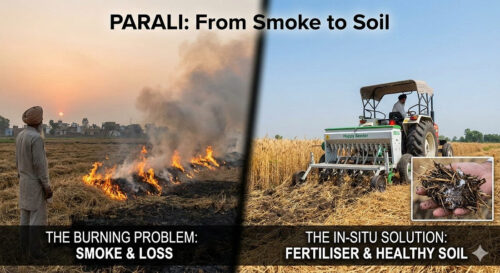
 Every October and November, North India rehearses the same tragedy: a narrow sowing window, a mountain of paddy straw, and a haze that travels farther than any political speech. We argue about blame—farmers, governments, courts, “Punjab”—and then do little to change the underlying arithmetic of time and incentives. Yet the most practical exit ramp is staring at us from the very fields we are fighting over: parali can be converted in situ into soil-improving organic matter, provided we stop pretending it happens “instantly” and start treating it as a managed biological process.
There is another truth we avoid because it complicates convenient narratives: the stubble crisis is not merely the consequence of Punjab’s choices. It is the after-effect of a national food system in which Punjab is a principal production platform for rice that is procured into the central pool. Much of this rice is not eaten in Punjab. It is grown to meet national procurement, stocking and distribution needs. When a state is effectively commissioned to produce for the national granary, it is intellectually dishonest to moralise the costs as if they are local misdemeanours. Responsibility sits as heavily in New Delhi as it does in Chandigarh.
The agronomic reality is simple. After rice is harvested, the gap before wheat sowing is tight—about 20–30 days in much of Punjab–Haryana. Burning is the fastest way to reset the field inside that window. So, any alternative that does not respect the clock will fail—no matter how moral the argument against burning sounds from an air-conditioned studio. If the Union Government’s procurement architecture continues to demand this cropping rhythm, it must also shoulder the burden of making residue management viable at scale.
What it really means to “turn parali into fertiliser”
“In-situ conversion” is not a slogan. It means keeping the residue in the field—either as surface mulch or incorporated into the topsoil—and decomposing it biologically instead of setting it alight. In practical terms, farmers retain or incorporate residues and, where needed, accelerate decomposition using microbial consortia along with moisture management. The straw is not magically transformed; it is processed—by microbes, water and time—into more stable organic matter that raises soil carbon and improves soil structure.

This matters because burning is not only an air-quality offence; it is also a nutrient bonfire. When straw is burnt, nitrogen, phosphorus, potassium and sulphur are lost along with organic carbon. What could have been returned to the soil becomes smoke and ash. If you think of straw as “waste”, you will burn it. If you think of it as unpaid fertiliser plus soil conditioner, you will manage it.
That shift in mindset cannot be demanded only of farmers. It must be mirrored by governments—state and Union—who have long treated Punjab’s soil and water as inputs into a national cereal factory. A system that rewards rice output while leaving residue costs on the farmer’s doorstep is not policy; it is outsourcing.
The hard truth: soil improvement is seasonal, not instant
A key reason farmers distrust “green solutions” is that many are sold as miracle cures. Soil does not work like a television advert. The benefits of residue retention show up over seasons, not in a single year. Long-term evidence from North India indicates that continuous residue retention or incorporation can meaningfully raise soil organic carbon—from roughly the low-0.4% range to around 0.7% over a decade or more—along with measurable improvements in humus and soil structure.
That is the promise: more organic carbon, better tilth, improved water relations, and a soil that is less brittle under heat and stress. But the timeline is also the warning: policy must help farmers survive the transition—the first few seasons when learning costs are highest and the fear of yield loss is real.
This is where the Government of India’s role becomes non-negotiable. If the centre expects Punjab’s farmers to continue producing for the central pool, it must finance the transition in the same spirit in which it finances procurement, storage and transport. Cleaner air cannot be an unfunded mandate.
Three pathways already exist—scale them properly
Punjab–Haryana do not need fantasies. They need execution. The core clusters of solutions are already well-known, but they need predictable, last-mile delivery.
1) Mulch-and-sow (Super SMS + Happy Seeder type systems).
One scalable route is to spread straw evenly during harvest and then directly sow wheat into the mulched field. The combine spreads residue uniformly; the seeding machine cuts and manages straw and places wheat seed while leaving straw as surface mulch. This protects the soil, conserves moisture, moderates temperature, and reduces the incentive to burn because it avoids the “clear the field first” compulsion.
This is also where public policy can be brutally practical. The farmer’s question is not whether the Happy Seeder is scientifically sound; it is whether the machine will arrive in time, whether the operator knows what he is doing, and whether the cost is bearable. Those are governance questions—and they span both Chandigarh and New Delhi.
2) Incorporation with microbial decomposers (Pusa Decomposer and similar).
Another route is decomposer-assisted decomposition. After harvest and chopping/spreading, a decomposer solution is sprayed, followed by light incorporation and irrigation so microbes can work quickly. Under good moisture and management, decomposition can be completed in roughly three to four weeks, allowing timely wheat sowing while converting residue into compost-like organic matter within the soil.
But decomposers are not magic capsules. If the irrigation schedule is wrong, if incorporation is poorly done, or if spraying services are absent, farmers will remember the failures, not the science. Governments must therefore treat microbial decomposition like a public health campaign: standard protocols, trained applicators, reliable supplies, and field supervision that prevents predictable mistakes.
3) Conventional incorporation with nitrogen balancing.
Where mulch-seeding machinery is unavailable, farmers can still incorporate residue by ploughing it into soil. But straw has a high carbon-to-nitrogen ratio, and microbes consume available nitrogen while decomposing it. Unless farmers adjust nitrogen fertiliser, wheat can face temporary nitrogen stress. This is not a flaw in the concept; it is basic biology. Good policy would treat nitrogen balancing as part of the package, not as the farmer’s private penalty for doing the right thing.
Here again, the Union Government cannot wash its hands. If it can calculate bonus and levy for procurement, it can also design transitional support for residue incorporation—whether through fertiliser advisory, soil testing, or targeted nutrient compensation.
The missing piece is not technology; it is trust, training, and last-mile delivery
When in-situ methods fail, it is usually because farmers are asked to change one thing (stop burning) while not being supported to change the linked things (seed rate, irrigation timing, pest vigilance, nutrient adjustments, and operations scheduling). Where farmers follow protocols, the outcomes are largely positive: soil health improves and yields are maintained or recover. Where protocols are ignored or poorly communicated, farmers report short-term yield dips, pest problems, or operational bottlenecks—especially when machinery is late or decomposer application is poorly timed.
That is the real scandal. Not that farmers burn—but that the state’s communication often stops at moral instruction instead of delivering a field checklist that prevents transitional problems. If government wants farmers to adopt in-situ management, it must supply not only equipment subsidies but also timed services, training, and agronomic support that makes the system work under real constraints.
And “government” here cannot be selectively defined. The Punjab Government has responsibilities in enforcement, extension, custom-hiring centres, and local logistics. The Government of India has responsibilities because the rice economy in Punjab is deeply shaped by national procurement, MSP signals, and the central pool. If New Delhi is a beneficiary of Punjab’s paddy, it is also a party to Punjab’s parali.
What an honest policy compact would look like
First, stop using enforcement as the headline and support as the footnote. The soil and air outcomes we want demand compliance—but compliance will not be stable unless it is economically and operationally rational within the farmer’s calendar.
Second, design packages, not parts. If a village is pushed toward incorporation, bundle decomposer access, sprayer and rotavator availability through custom hiring, a moisture plan, and nitrogen-balancing guidance. If a village is pushed toward mulch-and-sow, ensure the chain is complete: residue spreading at harvest, seeder availability immediately after, and reliable scheduling that matches the sowing window.
Third, treat custom hiring and reliable scheduling as infrastructure—like rural roads. The best machine is useless if it arrives after the sowing window has already narrowed to panic. If in-situ management is to win at scale, machines and services must arrive on time and at predictable rates, especially for small and medium farmers.
Fourth, align incentives with outcomes. As long as the national system encourages paddy acreage in a water-stressed region primarily to feed the central pool, it must internalise the environmental costs. One could imagine a simple principle: procurement policy must carry a residue-management covenant—funded, measurable and enforceable—rather than expecting farmers to bear the cost of a national stocking strategy.
The conclusion we keep avoiding
Parali burning is often portrayed as a moral failure. It is more accurately a system design failure under a brutal time constraint and a national procurement model that has leaned heavily on Punjab’s land and labour. The good news is that the alternative is not speculative. In-situ management—mulch-and-sow systems, decomposer-assisted decomposition, and nitrogen-balanced incorporation—has a clear technical basis and operational pathways that can work on real farms.
If Punjab is serious about ending farm fires, it must stop treating “no burning” as a command and start treating it as a service guarantee. If the Government of India is serious about clean air and climate commitments while continuing to draw rice from Punjab for national needs, it must stop acting like a distant referee and start behaving like a co-owner of the solution.
Only then does parali cease to be a pollutant and become what it always was: fertiliser we were foolish enough to burn—and a soil asset we can still rebuild, season by season.