
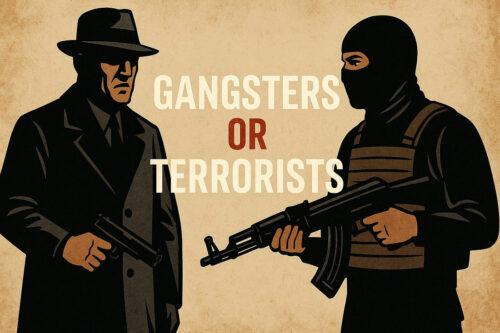
 What makes this question urgent is the disturbing mirror we now see in Canada. In Surrey, British Columbia, authorities have launched a multi-million-dollar crackdown on extortion and targeted shootings overwhelmingly directed at Punjabi-origin businesses and families. Canadian agencies openly state that many perpetrators — and many victims — are Punjabis. Deportations have already begun. A unified Extortion Task Force now brings together federal, provincial, and municipal bodies. Punjabi and Hindi victim-support guides are being issued.
Even more significantly, community leaders, lawyers, and public-safety groups are now demanding that these extortion and shooting networks be treated as terrorism offences because their actions terrorise entire communities, destroy livelihoods, and function like organised terror cells. The Law Society of British Columbia has formally warned lawyers about extortion attempts involving threats of physical harm, urging immediate reporting to police. (See links below.)
This forces us to face an uncomfortable truth in Punjab: a gangster is simply a terrorist without the colour of religion; otherwise, they are the same — with the same objective: to terrorise society for power or profit. One is driven by ideology, the other by greed. But both create the same fear, the same paralysis, the same destruction of public life. If a man can shoot, extort, kidnap, threaten, and choke economic activity, why pretend he is anything less than a terrorist? Canada has started recognising this reality. Punjab still hides behind soft vocabulary. Police trying to cover a bomb blast by calling it a Tyre burst. But till how long?
Meanwhile, back home, gangsterism has grown into a parallel system of authority. Extortion calls, WhatsApp threats, demand slips, and bullets fired at shops have become a part of daily life. Businessmen in Ludhiana, Moga, Bathinda, Mohali, and Jalandhar all say they feel unprotected, unheard, and increasingly helpless. What makes this grimmer is that many of the same gangs operating inside Punjab also run criminal networks abroad — especially in Canada, the UK, and Australia — targeting our own diaspora. That is Punjab’s tragedy: our sons become gangsters, and their victims are our own people everywhere.
The contrast with other States only deepens the concern. A relative from Uttar Pradesh recently visited us to invite us for a family wedding. Out of curiosity, I asked him how he feels living in UP as a minority, and what the law-and-order situation is like. His answer surprised me: UP has changed. Strict policing has brought a sense of safety he never felt earlier. Investment is flowing in, development is visible, and people feel the State is firmly in control. His experience revealed a simple truth: when a government focuses on law and order, everything else — economy, harmony, confidence — follows naturally.
And it made me wonder: if UP can be improved, why not Punjab? Are we waiting endlessly for such governance and courage?
Why does the crisis persist in Punjab? Because of the invisible but extremely powerful politician–police–gangster nexus that no government admits, but every citizen knows. My earlier oped explaining this nexus is at link below. Unless this nexus is broken, no “special drive,” no “anti-gangster squad,” no helpline, and no cosmetic announcements will restore public confidence. People are no longer impressed by speeches. They do not want a political letters written just for formality or for a press conference. Sincerity demands that the issue be raised seriously in Parliament through a starred question. What people want is simple: safety, dignity, and a government that refuses to bend before criminal elements.

Is former Member of Punjab Public Service Commission
A farmer and keen observer of current affairs
Let me be blunt: the AAP-led Punjab Government’s political image is collapsing rapidly because it is widely perceived as soft or failed on gangsterism. The political cost will be severe and irreversible if this perception does not change quickly. This issue will become a core theme for the 2027 elections. But voters will again be forced to choose among AAP, Congress, and the Shiromani Akali Dal all of whom carry historical baggage on gangsterism, with allegations flying about who introduced and cultivated gangs, who protected and partnered them, and who failed to control them. That leaves the untried BJP, so far, positioning itself as the “law-and-order alternative” whether justified or not.
Yet the solution for Punjab is not complicated. The State must push to legally classify organised gangster networks as terrorist organisations and deal with them accordingly. Their methods are identical; the law must treat them identically. The political-police-criminal nexus must be dismantled openly and ruthlessly. Victims must be given real protection, including multilingual outreach like Canada’s model. Cross-border cooperation must be strengthened because Punjab’s criminal problem no longer ends at its borders. And above all, the State must create real economic opportunities so young men do not see crime as a shortcut to power, mobility, and money.
Punjab has always been a land of courage; people who stood against tyrants, invaders, and oppressive systems. Today the enemy hides behind smartphones, foreign numbers, and political patronage but uses the same weapon: terror. If we keep calling gangster terror “just crime,” we surrender our future. If we confront it as what it truly is — terrorism — we reclaim our identity, our security, and our destiny. Punjabis everywhere, whether in Ludhiana or Surrey, deserve nothing less.