
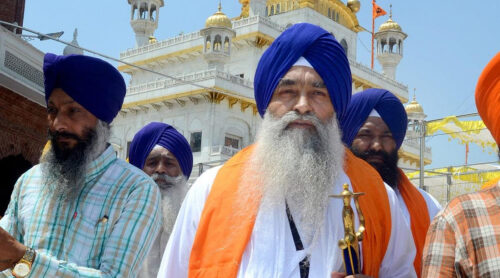
 Giani Raghbir Singh, the former Jathedar of the Akal Takht who presently serves as the Head Granthi (chief priest) of Sri Darbar Sahib (Golden Temple) Amritsar, held a dramatic press conference in Jalandhar today (Wednesday, 18 February 2026). In an unusually blunt intervention, he launched a scathing attack on the Shiromani Gurdwara Parbandhak Committee (SGPC) and the Badal family. The timing of the event—just a day ahead of the SGPC executive committee meeting scheduled for 19 February—immediately gave his remarks both institutional and political charge, sending tremors through Punjab’s panthic and political circles.
While a range of reactions is inevitable, the larger question is not merely what was said, but why it is being said now, and what moral and institutional weight it carries in the aftermath of his own tenure as Jathedar of Sri Akal Takht.
Key Allegations Against the SGPC and the Badal Family
At the core of Giani Raghbir Singh’s press conference was a series of serious allegations that amount to a direct challenge to the credibility of the SGPC leadership and what he described as the Badal family’s grip over Sikh institutions.
He alleged “massive corruption” within the SGPC and claimed that the Guru ki Golak (the community chest) is being plundered through illegal sale of properties, misappropriation of building funds, and questionable leasing practices involving SGPC land. He further raised the ongoing controversy relating to land linked to Gurdwara Amb Sahib in Mohali, alleging that gurdwara land had been sold at throwaway prices and that transparency in SGPC property transactions was lacking.
One of the more startling claims related to the langar. He alleged that dried rotis from the community kitchen were being sold and that crores of rupees were siphoned off through such practices. In a similar vein, he alleged that devotees were being asked to contribute up to ₹5 lakh for organising Akhand Path Sahib ceremonies at gurdwaras—amounts far beyond the nominal prescribed contribution.
He also revived the long-pending issue of 328 missing saroops (sacred copies of the Guru Granth Sahib), demanding accountability for their whereabouts. On this issue, he went further than a general demand for investigation, alleging that the Badal family had shielded SGPC employees linked to the matter.
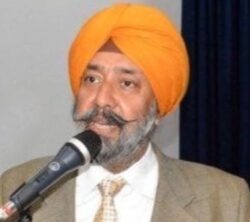
Controversial Decisions Under the Badal-Led SAD Government
Beyond allegations of corruption and mismanagement, Giani Raghbir Singh placed his critique in a broader political and moral frame by listing decisions taken during the Badal-led Shiromani Akali Dal government that, in his view, had weakened Sikh institutional credibility and fuelled successive crises.
He referred to the appointment of former DGP Sumedh Singh Saini, the controversial 2015 pardon granted to the Dera Sacha Sauda chief Gurmeet Ram Rahim, the clearance for the film MSG in Punjab, and what he described as the chain of events that culminated in the sacrilege incidents and the subsequent killing of two Sikh youths. By invoking these episodes together, he suggested a longer pattern of political patronage, institutional compromise, and consequential harm to Sikh sentiment.
Call for a Sarbat Khalsa
The most consequential announcement of the press conference was his call for a Sarbat Khalsa, described as the “need of the hour”. He declared that, if required in the interest of the Panth, he would not hesitate to call a Sarbat Khalsa, arguing that only such a collective assembly could now restore the sanctity and credibility of Sikh institutions.
He appealed to Damdami Taksal, Nihang Singh organisations, the Nirmala and Udasi sects, farmers’ unions, and Sikh bodies in India and abroad to set aside ideological differences and unite on a common platform. His stated objective was to free the SGPC from what he described as the grip of select interests.
Firm Stand on the 2 December Hukamnama
Giani Raghbir Singh also reiterated his firm stance on the Hukamnama issued on 2 December 2024 by the five Singh Sahiban—an Akal Takht decree that called for Sukhbir Singh Badal’s resignation as president of the Shiromani Akali Dal. He declared that he would “not retreat even an inch” from his stand on that decree.
This assertion is politically significant because his removal as Akal Takht Jathedar in March 2025 by the SGPC executive committee is widely viewed as retaliation for supporting that very decree against the Badal faction. The SGPC’s formal reason was “inadequate leadership”, but critics of the SGPC and several opposition Sikh groups interpreted the removal as politically motivated—an attempt to neutralise Jathedars who had stood by the December 2 decree.
Background and Context: The Office, the Authority, and the Unanswered Questions
Giani Raghbir Singh was appointed Akal Takht Jathedar in June 2023 and removed in March 2025. He continues to serve as Head Granthi of Sri Harmandir Sahib (Golden Temple). Yet, while the institutional history is important, it does not exhaust the moral question now posed by his public intervention.
Divergent reactions to his press conference are likely precisely because many will feel that, whatever the merits of the allegations, this is a belated raising of issues that were within his remit when he held the highest Panthic office. When he was Jathedar of the Akal Takht, it was his duty to secure implementation of the Hukamnama issued under his stewardship by the five Singh Sahiban, dated 2 December. That decree was meant to function as a Panthic directive backed by the authority of the Takht—not as an optional recommendation that could be honoured in rhetoric and ignored in practice.
Instead, his approach during that period appeared ambivalent. At a time when his leadership required continued presence in Amritsar, he undertook a foreign tour. The vacuum created by that absence was not merely physical; it created room for the decree’s opponents to set the narrative, to stall compliance, and to present their own interpretation as the practical inevitability.
The Supervisory Committee That Never Supervised
Equally central to the story is the seven-member committee constituted as a supervisory body for the new membership drive of Shiromani Akali Dal, headed by SGPC President Harjinder Singh Dhami. It was expected to become active and to discharge a supervisory role in accordance with the Hukamnama. As a matter of record, it did not undertake any supervisory role whatsoever. There was no effective oversight, no demonstrable enforcement, and no visible institutional will to translate the Akal Takht’s directive into an operational programme capable of preventing factional capture.
Consequently, the Sukhbir Badal faction continued to act on its own, ostensibly in accordance with the party constitution, and in effect in disregard of the Hukamnama. The familiar pretext was invoked: that compliance with the Akal Takht’s directive might lead to deregistration by the Election Commission. Yet this was precisely the point at which Panthic leadership and institutional stewardship were required—to secure legal clarity, to craft a compliance path that did not create avoidable electoral vulnerability, and to insist that constitutional or regulatory arguments could not be used as a blanket veto on the Takht’s moral authority.
No such institutional synthesis emerged. The outcome was not reform, but drift.
Removal and the Possibility of a Swan Song
In March 2025, Giani Raghbir Singh was removed as Jathedar of Sri Akal Takht and reverted to his substantive position as Head Granthi. Against that backdrop, his renewed public aggression now invites an additional interpretation. It is possible—though not provable—that he had prior information that some detrimental decision concerning him might surface in the SGPC executive committee meeting scheduled for 19 February 2026. If so, this press conference may also be read as a swan song: a final effort to reclaim moral centrality and pre-emptively frame any forthcoming institutional action as punitive retaliation for speaking out.
Reactions and Political Ripples
While no formal response from the Shiromani Akali Dal (Badal) had been issued at the time of publication, it is widely expected that the party will seek to delegitimise Giani Raghbir Singh by portraying him as a pawn of “anti-Panthic forces”—a familiar line of attack that typically relies on insinuation rather than attribution, pointedly avoiding any direct naming of the RSS or the BJP. Meanwhile, the press conference has already triggered heightened political and religious activity: opposition Panthic groups and youth organisations have reportedly welcomed the call for a Sarbat Khalsa, even as palpable unease is said to prevail within the SGPC and the Shiromani Akali Dal establishment. The ruling party, for its part, has also moved quickly to appropriate the moment, holding its own press conference and urging the Sikh community to “free” gurdwaras from what it described as Badal family control.
Yet public excitement and political opportunism are not the same as durable mobilisation. A press conference can disturb the day’s narrative; it rarely builds an enduring movement unless it connects to a disciplined organisational effort, resources, and credible leadership.
The Union Ministry of Home Affairs and the Democratic Deficit
There is also a wider institutional shadow that cannot be ignored: the role of the Union Ministry of Home Affairs, Government of India. Far from conducting elections to the general house of the SGPC—the last such elections having been held in 2011—the authorities have not even appointed a Chief Commissioner of Gurdwara Elections, after the previous incumbent Justice S. S. Saron demitted office. This prolonged inaction has contributed to a democratic deficit at the heart of what is, in effect, the mini-parliament of the Sikhs.
A genuinely cleansing and corrective step would be the holding of fresh general elections to the SGPC full house. Such elections would not merely refresh the institutional mandate; they would also allow young Sikh men and women who have since attained the voting age of 21 years to participate in the democratic selection of the body that manages Sikh shrines and resources, and that carries enormous symbolic and practical authority in Sikh public life.
Likely Political Impact: Why the Dent May Not Come
In our personal opinion, Giani Raghbir Singh’s belated intervention is not likely to create any significant dent in the overall structure of Akali or Panthic politics. The alternative platform—Shiromani Akali Dal Punar Surjeet—has not gained traction. Its president, Giani Harpreet Singh, appears increasingly isolated, with hardly any financial or manpower resources at his command. In such circumstances, even a strong religious figure’s denunciation, however dramatic, may not translate into a reconfiguration of forces.
The SGPC, as an institution, is not dislodged by rhetoric alone, and the long-entrenched Akali machinery is unlikely to concede ground merely because allegations have been publicly aired. Moreover, the Sikh public sphere has seen cycles of outrage before; the conversion of outrage into sustained institutional change is invariably the hardest step.
Sarbat Khalsa: How Panthic and Akali Politics Will Crystallise
Having said that, Punjab’s religio-political arena rarely remains static. The coming period will reveal whether this episode becomes merely another intense but transient moment, or whether it interacts with wider undercurrents—public discontent, organisational fracture, youth mobilisation, and electoral calculations—to alter alignments as the state moves towards the next election.
Any invocation of a Sarbat Khalsa also carries the weight of the most recent precedent—and that precedent is sobering. The last high-profile Sarbat Khalsa, convened on 10 November 2015 at Chabba (on the Jhabal Road, Amritsar), adopted resolutions that included the appointment of the incarcerated Jagtar Singh Hawara as Jathedar of the Akal Takht. The SGPC, emboldened by the open backing of the Parkash Singh Badal-led government then in power, refused to recognise those decisions, asserting that the appointment (and removal) of the Akal Takht Jathedar lay squarely within the SGPC’s statutory remit under the Sikh Gurdwaras framework. That earlier stand-off illustrates the practical constraint that confronts any such call: even if a Sarbat Khalsa is convened and resolutions are passed, institutional acceptance is neither automatic nor assured. It is for this reason that the latest call for a Sarbat Khalsa may not gain much traction—particularly in the absence of an immediate, catalytic trigger of the kind that existed in 2015, when serial incidents of sacrilege and desecration of Sri Guru Granth Sahib saroops and angs ignited a wave of fury across the Sikh community, most intensely in rural Punjab. The legitimate way forward, therefore—so that this cycle of confrontation is not endlessly repeated—is to proceed towards fresh SGPC elections, which are now long overdue and remain the only durable democratic corrective capable of restoring institutional legitimacy.