
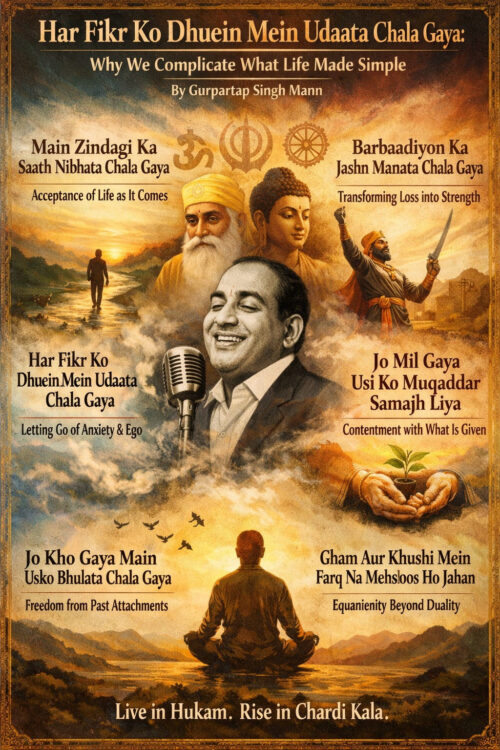
 Recently, in my YouTube music feed, a timeless melody—Main Zindagi Ka Saath Nibhata Chala Gaya from the film Hum Dono, written by the legendary poet Sahir Ludhianvi and immortalised in the voice of Mohammed Rafi.
What seemed like nostalgia soon revealed itself as philosophy—clear, practical, and profoundly relevant to our times. The entire philosophy of life, captured in a few lines.
We are a society that has learned to complicate what was originally simple. Our traditions gave us clarity; we replaced it with confusion. Our philosophies taught balance; we chose excess. And in doing so, we have burdened life with a weight it was never meant to carry.
Let us return, then, to the song—line by line—and rediscover the wisdom we have overlooked.
1. “Main zindagi ka saath nibhata chala gaya”
Acceptance of Life as It Comes
This line reflects the idea of flowing with life without resistance.
· In Sikhism, this is Hukam—the foundational principle articulated by Guru Nanak: “Hukmai andar sabh ko, bahar hukam na koe”. To live in acceptance is not passivity—it is spiritual alignment with the Divine Order. “Hukam Rajai Chalna, Nanak Likhia Naal”
· The Sikh Gurus further emphasised Sehaj—a state of natural, effortless living, where one moves with life rather than against it.

· In Hinduism, this resonates with Nishkama Karma in the Bhagavad Gita—action without attachment.
· In Buddhism, it reflects acceptance of impermanence (Anicca).
👉 The essence: “Live in Hukam—do not resist life.”
2. “Har fikr ko dhuein mein udaata chala gaya”
Letting Go of Anxiety and Ego
· In Sikhism, the Gurus repeatedly warned against Haumai (ego) and Moh (attachment) as the root of mental unrest. “Haumai deeragh rog hai”—ego is a chronic disease. Freedom comes through Naam, not worry.
· Sikh teaching does not advocate escape, but clarity—when one lives in remembrance (Naam Simran), anxiety naturally dissolves.
· In Hindu thought, this is Vairagya—detachment from mental agitation.
· In Buddhism, dukkha arises from craving; letting go ends suffering.
👉 The line teaches: “Fikr is not fate—it is a creation of Haumai.”
3. “Barbaadiyon ka shok manaana fizool tha, barbaadiyon ka jashn manaata chala gaya”
Transforming Loss into Spiritual Strength
· In Sikhism, this is the spirit of Chardi Kala—not merely enduring adversity, but rising above it. The lives of the Sikh Gurus—from Guru Arjan’s martyrdom to Guru Gobind Singh’s unparalleled sacrifices—demonstrate acceptance without despair and resilience without bitterness.
· This is not denial of suffering; it is transcendence of it. Loss does not define the individual—the response to it does.
· In Hinduism, this reflects the deeper acceptance of karma—destruction is part of cosmic balance.
· In Buddhism, suffering becomes a pathway to awakening when understood.
👉 The message: “Do not mourn destruction—rise above it with Chardi Kala.”
4. “Jo mil gaya usi ko muqaddar samajh liya”
Contentment with What Is Given
· In Sikhism, this reflects “Tera Bhana Meetha Lage”—accepting the Divine Will as sweet, even when it is difficult. The Gurus taught gratitude, not grievance.
· Sikh thought emphasises Santokh (contentment) as a pillar of spiritual life—without it, no inner peace is possible.
· In the Bhagavad Gita, this is Santosha.
· In Buddhism, it is Upekkha—equanimity.
👉 The idea: “Contentment is not compromise—it is clarity.”
5. “Jo kho gaya main usko bhulata chala gaya”
Freedom from Past Attachments
· In Sikhism, the Gurus emphasised living in the present through Naam. Regret and attachment to the past are forms of Moh that bind the mind.
· The Sikh path is forward-looking—rooted in remembrance, not in regret.
· Hindu philosophy similarly cautions against attachment to outcomes.
· Buddhism teaches that clinging to the past sustains suffering.
👉 The message: “Do not let the past occupy the space meant for awareness.”
6. “Gham aur khushi mein farq na mehsoos ho jahan”
Equanimity Beyond Duality
· In Sikhism, this is the lived reality of Gurmukh—one who remains steady in both adversity and success. Chardi Kala is not situational optimism; it is a disciplined inner state.
· The Sikh Gurus demonstrated this balance—grace in suffering, humility in strength.
· The Bhagavad Gita calls this Sthitaprajna.
· Buddhism defines it as ultimate equanimity.
👉 This is the highest state: “Beyond duality lies freedom.”
The tragedy of our times is not that wisdom is absent—it is that we have stopped living it. We continue to search for complex answers to problems that have already been addressed with remarkable simplicity.
What the Sikh Gurus lived, what our scriptures articulated, a poet like Sahir Ludhianvi captured in a few effortless lines.
Life was never meant to be controlled at every step. It was meant to be lived—in Hukam, with Santokh, and in Chardi Kala.
The wisdom is not hidden. It is already known. The only question is can and will we live it?
🎵 Lyrics
Main zindagi ka saath nibhata chala gaya
Har fikr ko dhuein mein udaata chala gaya
Barbaadiyon ka shok manaana fizool tha
Barbaadiyon ka jashn manaata chala gaya
Jo mil gaya usi ko muqaddar samajh liya
Jo kho gaya main usko bhulaata chala gaya
Gham aur khushi mein farq na mehsoos ho jahaan
Main dil ko us maqam pe laata chala gaya
Main zindagi ka saath nibhata chala gaya
Har fikr ko dhuein mein udaata chala gaya