
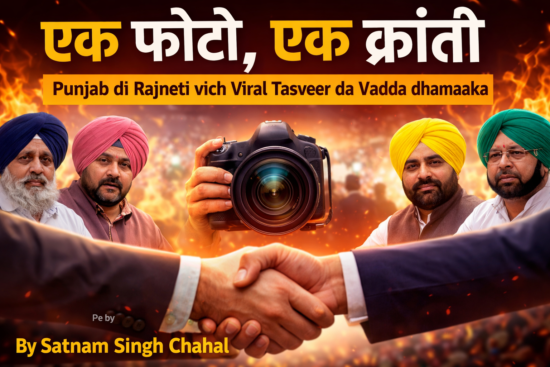
In today’s highly competitive world, degrees are optional, skills are negotiable, but one thing that truly guarantees “success” is a well-timed photograph with a political leader. Yes, the modern ladder of achievement no longer rests on hard work or perseverance it rests on how close you can stand to a Netaji while smiling confidently into a camera that may or may not belong to you.
There exists a special breed of citizens who have mastered this ancient yet modern art. They are neither politicians nor celebrities, yet their social media profiles suggest otherwise. Their bios often read: “Social Worker | Political Analyst | Close Associate” a title earned not through years of service, but through one slightly blurred photo taken at a crowded rally where the leader is barely visible behind five layers of security and fifteen other “close associates.”
The process is almost scientific. Step one: attend any political event, preferably where free snacks are available. Step two: slowly infiltrate the crowd near the leader. Step three: stretch your arm like a professional cricketer diving for a catch and click at least 47 photos in under 10 seconds. Step four: go home, crop out everyone else, zoom in until pixels start crying, and finally post with the caption: “Had a detailed discussion today about the future of the nation.”
The real magic begins after posting. Suddenly, long-lost relatives start commenting, “Proud of you!” Friends begin asking for “contacts,” and a few people might even request help with transfers, jobs, or getting their electricity bill reduced. Overnight, you transform from “that guy who never paid chai money” to a “well-connected personality.” Such is the power of one photograph.
Interestingly, these photos are treated like investment assets. Just like stocks, they are reused multiple times. A single image with a leader can be reposted on birthdays, anniversaries, election seasons, and even random Tuesdays when engagement is low. Some experts even maintain a “photo portfolio” with leaders from different parties just in case the political wind changes direction. After all, flexibility is the key to survival.
Of course, the leaders themselves are unaware of this silent revolution. For them, it’s just another handshake in a sea of faces. But for the selfie-taker, it is a life-changing milestone—a moment that justifies buying a new shirt, borrowing a friend’s sunglasses, and skipping work for the day.
But let’s not underestimate the economic impact of this phenomenon. Local photographers, mobile data companies, and even photo-editing apps are thriving because of this “photo economy.” Entire careers are being built on the foundation of one smile and one lucky click. If GDP calculations included “political selfies,” we might already be a superpower.
In the end, the truth is simple: some people believe that standing next to power is the same as having power. And while that may not always translate into real influence, it certainly guarantees one thing an upgraded WhatsApp display picture and a temporary boost in social status.
So the next time you see someone proudly posting a photo with a political leader, don’t question what they gained from it. The answer is obvious: respect, recognition, and at least 200 likes—arguably the most valuable currency of our times.