
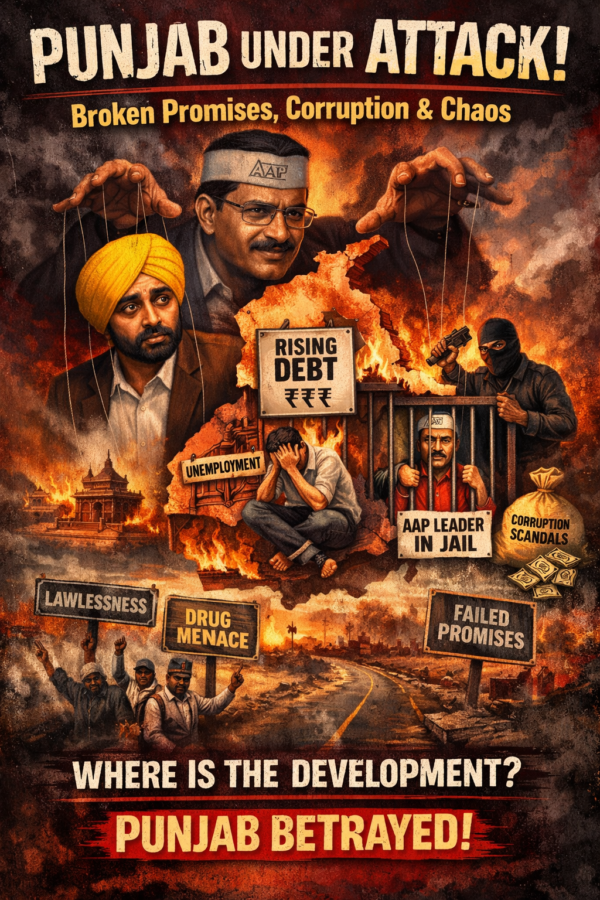
 Punjab, once regarded as one of India’s most progressive and prosperous states, has been going through a period of intense political and administrative transition since the rise of Bhagwant Mann under the Aam Aadmi Party government in 2022. While the leadership continues to present its governance model as reform-driven and people-centric, critics argue that both direct decisions and indirect consequences have significantly impacted the state’s administrative strength, economy, and institutional credibility.
One of the most debated issues is the perception that Punjab’s governance is not entirely independent. Opposition parties have repeatedly alleged that key decisions are influenced by central leadership outside the state, particularly by figures like Arvind Kejriwal. This has given rise to the narrative of “remote-controlled governance,” suggesting that Punjab’s unique needs and priorities may not always be at the forefront. Even if partially political in nature, such perceptions have indirectly weakened public confidence and raised concerns about the autonomy of state leadership.
Another area of major criticism lies in administrative appointments and the functioning of government departments. There have been allegations that certain individuals with controversial backgrounds or prior accusations were either reinstated or given important responsibilities within the system. Critics argue that such decisions directly damage the credibility of governance, especially when the government had come to power promising transparency and a corruption-free administration. These concerns have led to questions about whether systemic reform has truly taken place or whether old practices continue under new leadership.
The issue of corruption has also remained a sensitive and controversial subject. Despite strong claims of zero tolerance, incidents involving members of the ruling establishment have surfaced from time to time. These episodes have provided ammunition to opposition parties, who argue that corruption has not been eliminated but merely changed form. Even when action is taken, critics say that repeated occurrences indicate deeper structural weaknesses. This not only directly affects governance but also indirectly erodes the moral authority of the government.
Law and order has further contributed to the ongoing debate. Incidents involving elected representatives and criminal allegations have raised serious concerns about candidate selection and political accountability. Such developments create a perception of instability and weaken the trust citizens place in their leaders. Even isolated cases can have a broader indirect impact by shaping public opinion about the overall functioning of the administration.
Economically, Punjab continues to face significant challenges, particularly regarding rising debt and limited revenue growth. While these issues are not new, critics argue that there has been little structural improvement under the current government. The financial strain affects development projects, job creation, and welfare schemes, thereby indirectly slowing down the state’s overall progress. For a state already battling agrarian distress and unemployment, economic mismanagement can have long-lasting consequences.
The gap between promises and delivery has also become a focal point of criticism. The government had entered power with ambitious commitments, including employment generation, drug eradication, and systemic reforms. While certain initiatives have been launched, many observers believe that progress has been slower than expected. This mismatch between expectations and outcomes has contributed to growing public dissatisfaction, especially among youth and working-class communities.
Adding to these challenges is the issue of internal dissent and political coordination. Reports of disagreements within the ruling party itself suggest that governance is not always cohesive. When leaders within the system raise concerns, it indirectly signals a lack of unity and consistency in decision-making. This can slow down policy implementation and create confusion at the administrative level.
At the same time, it is important to note that the government continues to highlight its achievements in sectors such as healthcare, education, and anti-corruption drives. Supporters argue that systemic change takes time and that the administration is moving in the right direction. However, critics maintain that the gap between narrative and ground reality remains significant, particularly in rural areas and among economically weaker sections.
In conclusion, the impact of the present government on Punjab is complex and deeply contested. Direct decisions related to appointments, governance, and policy-making have had visible consequences, while indirect factors such as perception, trust deficit, and economic pressure have further shaped the state’s trajectory. Punjab today stands at a critical juncture, where the effectiveness of governance will determine whether it can reclaim its legacy of growth and stability or continue to struggle with ongoing challenges.