
 The quiet coastal city of Astoria, Oregon, known today for its Victorian charm and maritime heritage, holds a far more revolutionary past than most residents realise. More than a century ago, this small American town became the birthplace of one of the most influential anti‑colonial movements in Indian history: the Gadar Party. What is now a city with only a handful of Indian American families was, in the early 1900s, home to a thriving Punjabi immigrant community whose courage and political awakening helped shape the global struggle for India’s independence.
According to official records from 1910, Astoria was home to at least 74 Indian men, almost all of them Sikh labourers from Punjab, who worked in the lumber mills along the Columbia River. These men, labelled “Hindus” in government documents regardless of their actual faith, lived in bunkhouses, worked gruelling shifts, and endured harsh racial discrimination. Yet, despite the challenges, they built a close-knit community grounded in solidarity, resilience, and a shared longing for justice.
It was within this environment that the seeds of the Gadar Movement were planted. In May–June 1913, Punjabi workers, students, and activists gathered in Astoria’s Finnish Socialist Hall to hold what is now recognised as the first founding conference of the Gadar Party. This meeting, small in number but monumental in impact set in motion a global revolutionary movement dedicated to overthrowing British colonial rule in India.
Oregon Governor Kate Brown, in her message to the Gadar Memorial Foundation, highlighted the significance of this moment. She noted that at a time when Sikhs and Punjabis faced severe discrimination across the West Coast, the community in Astoria chose not to retreat but to organize. “Over a century ago, the Gadar Party made strides in both India and the West that paved the way for Indian independence from colonial Britain. When facing harsh discrimination, Sikhs and Punjabis turned to the law and demanded justice,” she said.
The rediscovery of Astoria’s role in the Gadar Movement is itself a remarkable story. For decades, the 1913 meeting was absent from mainstream historical accounts. It resurfaced only when historian Johanna Ogden uncovered archival evidence during her research into early Punjabi migration. Her findings revealed that Astoria unlike many other West Coast towns—had been a relatively safe haven for Indian immigrants, thanks in part to the presence of Finnish socialists and labor radicals who welcomed them into their organizing spaces. Ogden’s work prompted her to write to the Astoria City Council, urging recognition of this forgotten chapter.
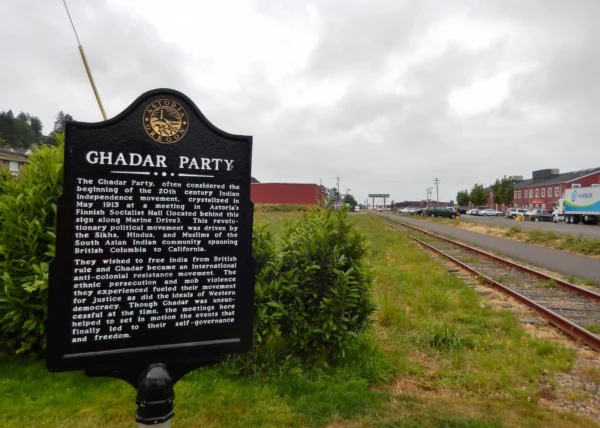
In response, the city installed a commemorative plaque in a park adjacent to the original meeting site. The plaque acknowledges the Gadar Party’s early efforts and reads:
“Though Gadar was unsuccessful at the time, the meetings here helped to set in motion the events that finally led to their self-governance and freedom.”
The plaque was stolen , but the city supported by local community leaders reinstalled it, reaffirming its commitment to preserving this history. One of the key figures in this revival is businessman who helped establish the Gadar Memorial Foundation of Astoria. Singh, who runs a successful chain of grocery stores across Oregon, emphasized the importance of honoring the pioneers who gathered here more than a century ago. “This is the place where the seeds of the Gadar Party were laid. It is our endeavor to revive it for future generations,” he said.
The foundation now plans to make the commemoration an annual event and hopes to build a permanent memorial in Astoria. Their efforts have gained support from state leaders, including Oregon Attorney General Ellen F. Rosenblum, who announced that the story of the Gadar Party in Astoria will be incorporated into the state’s school curriculum. She acknowledged that while Astoria was more welcoming than other parts of the West Coast, Punjabi immigrants still faced racism and exclusion. “Your history here is complex and subject to much of the same racism and classism that we face today,” she said. “We are committed to doing everything we can to oppose this basic injustice.”
The recent commemorative event, held on the banks of the Columbia River, drew hundreds of Indian-Americans from Oregon, Washington, California, and even British Columbia. The celebration featured speeches from community leaders, Sikh martial arts demonstrations, and vibrant bhangra performances symbolic reminders of the cultural strength and resilience of the early Punjabi pioneers.
Today, as the Gadar Memorial Foundation works to preserve this legacy, Astoria stands as a testament to the global nature of India’s freedom struggle. The story of the Gadar Party’s first meeting born in a small American lumber town remains a powerful reminder that the fight for justice and dignity transcends borders. The revolution that began in Astoria continues to inspire generations across continents, ensuring that the sacrifices of those early Punjabi immigrants are never forgotten.