
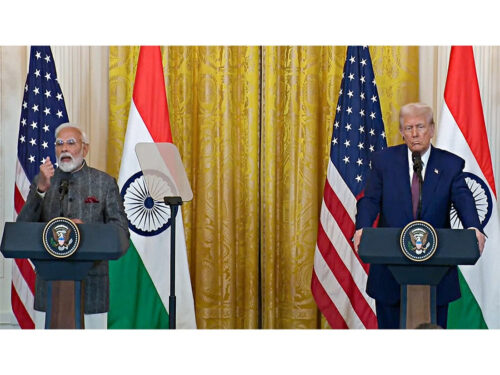
Donald Trump’s fulsome post, echoed warmly by Prime Minister Narendra Modi, marks the most consequential reset in India–US trade relations in years. Far from a one-sided concession, the emerging compact reads as a hard-nosed bargain in which India secures significantly better access for its exports, while keeping its strategic and economic flexibility intact.
One fact anchors the optimism: the United States continues to be India’s largest export destination in dollar terms, accounting for 17.74% of India’s merchandise exports in FY 2023–24, and rising further to 18.92% in April–September 2024–25. That share is only bound to increase—notwithstanding the European Union deal, the mother of all deals—because the sheer scale of American demand, combined with a better tariff position, will keep pulling Indian firms into deeper, longer-running commercial relationships across sectors.
The 18% tariff and the “$500 billion” promise
At the heart of the announcement lies Washington’s decision to cut its special “reciprocal” tariff on Indian goods to 18%, down from the earlier punitive band. That single number matters because it puts India at the lower end of the new US tariff spectrum, often below what comparable emerging economies face. For Indian exporters, especially in sectors like engineering goods, textiles, footwear, pharma formulations and processed foods, the cost advantage over regional competitors could be decisive.
Overlaying this is Trump’s claim that India has committed to buy “over $500 billion” worth of American energy, technology, agricultural and other products. Crucially, there is no specified time frame and no detailed, legally binding schedule in the public domain. That makes the figure more of an ambition and a political marker than a rigid quota. India is signalling that as its economy grows and diversifies, a large share of its incremental imports and investment can, and likely will, come from the US—but on market-based terms rather than through a forced, time-bound shopping list.
Seen together, the tariff cut and the aspirational $500 billion number create a virtuous narrative: India gets systematically better access to the world’s biggest market; the US gets the prospect of a rapidly expanding customer and investment destination.
Oil, Russia, and Venezuela: autonomy preserved
Energy is where Trump’s messaging is most dramatic: he speaks of India agreeing to stop buying Russian oil and instead buying “much more” from the US and potentially Venezuela. It is important to parse this calmly.
In practice, India’s purchases of Russian oil have already been on a gradual adjustment path. Discounts have narrowed, logistics and payment channels have become more complicated, and refiners have been rebalancing their baskets in any case. The new understanding nudges this existing trajectory rather than abruptly reversing it.
At the same time, Venezuelan crude is re-entering global markets as sanctions ease and waivers expand. That means India is not being funnelled into paying a “political premium” for US oil alone; instead, it is gaining access to a broader menu of suppliers, including American and Venezuelan barrels, which can compete on price and quality. The underlying logic remains commercial: refiners will buy the grades that make economic sense.
In other words, India is not surrendering its strategic autonomy in energy. It is using the diplomatic opening to normalise its Houston-to-Venezuelan sourcing options while retaining the freedom to adjust purchases as prices and geopolitics evolve.

Positioned well in America’s tariff landscape
The broader context is instructive. Trump’s second stint in office has been defined by aggressive use of “reciprocal” tariffs across partners. The European Union, for instance, began by facing sharply higher duties on cars, steel and some green-tech products, and had to negotiate sectoral relief step by step. Several ASEAN economies have also been bracketed in high-teens or low-twenties tariff bands on a range of goods.
By contrast, India’s 18% slab now looks distinctly favourable. It is not zero—nor should it be, given that New Delhi legitimately wants to retain bargaining chips—but it is low enough to confer an advantage relative to many competitors. Indian exporters who have already invested to meet demanding EU and UK standards can now amortise that effort across the US market as well, using the same upgraded plants, processes and compliance systems.
This sits comfortably alongside India’s own deals with the UK and its ongoing engagement with the European Union. The pattern is clear: India is slowly but surely stitching itself into the higher-income world’s trading architecture, on terms that combine better market access with calibrated protection for sensitive sectors.
Why Indian exporters stand to gain
For India’s outbound sectors, the balance of advantage is evident.
A structurally weaker rupee amplifies the benefit of lower tariffs. A currency that is modestly soft, but stable, makes Indian prices more attractive in dollar terms. When you add a tariff cut on top, the combined effect can be powerful: a few percentage points in duties plus a currency edge often determine who wins the order in sectors like auto components, machine tools, speciality chemicals and consumer goods.
Meanwhile, Indian exporters have already been climbing the quality ladder. To serve the EU, UK and other negotiated partners, they have had to upgrade everything from packaging and traceability to labour and environmental standards. Those sunk costs now pay an extra dividend as firms use the same capabilities to compete in the US.
The $500 billion narrative itself, handled wisely, is a positive signal. It tells global buyers and investors that the political leaderships in Delhi and Washington see this as a long-term, expanding relationship rather than a tactical truce. That sense of inevitability is often what nudges multinational boards to place their next plant, or their next big procurement contract, in India.
Industries that must up their game
Of course, reciprocal openness means sharper competition at home—but this is an argument for reform and upgradation, not retreat.
Dairy and high-value foods will see the strongest pressure. American dairy and processed-food industries operate at massive economies of scale and are backed by deep marketing muscle. If tariffs come down and non-tariff barriers are rationalised, Indian cooperatives and private dairy firms will have to move beyond commodity thinking. The response must be better branding, new product lines (speciality cheeses, health-oriented products, ready-to-eat ranges), more reliable cold chains and aggressive retail strategies. The payoff is that those same capabilities can then be used to target export markets.
In agriculture more broadly—edible oils, pulses, niche cereals—India can use competition to push its own value-addition. Encouraging farmer-producer organisations, contract farming under fair safeguards, and agri-processing clusters can turn what looks like a threat into a spur for investment and productivity.
Certain manufacturing segments—autos, high-end motorcycles, some electronics and capital goods—will have to live with thinner tariff cushions. Here, the choice is stark but healthy: either climb the curve on productivity, design, and brand, or risk losing share. The government can help by streamlining logistics, cutting domestic indirect costs and ensuring that the “India stack” of digital infrastructure reduces frictions for both manufacturers and exporters.
A deal made, not a deal given
What stands out in this episode is the unmistakable sense that India has negotiated, not capitulated. Trump has been able to tell his domestic audience that he secured a big pledge to buy American and a friend in Delhi who will align more closely with US strategic goals. Modi can credibly tell Indian businesses that he has extracted one of the lowest reciprocal tariffs on offer, opened up the world’s largest market further, and still kept India’s policy options open on energy and sensitive sectors.
That symmetry is the hallmark of a serious negotiation. It testifies to painstaking work by India’s commerce ministry and its negotiating team, who have managed to navigate a famously transactional White House without yielding core interests. It also reflects a Prime Minister willing to take calculated risks to embed India in Western supply chains, confident that Indian industry can rise to the challenge.
If New Delhi now follows through with targeted support for upgradation—helping vulnerable sectors move up the value chain rather than sheltering them indefinitely—this deal can become a pivot, not a one-off gesture. The 18% tariff, the flexible $500 billion aspiration, and the rebalanced energy play together offer India a wider economic runway, not a narrower one.
Seen in that light, the Trump–Modi exchange is not a story of India bending; it is the story of India bargaining hard, stepping up, and quietly betting on its own capacity to compete and win.